
Layouts
#L0234
portrait poster design — Oversized Title · Centered · Muted Palette
L0234 · portrait poster design — Oversized Title · Centered · Muted Palette. Explore the reference image and prompt, then open this composition in the layout tool.
Reference details
- Layout ID
- L0234
Reference prompts
Layout reference prompt
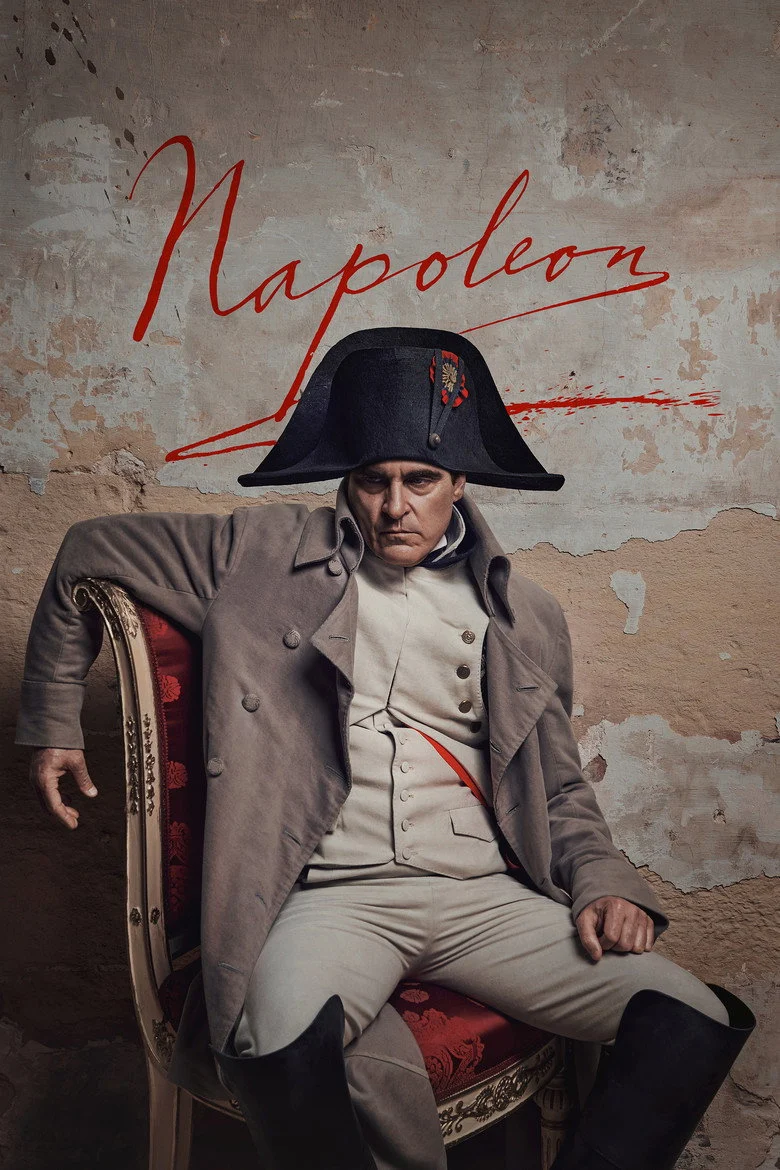
A historical drama movie poster shows an adult man in early-19th-century military dress seated on an ornate chair, before a peeling plaster wall. The background is a weathered wall of flaking beige plaster, with patches of gray undercoat showing through. In the upper-center area, a large red handwritten script "TITLE" sweeps across the wall in flowing cursive, underlined by a long red flourish. The script is bold and gestural, with a paint-like texture and a horizontal splatter streak extending to the right. At the center of the frame, the adult man sits facing the viewer, his stern gaze meeting the camera. He wears a black bicorne hat with a red-and-gold cockade pinned at the front. His gray greatcoat with wide lapels hangs open over a cream waistcoat with brass buttons. Cream breeches and tall black riding boots complete the uniform. A thin red sash crosses his waist beneath the coat's edge, barely visible. His right arm drapes over the chair's high back, hand dangling loosely. The chair is upholstered in red patterned damask with a gilded carved wooden frame. The gilt carving shows scrolls and floral reliefs along the armrest. In the lower-left corner, the chair's carved leg descends out of view. On the left edge of the frame, his dangling hand and the chair's carved armrest catch a soft highlight. In the lower-right corner, his other hand rests on his knee, the black boot planted firmly. In the bottom-center area, the red damask seat glows faintly beneath his weight. The man's face is weathered and resolute, with deep-set eyes and a firm mouth. The lighting is soft and frontal, like a studio portrait, with gentle modeling on the face and coat while the wall behind stays evenly lit, casting only a faint shadow of the chair. In the upper-left corner, the wall's peeling texture is most visible, with dark speckles. In the upper-right corner, the red flourish's splatter fades into the plaster. On the right side of the frame, the peeling plaster reveals a darker stain behind the chair. The palette is muted and earthy: warm beige, charcoal, cream, and black, with the red script as the single vivid accent. The photographic style is crisp, with fine detail in the fabric weave and the wall's decay. Overall, the centered seated portrait balances the figure against the vast peeling wall, anchored by the red script above in a muted beige-charcoal palette, rendered as a stately historical portrait that feels stern, brooding, and monumental.