
Styles
#0092
Bioluminescent colors style reference and prompts
Explore the “Bioluminescent colors” reference with asymmetric composition, small luminous marks, and low-key lighting. View the images, copy the style or example prompt, and discover related styles on Looksift.
Compare the Qwen Image 2.1 and GPT Image 2.5 examples, choose the visual qualities you want, and copy the style prompt for your own project.
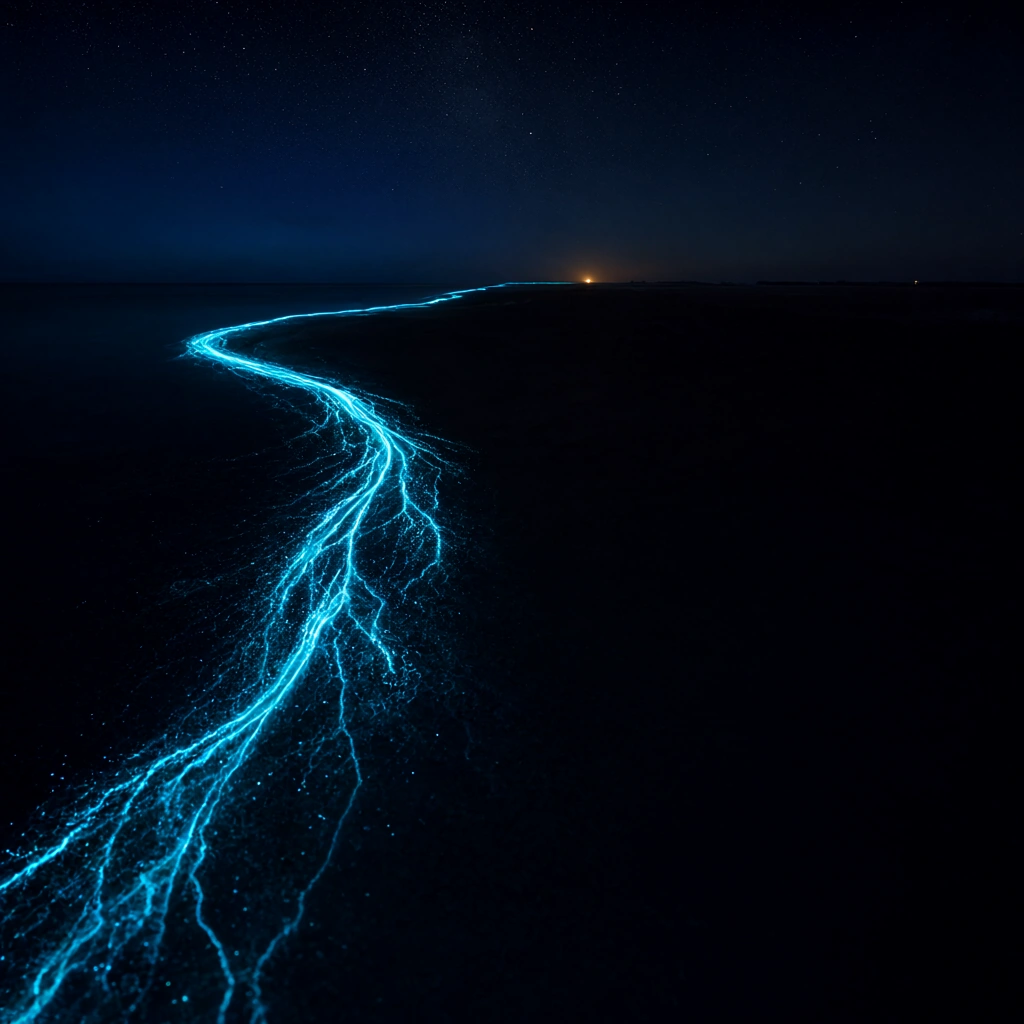 Qwen Image 2.1
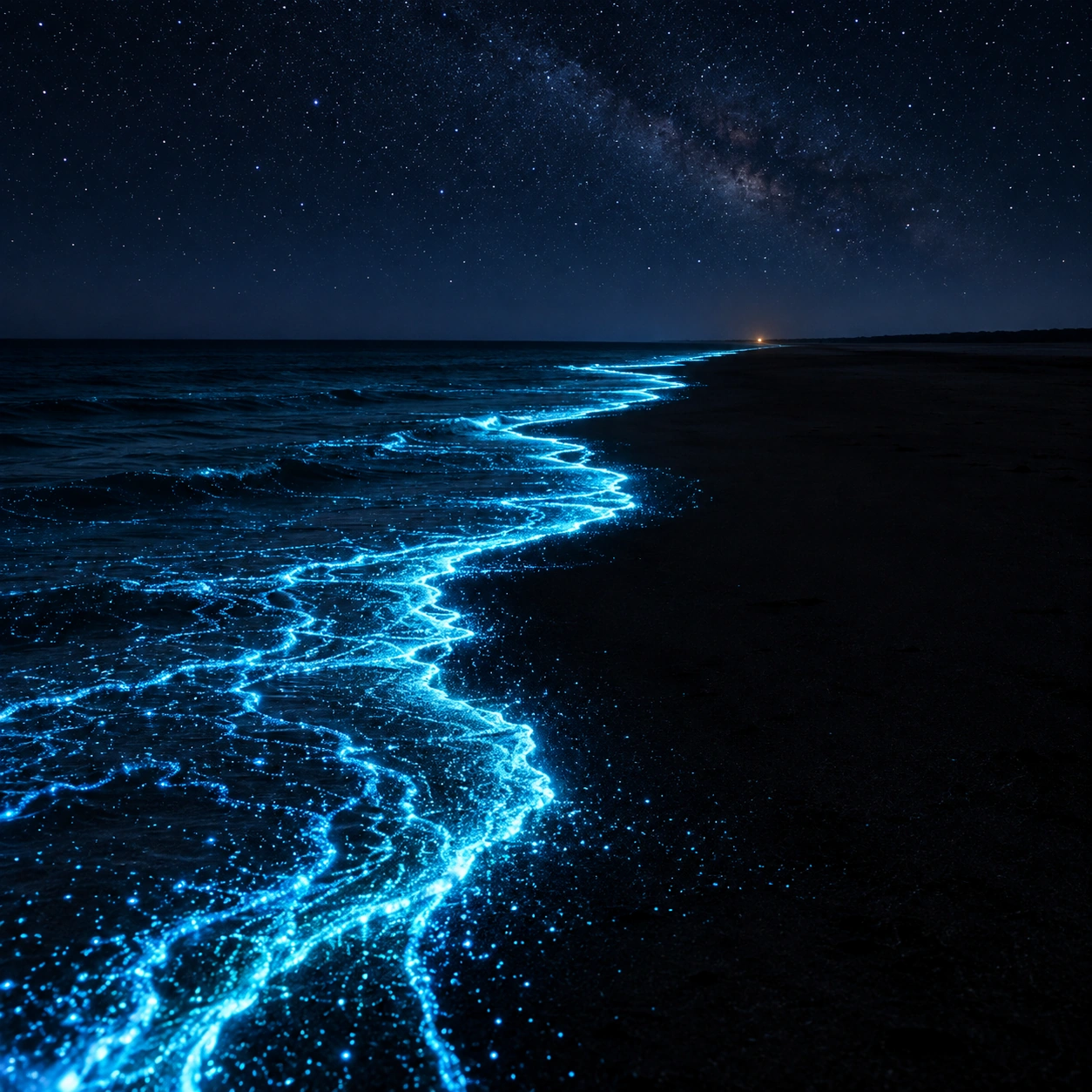 GPT Image 2.5
Reference details
- Reference ID
- 0092
- Category
- Photography
Reference prompts
Style prompt
The photographic treatment is a restrained low-key rendering built from near-black blue fields and narrow luminous marks. Cyan and turquoise form the brightest accents, while small warm points provide contrast without broadening the palette. Edges stay irregular, granular, and finely branched instead of mechanically smooth. Light gathers along a limited path and fades into large areas of negative space. Tiny speckles lend texture, and the glow softens gradually rather than ending in a hard outline. The composition relies on asymmetry, a strong directional curve, and a quiet balance between cool brightness and deep shadow.Full example prompt
The image is a square atmospheric night photograph of a single bioluminescent shoreline beneath a deep blue-black sky. The upper third contains fine scattered stars and a faint denser band of starlight, with blue haze above the horizon and a small amber light right of centre. A narrow, nearly level horizon separates the sky from the dark coastal expanse below. The luminous edge begins close to that distant point and bends down toward the left foreground in a long, fluid curve. Its brightest turquoise and cyan marks run in broken parallel threads, expanding into branching filaments as they approach the lower-left corner. Small flecks and fine stippling cluster around the glowing path, giving its edge a granular, electric appearance. The light is concentrated along this one winding margin. Across the centre and right side, broad areas remain almost black, forming a quiet dark beach beside the luminous surf, while the sea extends to the left. The transition between the glow and the dark field is irregular, with thin cyan tendrils reaching out and fading into the surrounding blue. Near the horizon, the bright line becomes narrow and pale, then nearly disappears beside the tiny warm light. In the foreground, the curves spread wider and brighter, creating the strongest contrast against the dark ground. The shoreline is seen from above at a shallow angle, so its path leads the eye inward rather than closing into a loop. The luminous threads vary in thickness: a few central bands are broad and intense, while delicate lines run alongside them and break into dotted spray. The stars remain much smaller and dimmer than the waterline, keeping the foreground glow distinct from the sky. The dark right-hand field contains only faint tonal variation and gives the bright curve room to breathe. No distinct buildings or figures interrupt the open night. The light appears to come from the shoreline itself, casting a faint cool sheen into the nearby darkness without producing a broad reflection. The amber point at the horizon adds a small warm counterpoint to the dominant cool glow. The central stretch stays darkest, so each bright branch reads clearly against the surrounding field. Fine glowing wave edges spread over the wet shore, creating a sense of slow surf beneath the still star field. The overall composition sets one diagonal, branching ribbon of cyan light against a large, still dark field, with a star-filled sky and the distant warm point lending the scene depth and quiet mystery.