
Styles
#0097
Anne Gifford style reference and prompts
Explore the “Anne Gifford” reference with faceted color planes, visual framing, and even lighting. View the images, copy the style or example prompt, and discover related styles on Looksift.
Compare the Qwen Image 2.1 and GPT Image 2.5 examples, choose the visual qualities you want, and copy the style prompt for your own project.
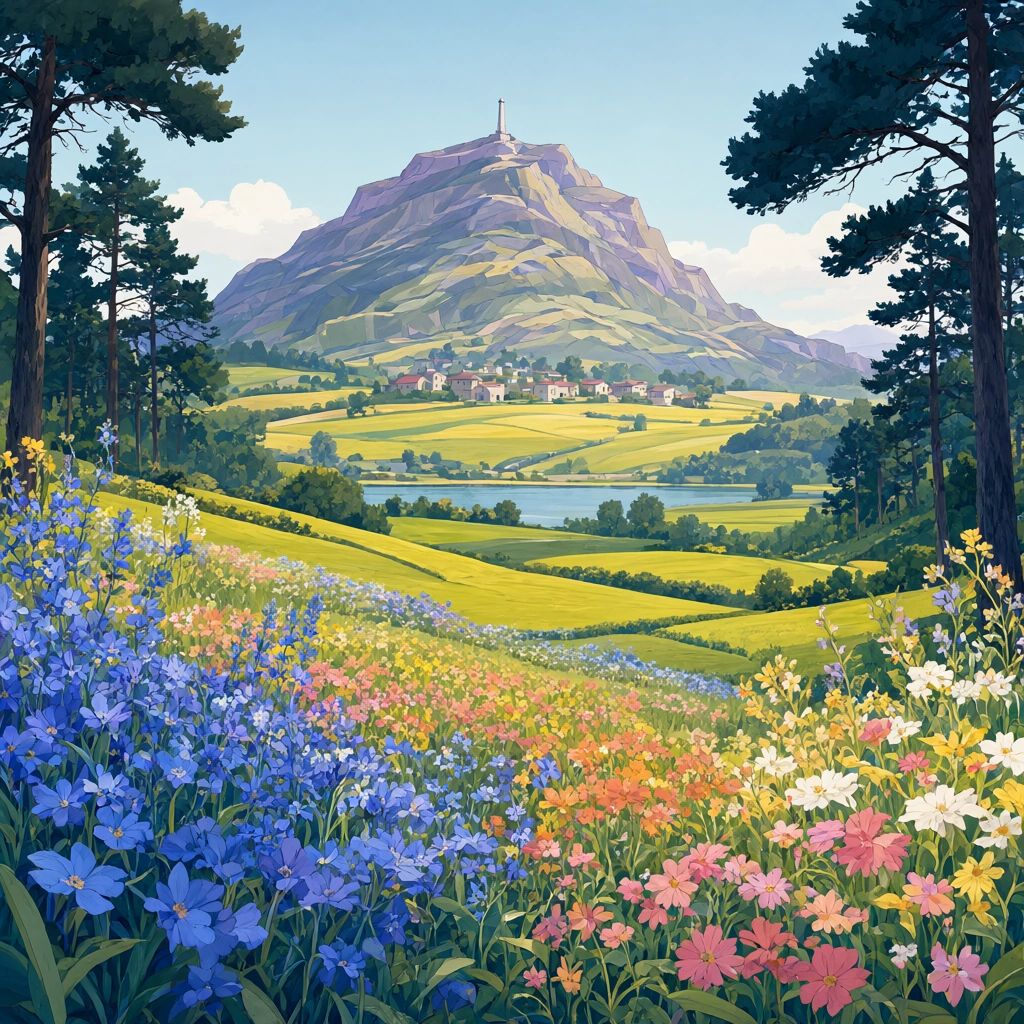 Qwen Image 2.1
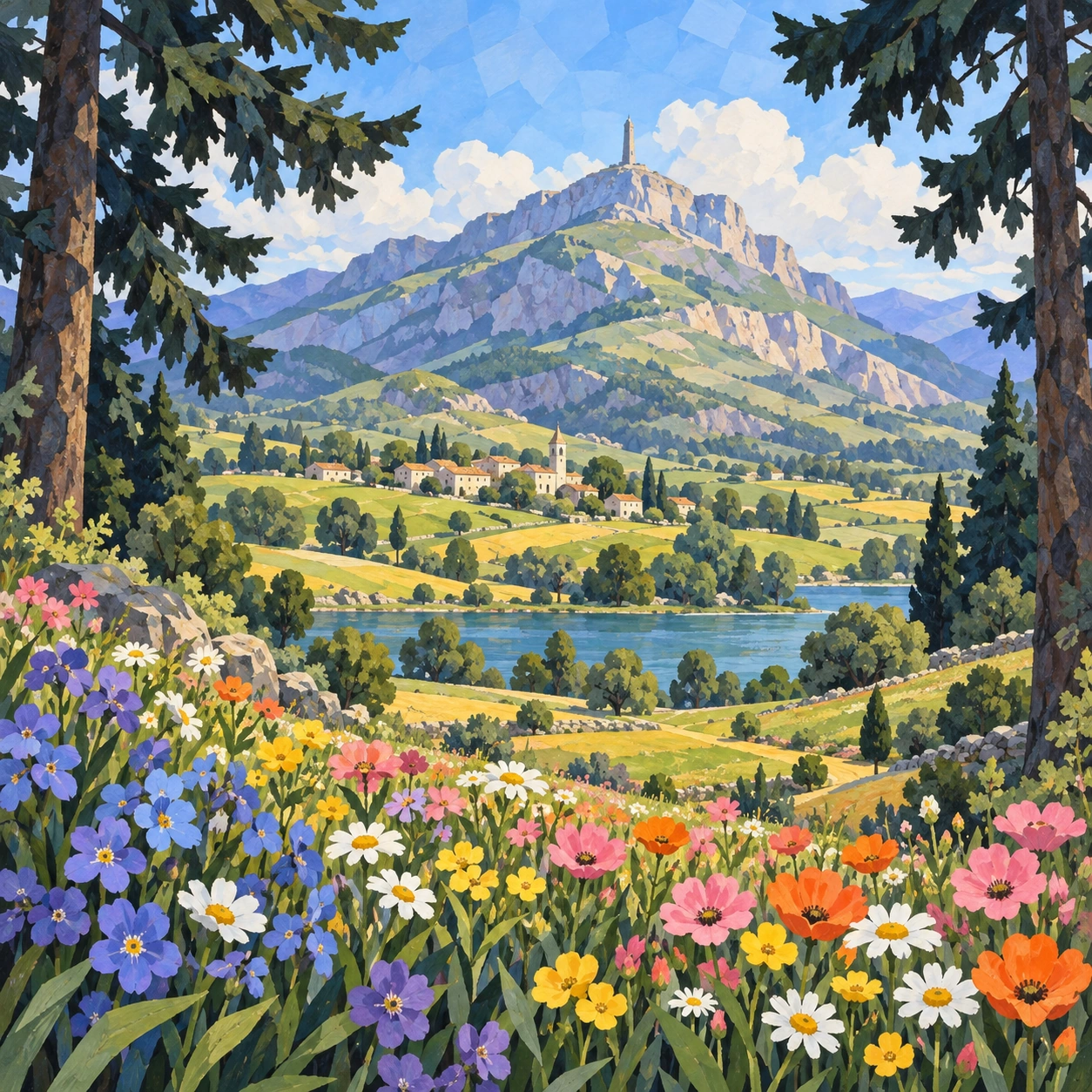 GPT Image 2.5
Reference details
- Reference ID
- 0097
- Category
- Flat illustration
Reference prompts
Style prompt
The style is a polished storybook illustration with broad, clearly separated colour shapes and fine dark contours. Interlocking angular facets lend the surfaces a mosaic-like rhythm. Cool blues and greens establish the overall field, while yellow, orange, and pink accents bring warmth to selected areas. Distant forms simplify into layered bands, and nearer details become smaller repeated marks without turning photorealistic. Light is even and bright, with shadows used sparingly to separate planes. Tall dark framing shapes create a visual border around an open central view. The composition relies on stacked depth, balanced colour distribution, and crisp edges softened by gentle tonal transitions.Full example prompt
The image is a square storybook landscape illustration of a flowered valley beneath a layered mountain crowned by a slender monument. Angular, interlocking facets give the rocks, leaves and sky a mosaic-like painted surface. A pale blue sky opens across the upper centre, with soft white clouds behind the rocky summit. Dark evergreen branches frame both upper corners, and tall pine trunks rise along the far left and right edges. The mountain occupies the centre distance, its broad slopes built from overlapping bands of muted lavender, sage green, pale ochre, and blue-grey. At the summit, a narrow upright tower or monument stands against the sky, distinct but small. Below the mountain, light-coloured houses appear in a compact cluster among trees, with only their simple roofs and facades visible. The houses sit above the waterline and below the mountain's lighter foothills, giving the middle distance a settled scale between the flowers and the peak. Narrow yellow paths divide the fields into irregular patches, and darker hedges or tree groups mark some boundaries. The water remains a quiet horizontal band, partly concealed by the rising banks and vegetation. The monument is slender enough to read as a small vertical accent rather than a second mountain peak. The nearest dark pines are cropped by the frame and therefore feel taller than the village trees. Their heavy foliage contrasts with the fine stems of the flower bed, while the open central sky keeps the mountain summit clearly separated from the frame. Yellow-green fields and narrow paths spread across the middle ground, stepping down toward a calm blue-green band of water that crosses the valley. Small trees and bushes punctuate the slopes and shoreline, their rounded shapes separated by clear patches of grass. The foreground is densely filled with flowers: cool blue and violet blossoms cluster along the lower-left edge, while pink, orange, yellow, and white blooms gather through the centre and lower right. Long green leaves and stems weave between the blossoms, forming a textured border that draws the eye inward. The flowers are individually stylized, with simple petal shapes and small darker centres, rather than rendered as realistic botanical studies. Soft daylight falls evenly across the landscape, brightening the fields and mountain planes while the framing pines remain deep blue-green. Shadows are short and gentle. The overall composition layers bright foreground blooms, pastoral middle ground, and a monumental distant peak, using clear colour bands and dark framing trees to create a welcoming, balanced scene.