
Styles
#0099
Aboudia style reference and prompts
Explore the “Aboudia” reference with layered surface texture, pale neutral tones, and even lighting. View the images, copy the style or example prompt, and discover related styles on Looksift.
Compare the Qwen Image 2.1 and GPT Image 2.5 examples, choose the visual qualities you want, and copy the style prompt for your own project.
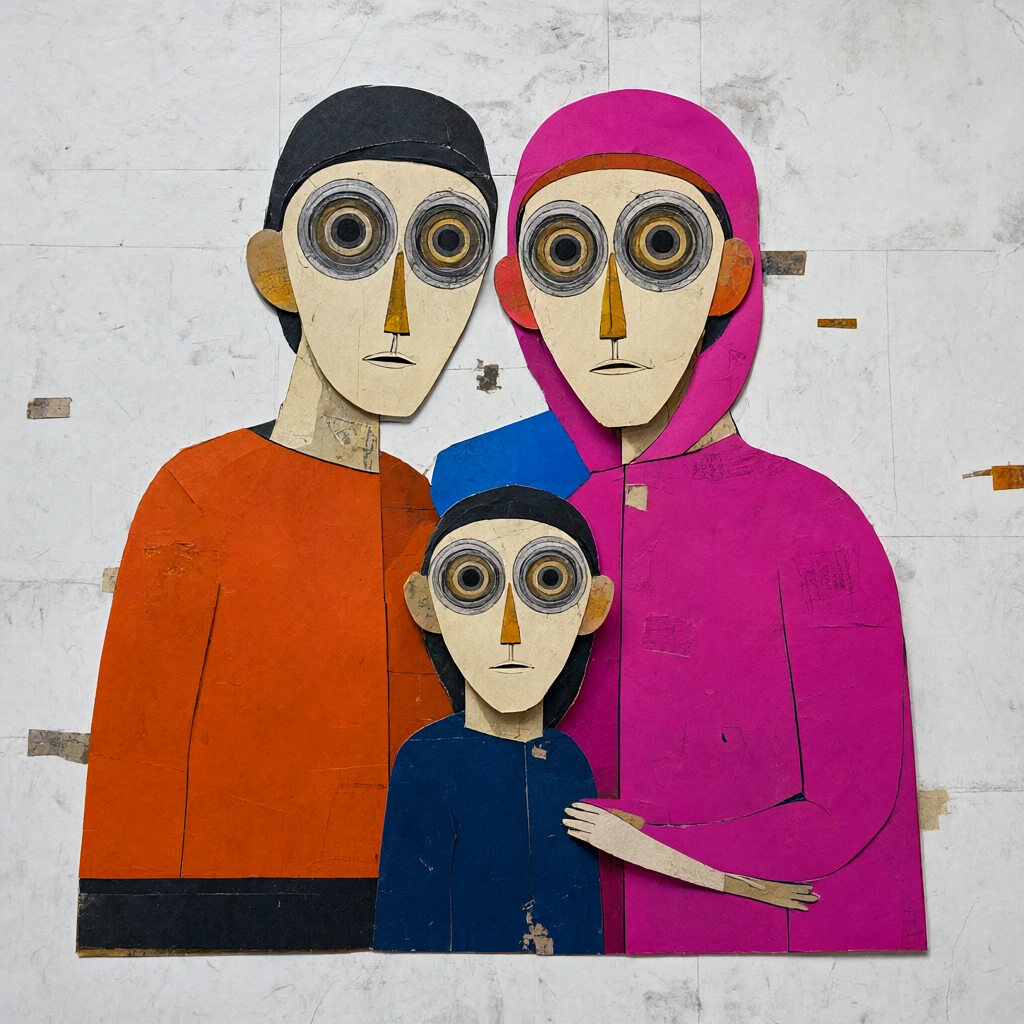 Qwen Image 2.1
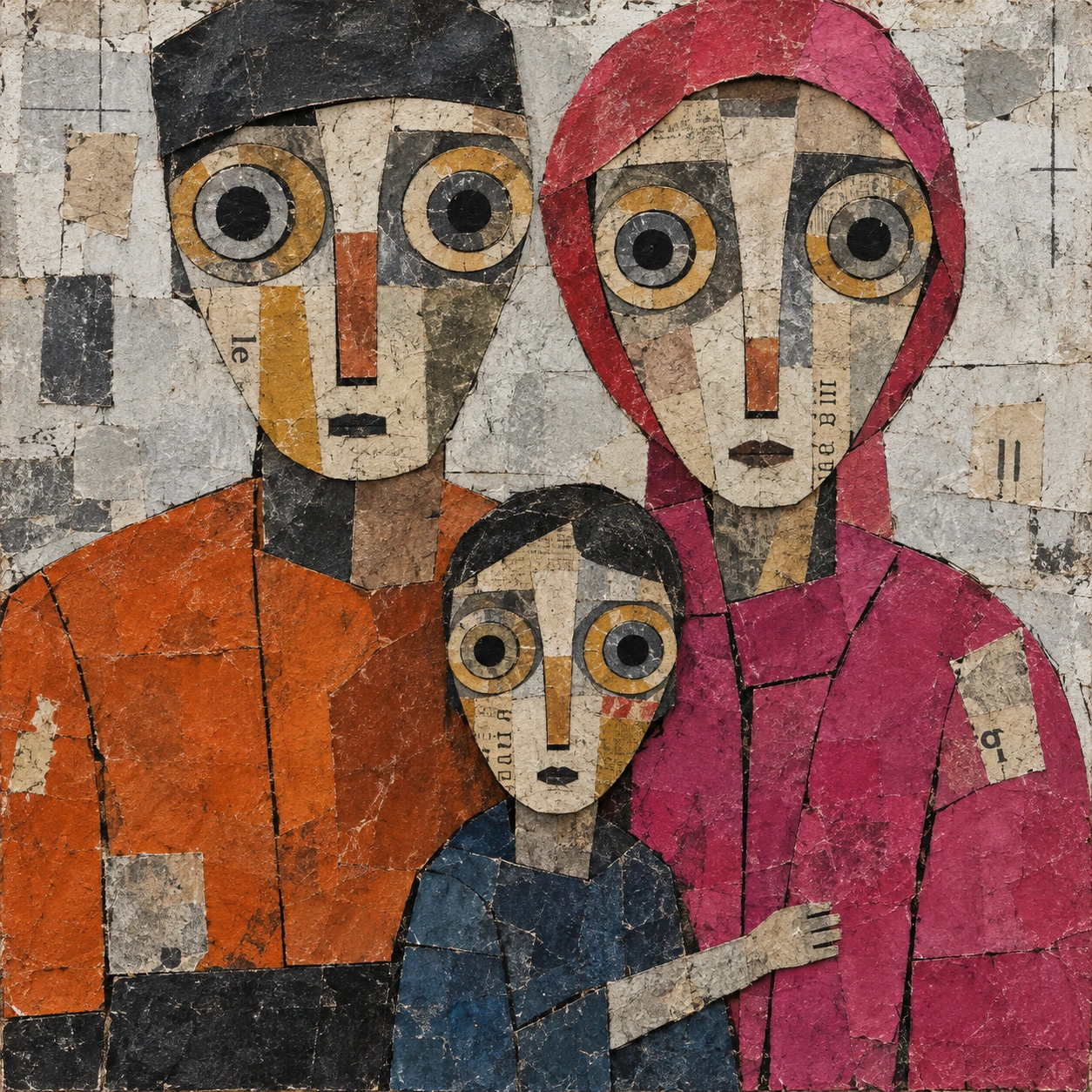 GPT Image 2.5
Reference details
- Reference ID
- 0099
- Category
- Collage & mixed media
Reference prompts
Style prompt
The style combines crude collage construction, hand-drawn black contours, and a worn paper ground. Shapes are deliberately angular and disproportionate, with repeated circular motifs providing a strong graphic rhythm. Bright orange, magenta, and blue accents interrupt a pale grey field, while charcoal lines hold the pieces together. Surface marks include faint scuffs, fibres, and small fragmented patches rather than polished gradients. Lighting remains flat and frontal, preserving the cut edges and compact, crowded arrangement. The result feels raw, layered, and visually direct, with colour blocks carrying as much weight as line.Full example prompt
The image is a square paper collage showing three stylized human figures arranged as a compact group on a pale grey, scuffed background. Two large figures stand behind a smaller child-sized figure at the lower centre. The left figure wears a burnt orange garment and a dark cap or head covering; the right figure wears a vivid magenta jacket with a rounded red-pink hood. Between them, the smaller figure wears a dark blue top and has a narrow, elongated face. All three faces have oversized circular eyes built from concentric black, grey, and ochre rings, with small geometric noses and simplified mouths. The two large faces dominate the upper half, looking forward with fixed expressions; the central child figure sits or stands lower, partially overlapping their torsos. Their proportions are deliberately uneven, with long narrow heads, angular necks, and block-like shoulders. The large heads nearly touch the top edge, and their circular eyes dominate the otherwise spare facial planes. The smaller central face sits beneath them at about chest level, with its gaze aligned forward. Their shoulders and sleeves overlap rather than forming separate full figures, so the group reads as one compressed arrangement of cut shapes. Fine black lines divide garments into panels and trace seams, while small cut-paper rectangles, faint writing-like marks, and worn fragments scatter across the background. The left orange torso fills the lower-left area and ends at a dark horizontal band near the bottom. On the right, the magenta garment spreads broadly toward the edge, with black outlines separating its sleeves and front panels. A narrow blue shape marks the smaller figure at the centre and visually links the larger bodies. The background stays mostly light, but grey smudges and paper fibres create a rough, layered surface. Several fine horizontal and vertical marks cross the pale ground like faint construction lines, while small torn-looking rectangles interrupt the open spaces. Repeated circular eyes draw attention across the group and down towards the smaller central face. Yellow, rust and dark grey fragments divide the mask-like faces, while a thin bent arm-like shape extends from the smaller figure across the magenta area. Flat diffuse light keeps the collage evenly visible, with only shallow shadows along the cut edges. The overall composition clusters the three figures tightly, balancing the two large round-eyed faces above the smaller central one and using orange, magenta, and blue clothing to punctuate the muted paper ground.