
Styles
#0518
Ray Johnson style reference and prompts
Explore the “Ray Johnson” reference with scratch-like marks, repeated linear rhythms, and saturated colors. View the images, copy the style or example prompt, and discover related styles on Looksift.
Compare the Qwen Image 2.1 and GPT Image 2.5 examples, choose the visual qualities you want, and copy the style prompt for your own project.
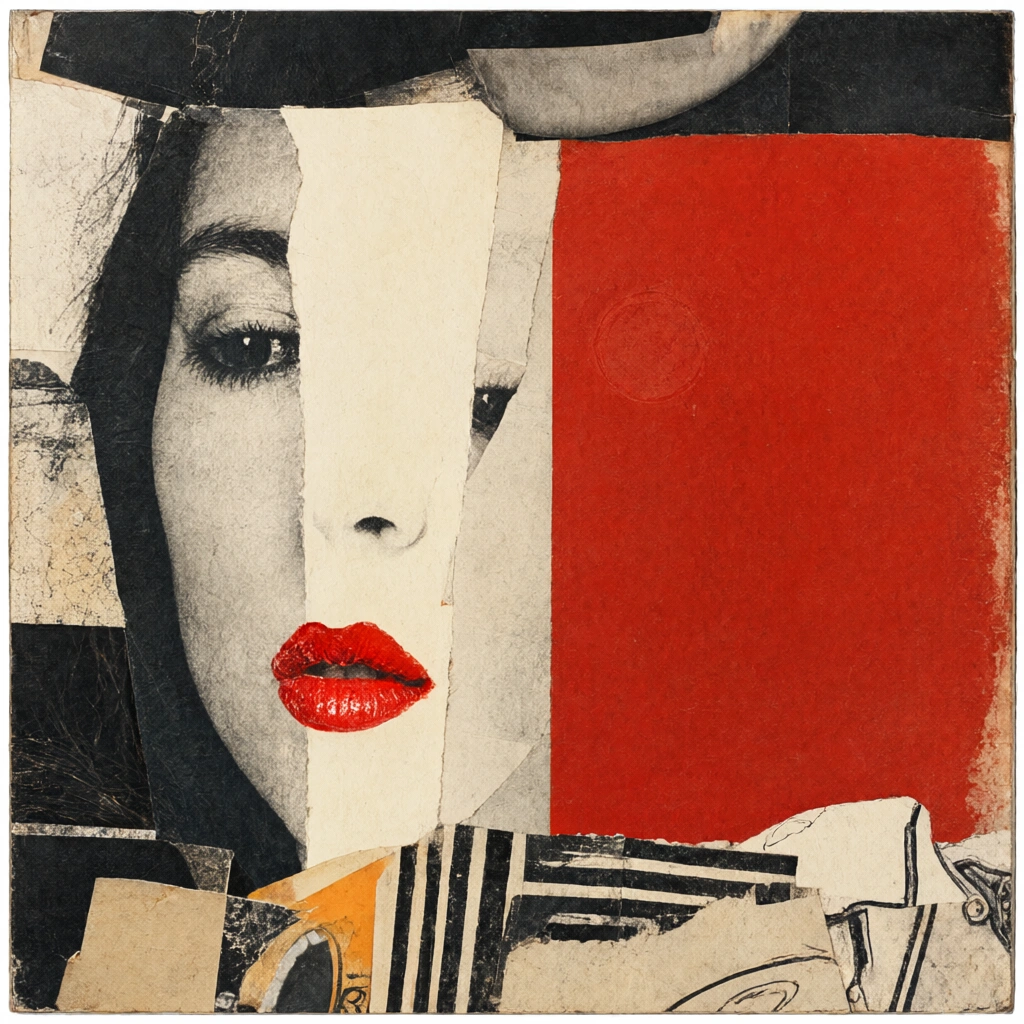 Qwen Image 2.1
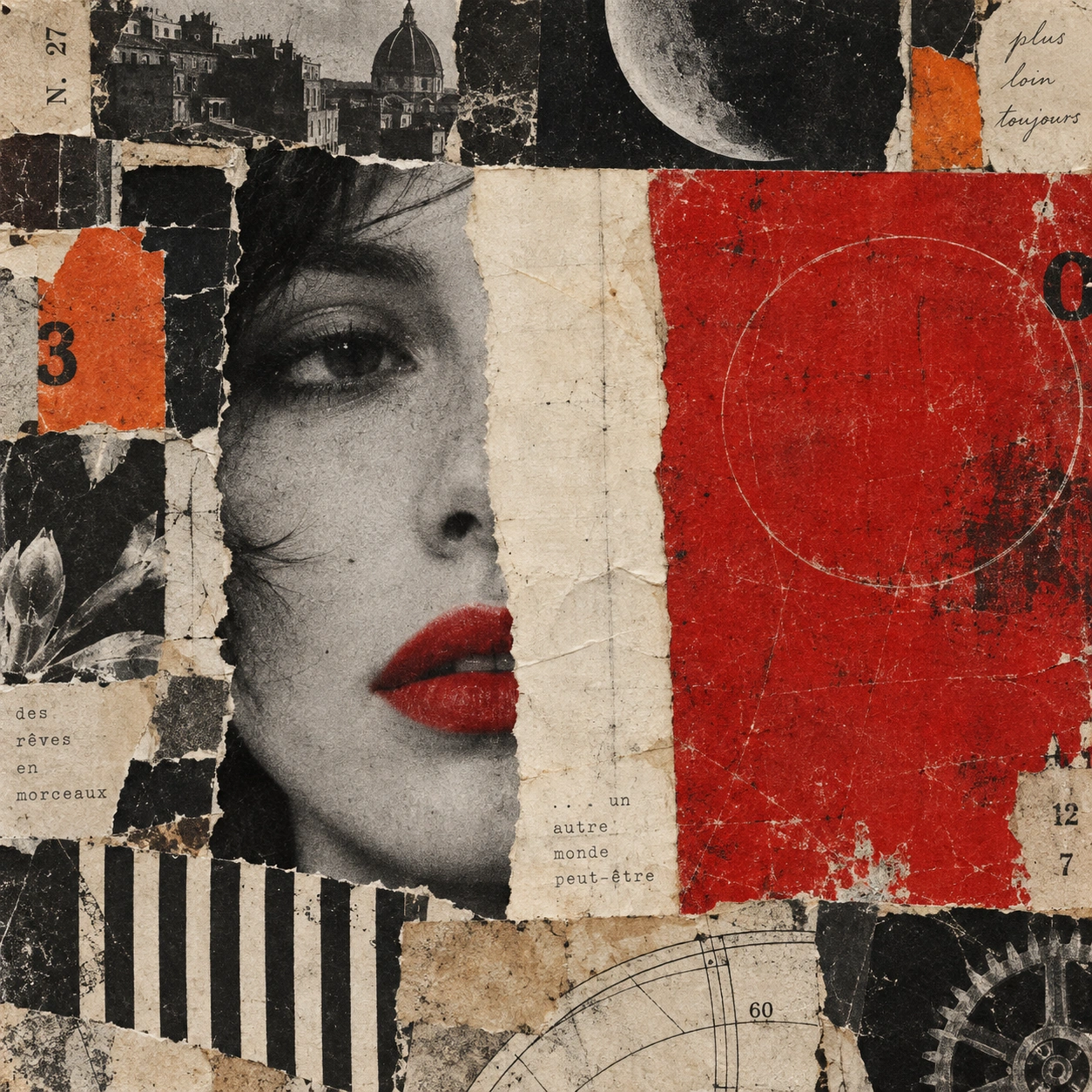 GPT Image 2.5
Reference details
- Reference ID
- 0518
- Category
- Collage & mixed media
Reference prompts
Style prompt
Tactile mail-art collage assembles torn photographs, printed pattern, and colored paper into a shallow field of abrupt overlaps. Charcoal black, faded gray, warm cream, and a large vermilion rectangle dominate, with tiny orange accents sharpening the limited palette. Straight-cut strips meet ragged abraded edges; rubbed ink, visible paper fibers, scratches, and partial circular marks keep each layer materially distinct. Some fragments are granular and soft, others sharply graphic or heavily opaque. A partly obscured focal patch sits between a pale vertical strip and a saturated color block, while compressed horizontal bands frame the top and bottom. Lighting is flat and even, leaving the physical seams and texture to create depth. The composition moves by interruptions, not smooth transitions: contrasting scales, hard cutoffs, broken imagery, and repeated stripes form an intimate but cryptic rhythm.Full example prompt
A tactile mixed-media paper collage fills a square frame with overlapping scraps of photographs, printed texture, and colored paper. Near the left center, a torn black-and-white photographic fragment shows part of a woman's face, one eye and nose softened by grain, while bright red lips are sharply overprinted near the lower edge. A tall cream paper strip partly covers the other half of the face. On the right, a dense vermilion rectangle occupies a large area, its surface rubbed and scratched so faint circular marks become visible within it. Across the top, dark photographic pieces and a gray crescent-like form make a compressed horizontal band. The bottom edge is busy with black-and-white striped scraps, rough beige paper, and partial mechanical or hand-drawn curves. Every piece has its own age and finish: some edges are straight cut, others torn or abraded; ink is faded in places, and paper fibers show through the colored areas. The arrangement is deliberately discontinuous. The viewer sees suggestive bits of image and pattern but no single continuous scene. Black and charcoal carry much of the weight, balanced by warm cream, a strong red block, and small orange fragments. The central face remains the emotional point of orientation, partly hidden by the pale strip and separated from the red field by a hard vertical boundary. Light is flat and archival, as though the assembled paper surface were photographed on a table. Its visual rhythm comes from opposing vertical strips, horizontal bands, small circular traces, and abrupt shifts in scale and texture. The collage feels personal, cryptic, and handmade, with its meaning residing in the friction between familiar imagery and broken arrangement.