
Styles
#1048
Vincent Munier style reference and prompts
Explore the “Vincent Munier” reference with fine grain, negative space, and near-monochrome cool tones. View the images, copy the style or example prompt, and discover related styles on Looksift.
Compare the Qwen Image 2.1 and GPT Image 2.5 examples, choose the visual qualities you want, and copy the style prompt for your own project.
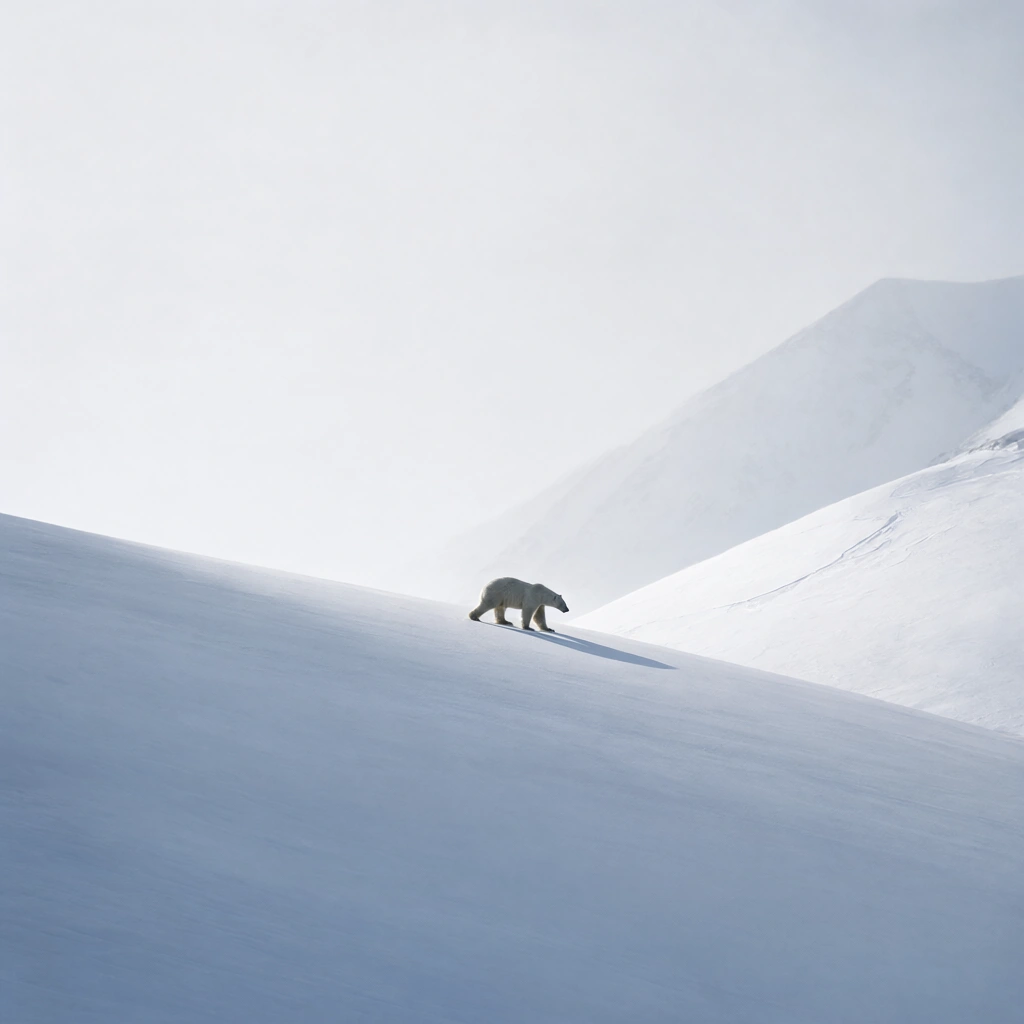 Qwen Image 2.1
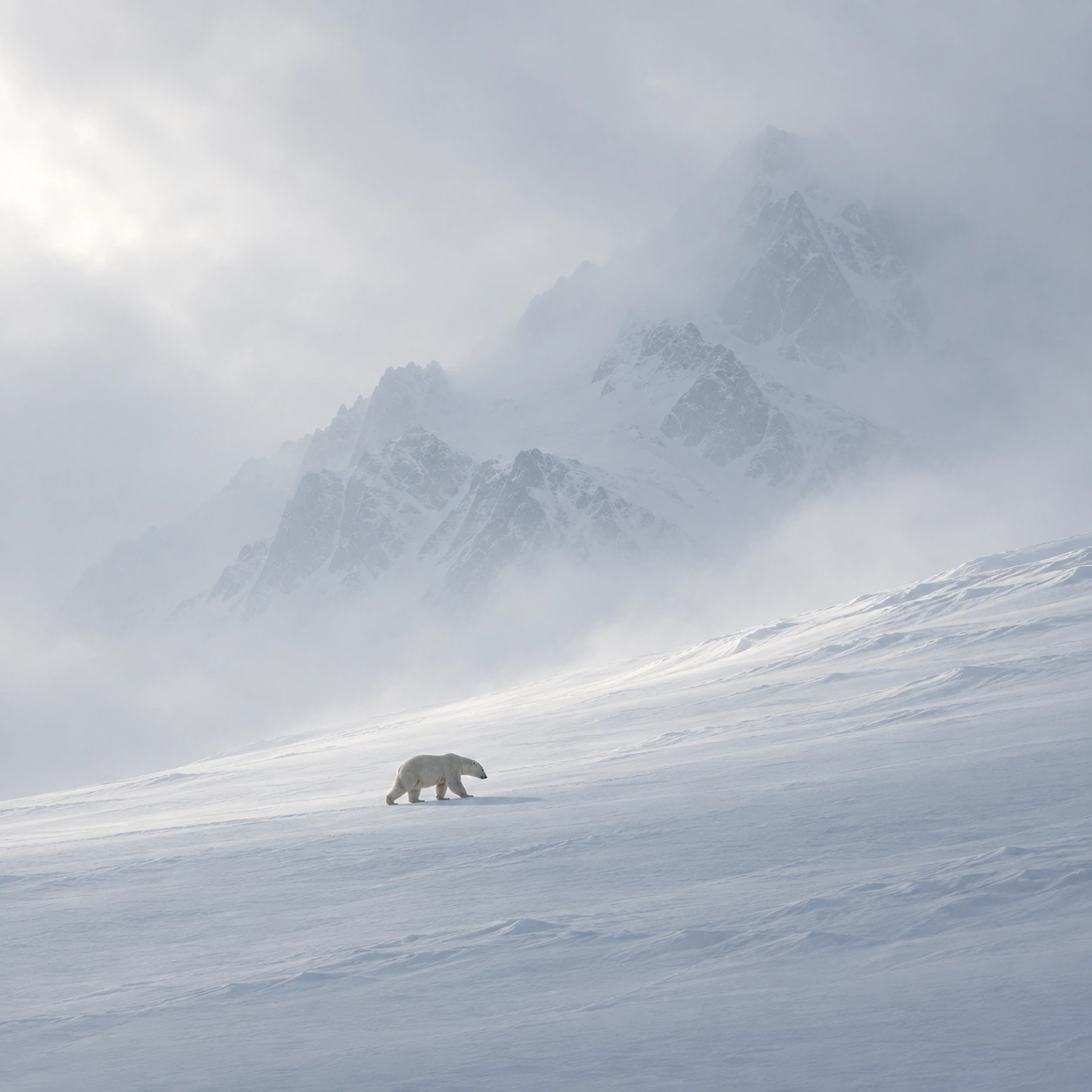 GPT Image 2.5
Reference details
- Reference ID
- 1048
- Category
- Photography
Reference prompts
Style prompt
Minimalist color photography uses near-monochrome whites, icy blue-grays, and restrained slate shadows. A very small darker accent is set within expansive pale negative space, so scale and isolation become the primary compositional forces. Broad diagonal planes overlap gently, their boundaries partly dissolved by mist. Diffuse light keeps contrast low across most of the frame, while a narrow local shadow clarifies the focal form and the slope beneath it. Fine grain and faint wind-like texture give the pale fields physical substance without filling them with detail. Edges grow softer with distance, and the upper area approaches an almost seamless atmospheric gradient. The composition is weighted low, allowing a large quiet field above to dominate. The overall effect is hushed, spacious, and cold, relying on subtle tonal separation and a single carefully placed point of attention.Full example prompt
A square minimalist wildlife photograph shows a lone polar bear crossing a vast pale snow slope beneath a mist-softened mountain. The small animal stands just left of center in the lower middle, walking toward the right with its head low and four dark feet visible against the white surface. A short blue-gray shadow extends behind and slightly to the right of its body. The bear is dwarfed by the surrounding terrain; no other creature or human structure appears. The foreground snow slopes upward from left to right and is rendered in smooth cool blue-gray, with faint ridges and wind-shaped lines near the upper right. Behind the bear, a brighter diagonal band rises toward the right edge. Farther back, the mountain's broad triangular faces fade into a thick pale mist, some edges barely distinguishable from the sky. The upper half is mostly open gray-white atmosphere, with very subtle tonal variation rather than a clear horizon. Light is diffuse, likely filtered through cloud and haze, but a slight directional lift from the upper left keeps the near snow and bear's fur legible. The palette is almost monochromatic, moving between warm white, icy pale blue, and deeper slate-blue shadow. Fine photographic grain and gentle tonal transitions preserve the softness of the weather while small details in the snow give physical scale. The bear's outline remains clear at the point of contrast with the brighter diagonal slope; its interior is less detailed because it is distant. No text appears. The overall composition is extremely spare, using one tiny darkened moving form, broad diagonal terrain, and immense negative space to convey solitude and cold quiet.