
Styles
#1198
Julian Beever style reference and prompts
Explore the “Julian Beever” reference with anamorphic perspective. View the images, copy the style or example prompt, and discover related styles on Looksift.
Compare the Qwen Image 2.1 and GPT Image 2.5 examples, choose the visual qualities you want, and copy the style prompt for your own project.
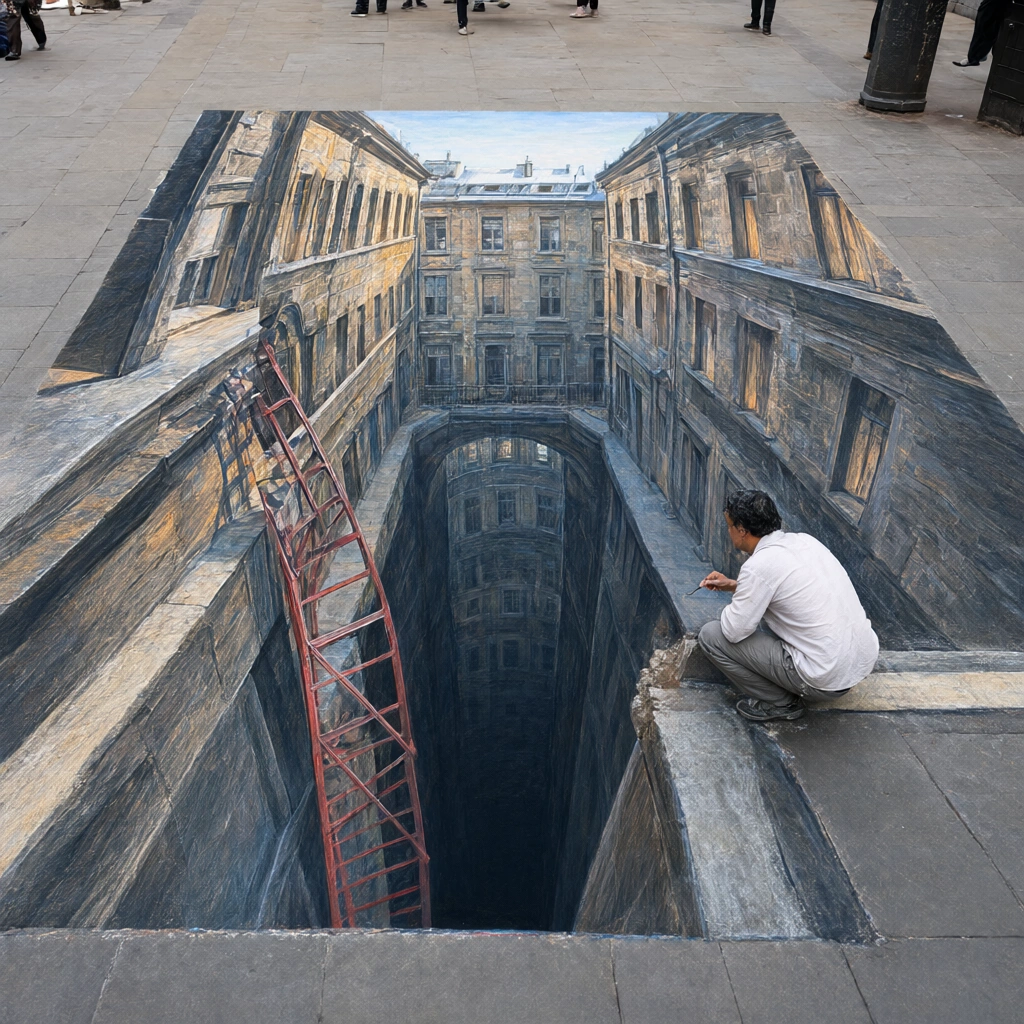 Qwen Image 2.1
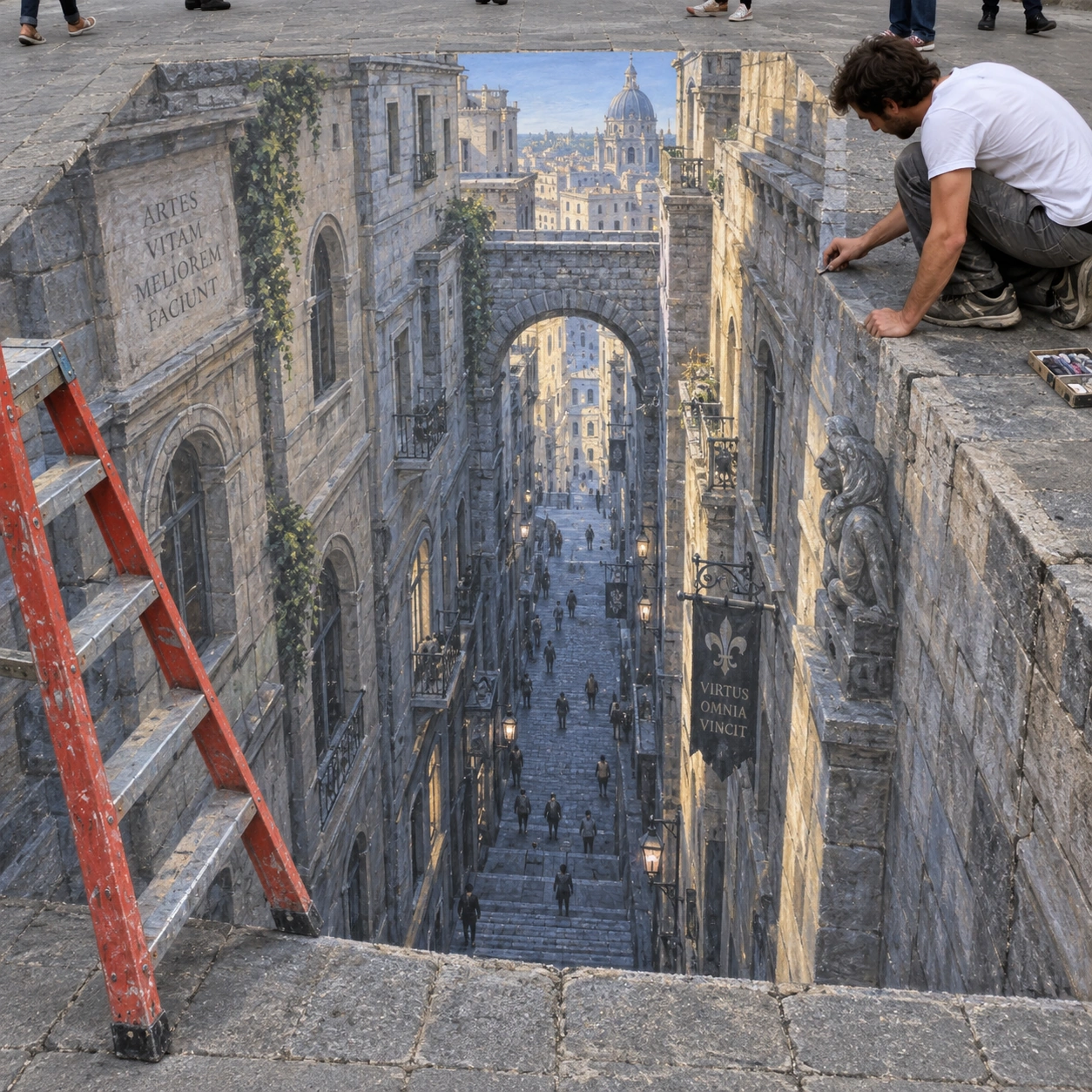 GPT Image 2.5
Reference details
- Reference ID
- 1198
- Category
- Photography
Reference prompts
Style prompt
The style is documentary photography of anamorphic street drawing, with a carefully chosen viewpoint that converts a flat textured surface into apparent spatial depth. Precise converging lines, layered architectural shading and chalky pigment create the illusion, while visible surface grain and working traces reveal its material basis. Natural daylight and ordinary public-space context keep the scene credible. The square composition balances a steep central recession against surrounding flat borders, making the perceptual switch itself the principal event.Full example prompt
A square documentary photograph shows an artist crouched at the edge of an enormous chalk illusion on a paved pedestrian square. From the camera's chosen viewing point, the flat ground appears to plunge into a deep urban canyon lined with old stone facades and a distant arch. A red stepladder seems to descend along the left side of the apparent drop, although its feet remain on the real surface. The artist, wearing a plain white shirt and gray trousers, works near the right rim with a small drawing tool. Real pavement surrounds the image, and a few cut-off passerby legs at the top edge reveal the ordinary public setting. The illusion is most convincing in its converging architectural lines, blue-gray shadowed depth and warm highlights along windows and masonry. Its near edge deliberately exposes the transition between actual pavement and pigment, allowing the viewer to understand both the trick and the labor behind it. Daylight is open and natural, with no fantasy glow or digital portal effects. Fine chalk strokes and grain of the slabs remain visible even inside the simulated depth. The image presents a precise anamorphic perspective as a public performance: one viewpoint turns a horizontal surface into a vertiginous imaginary space while the working artist anchors it in reality.