
Styles
#1228
Elmer Bischoff style reference and prompts
Explore the “Elmer Bischoff” reference with visible brushwork. View the images, copy the style or example prompt, and discover related styles on Looksift.
Compare the Qwen Image 2.1 and GPT Image 2.5 examples, choose the visual qualities you want, and copy the style prompt for your own project.
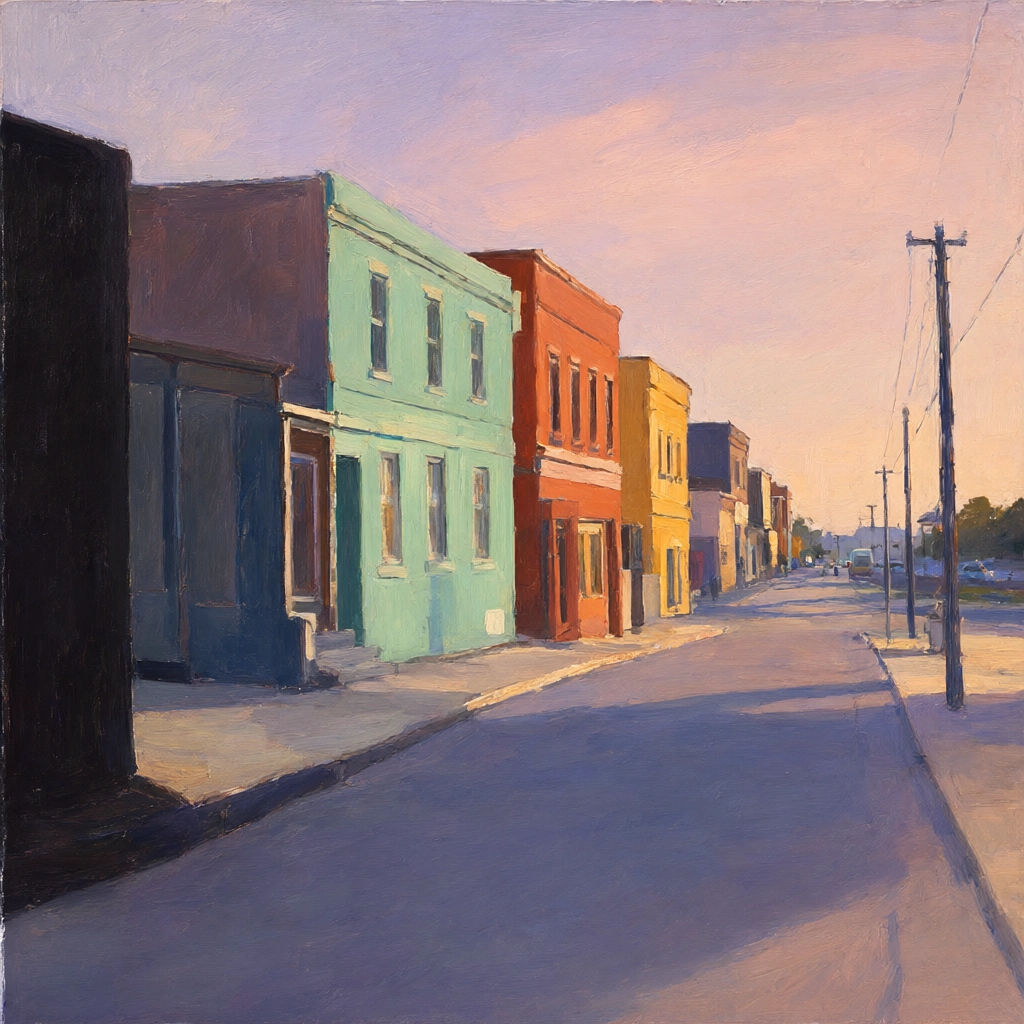 Qwen Image 2.1
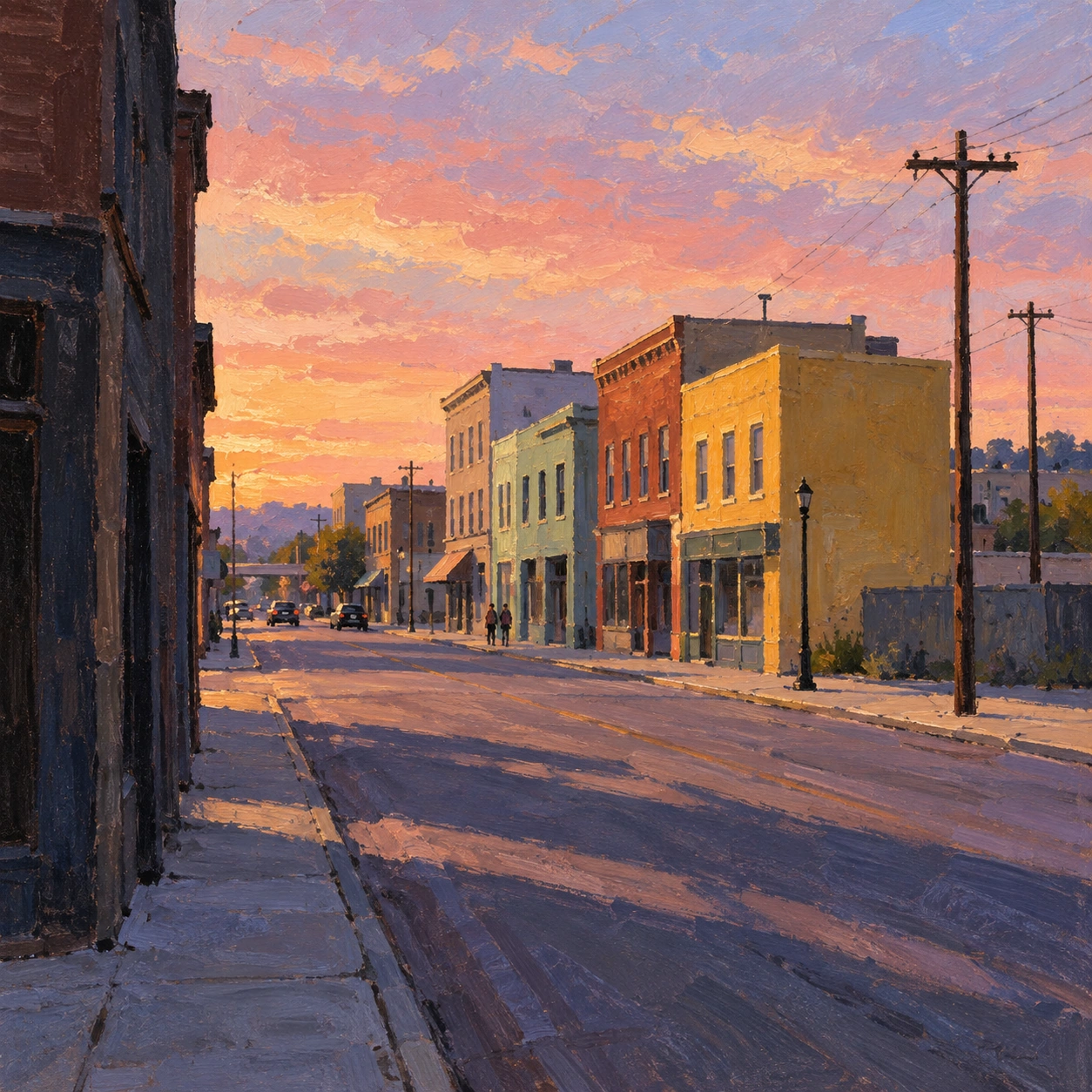 GPT Image 2.5
Reference details
- Reference ID
- 1228
- Category
- Painting
Reference prompts
Style prompt
Paint with broad, loose oil strokes and simplified interlocking color planes. Use muted mint, brick red, ochre, salmon, pale lavender, and blue-violet shadows, allowing neighboring hues to mix visibly at their edges. Keep perspective readable through large value masses while reducing small details to quick marks and thin accents. Set warm low-angle light against cooler shaded areas. Balance a dark foreground anchor with a brighter middle distance in a quiet square composition.Full example prompt
The painting looks down a quiet street toward a row of boxy, low-rise buildings. The road begins wide at the lower edge and narrows toward a small distant crossing. A dark building mass presses in from the left foreground, making a firm vertical border, while the right side opens toward a wide pavement, telephone poles, and a low horizon. The central buildings are simplified into stacked rectangular planes rather than precise architectural detail. One facade is mint green, another a warm brick red, and a bright ochre yellow block catches the last light. Salmon pink and pale lavender spread through the sky behind them. A few tiny pedestrians and indistinct vehicles appear far down the road, but the scene remains still and sparsely populated. Long blue-violet and mauve shadows stretch diagonally across the asphalt and sidewalk. Paint is applied in loose, visible strokes: broad sweeps flatten the road, shorter marks articulate windows and cornices, and thin dark lines establish poles and edges. The colors appear mixed on the canvas, leaving traces of one hue inside another. Lighting feels like late afternoon or early evening, with low warm illumination on the building faces and cooler shade in the street. Perspective remains believable despite the broad simplification. The square composition balances the heavy left foreground against the bright stepped facades, turning an ordinary block into a study of color, light, and quiet urban space.