
Styles
#1743
Theo Prins style reference and prompts
Explore the “Theo Prins” reference with weathered surfaces, pale neutral tones, and atmospheric depth. View the images, copy the style or example prompt, and discover related styles on Looksift.
Compare the Qwen Image 2.1 and GPT Image 2.5 examples, choose the visual qualities you want, and copy the style prompt for your own project.
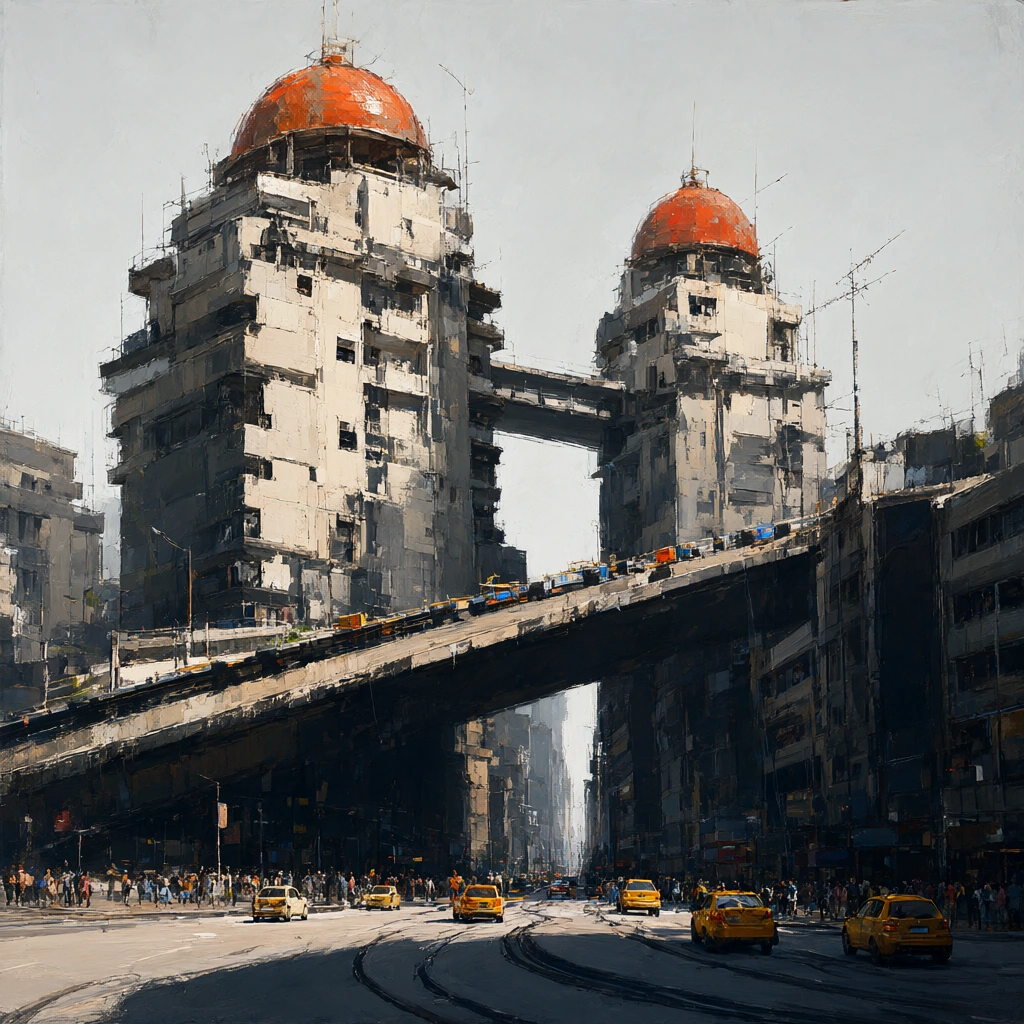 Qwen Image 2.1
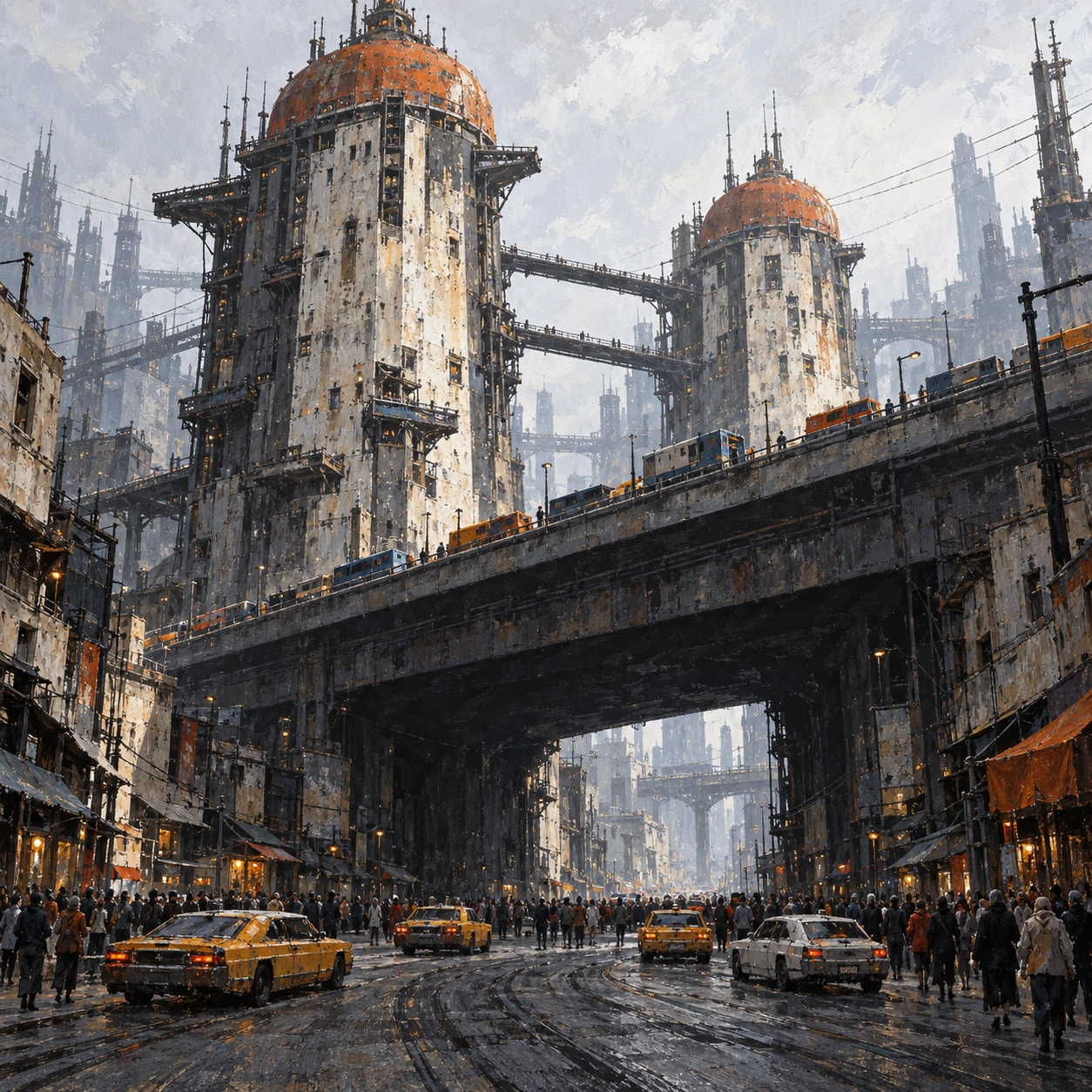 GPT Image 2.5
Reference details
- Reference ID
- 1743
- Category
- Painting
Reference prompts
Style prompt
The painterly concept image combines monumental stacked forms with rough blocky marks and atmospheric distance. Cream, slate gray, soot black, and muted blue-green cover broad structural planes, while rust orange and small yellow accents punctuate the upper and lower focal areas. Edges alternate between crisp linear fragments and scraped, broken paint, so complex construction remains readable without polished precision. Deep openings and heavy overhangs form near-black voids beneath pale diffuse skylight. Thin rails, wires, and repeated small rectangles establish scale and directional rhythm across the large masses. A strong diagonal crossing divides the frame and pushes the eye toward a brighter central gap; tiny clustered marks below supply a sense of activity. Surface wear is visible as chipped color, stains, and granular patches rather than uniform digital smoothness. The overall effect is expansive and lived-in, with controlled perspective and rough material texture making the scene feel both engineered and atmospheric.Full example prompt
A square painterly urban concept image looks up a crowded street toward two tall, weathered towers capped with rusty orange domes. The pale gray sky is crossed by thin antennas, wires, and distant structural lines. The larger tower rises on the left, its cream and charcoal facade broken into stacked ledges, dark window slots, and projecting platforms. A somewhat smaller matching tower stands farther back to the right. Narrow elevated walkways connect the two in the upper middle, emphasizing the gap between them. Across the center, a much broader roadway climbs diagonally from lower left to upper right. Small vehicles or rectangular traffic units move along its top, picked out by bright orange, blue, and gray marks. The road's deep shadow cuts across the lower buildings, leaving a bright hazy passage visible through the opening beneath. At street level, many tiny figures gather along the edges and in the distant center, their individual details dissolving into dark clusters. Several yellow-orange cars and one pale car spread across the foreground intersection. Their small warm shapes contrast with the huge cool masonry above them. Curving dark road marks lead from the lower edge toward the vehicles, giving the foreground a broad sweep. The towers' sides carry chipped paint, soot, and irregular panels, while the far structures fade into gray-blue atmospheric depth. Light is diffuse from the pale overcast sky, catching exposed ledges and the domes but leaving underpasses and recesses almost black. Brushstrokes remain conspicuous, with scraped blocks and broken edges rather than precise architectural line drawing. A few sharp rails and antennae preserve the sense of constructed scale amid the looseness. No lettering is readable. The overall composition rises from a busy human-scale street into massive layered infrastructure, balancing rust-colored crowns and warm vehicles against a cool, worn urban field.