
Styles
#1862
Julian Opie style reference and prompts
Explore the “Julian Opie” reference with asymmetric composition. View the images, copy the style or example prompt, and discover related styles on Looksift.
Compare the Qwen Image 2.1 and GPT Image 2.5 examples, choose the visual qualities you want, and copy the style prompt for your own project.
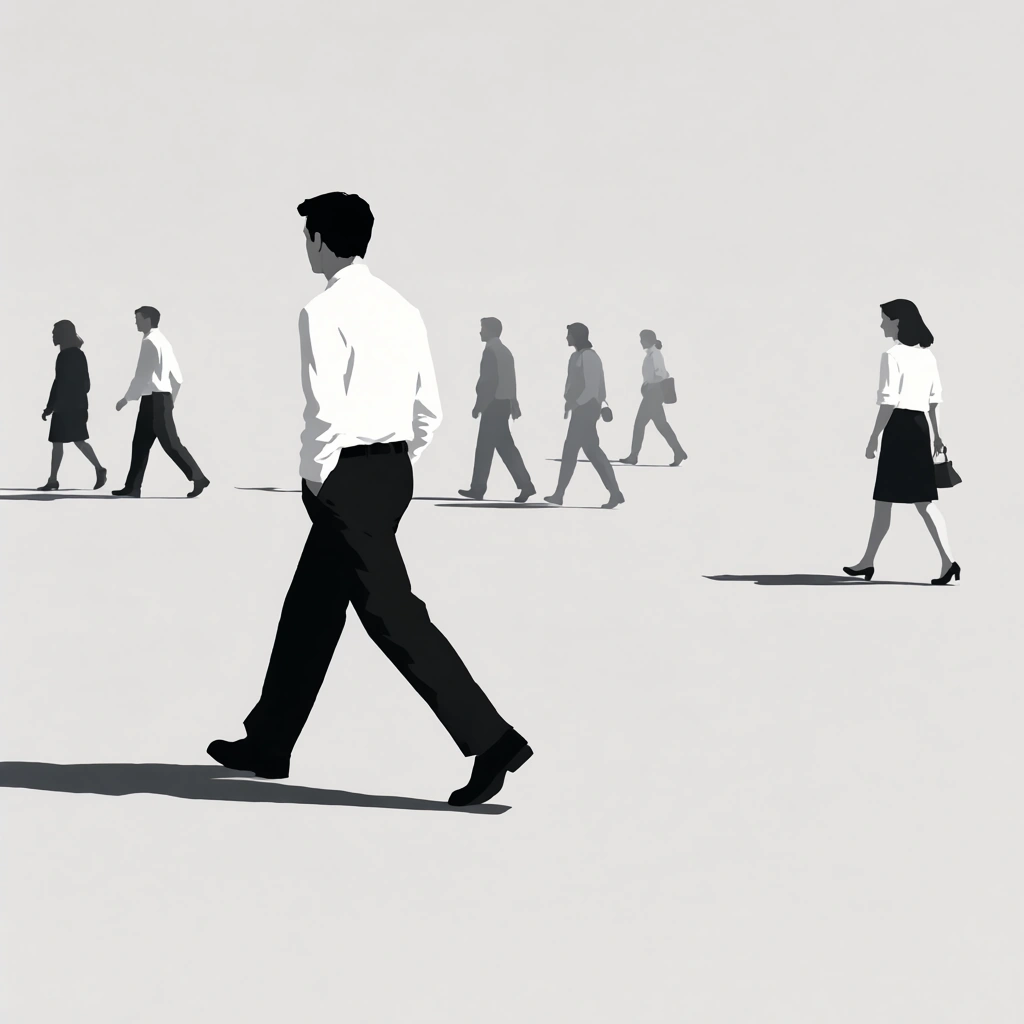 Qwen Image 2.1
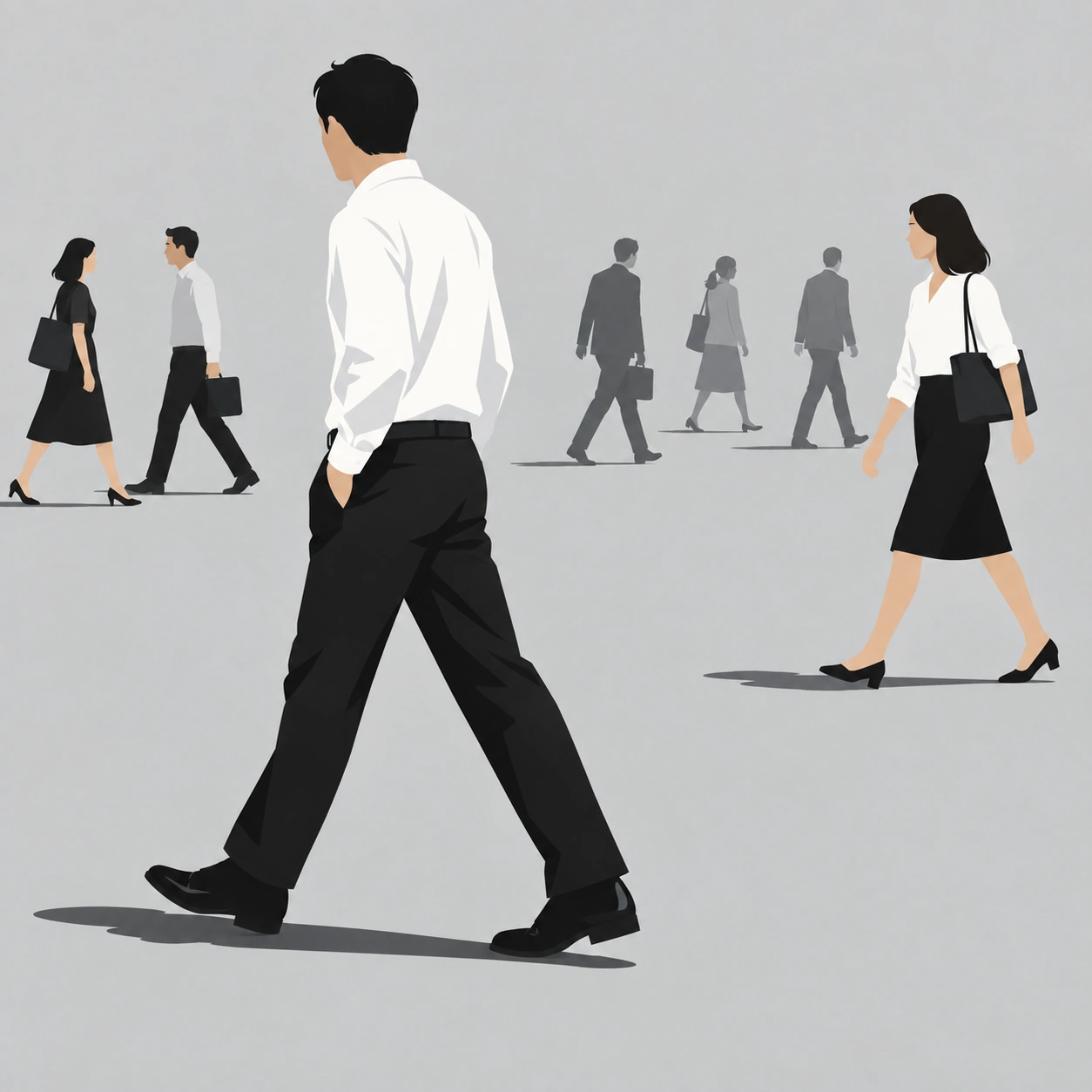 GPT Image 2.5
Reference details
- Reference ID
- 1862
- Category
- Flat illustration
Reference prompts
Style prompt
Flat graphic illustration reduces observed forms to a few crisp black, white, and gray silhouettes on a uniform neutral ground. Use hard edges, minimal internal detail, and measured spacing between differently scaled figures or objects. Compact cast shadows can signal direction and slight depth without building a full environment. Let one larger foreground shape set the motion, with smaller, paler marks receding across the frame. The economy of color and contour creates a clean urban rhythm; preserve enough posture and asymmetry to keep the scene human rather than schematic.Full example prompt
A square graphic illustration shows several office workers walking in different directions across a flat pale gray field. The largest figure is a man in the center-left foreground, seen in side and slight rear view. He wears a white long-sleeved shirt and black trousers, one hand in a pocket, and strides toward the left with a long shadow beneath his shoes. His black hair and dark belt are rendered as simple solid shapes. At the far left, two smaller figures pass one another, one in a dark dress and one in light shirt and dark pants. Across the back middle, a few gray silhouettes walk toward the right, their bodies fading against the neutral ground. On the right, a woman in a white blouse and black knee-length skirt walks leftward, carrying a small bag. The image contains no buildings, pavement markings, or sky; the implied public space is communicated entirely by the walking poses and cast shadows. Bodies are made from broad flat blocks of white, black, and several grays with very little facial detail. Sharp contour edges and measured negative space keep each person distinct. The light appears high and directional enough to cast compact dark shadows, but the scene remains almost diagrammatic. The crowd feels ordinary and anonymous rather than dramatic. The strong foreground stride supplies motion, while receding smaller figures give a shallow sense of depth. The composition is balanced through alternating dark and light silhouettes across the otherwise empty field. Its visual language is economical, urban, and crisp, reducing a brief street moment to rhythm, spacing, and shape.