
Styles
#2325
David Downton style reference and prompts
Explore the “David Downton” reference with calligraphic marks, scratch-like marks, and negative space. View the images, copy the style or example prompt, and discover related styles on Looksift.
Compare the Qwen Image 2.1 and GPT Image 2.5 examples, choose the visual qualities you want, and copy the style prompt for your own project.
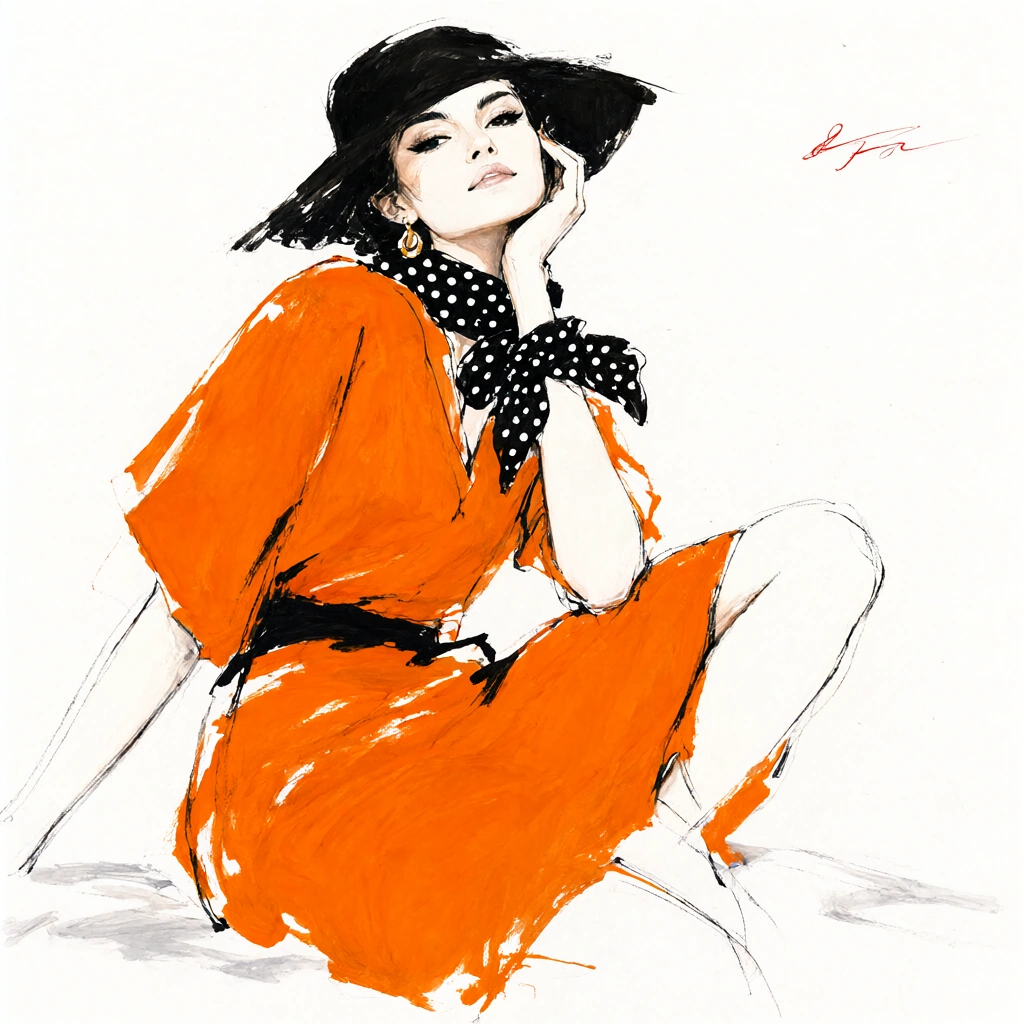 Qwen Image 2.1
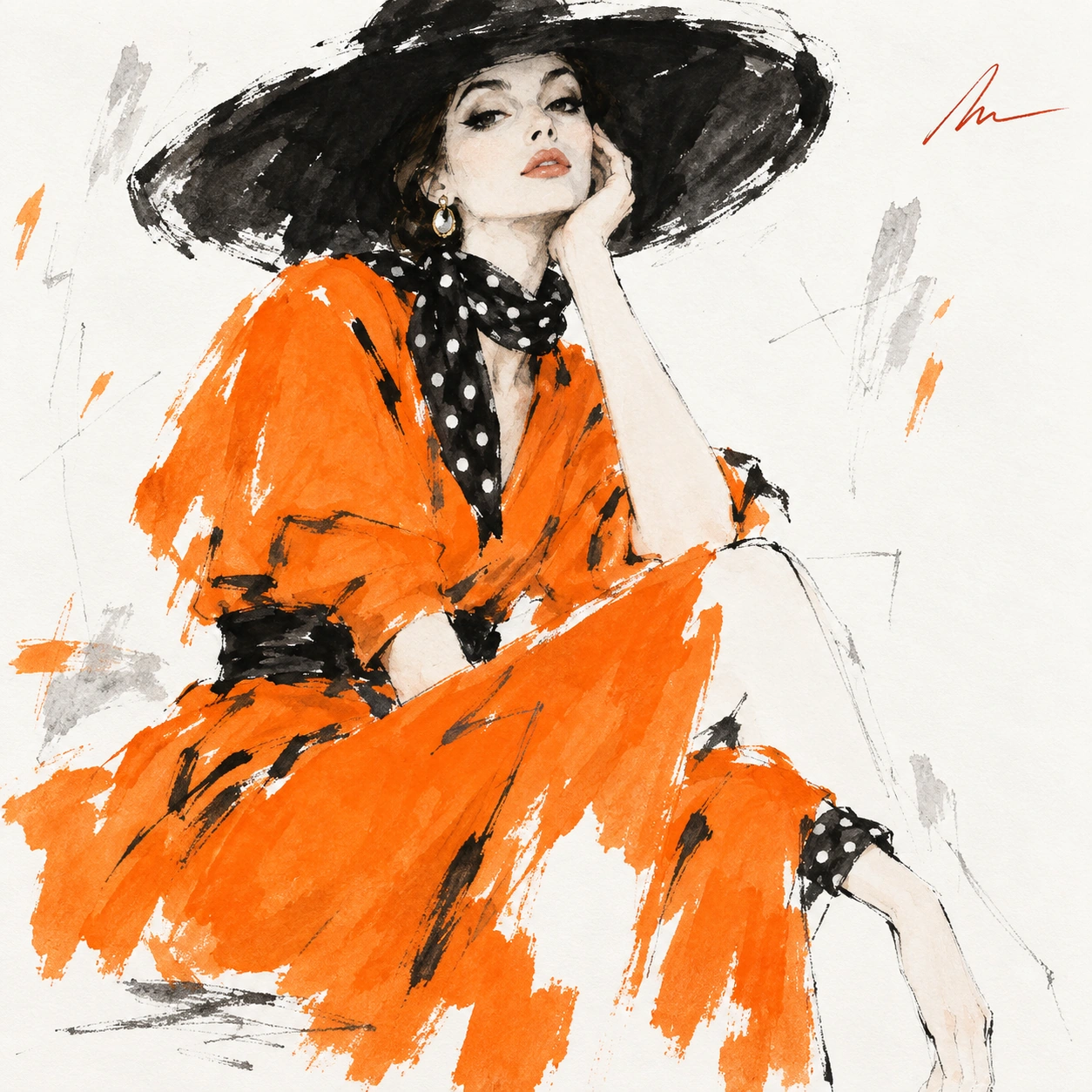 GPT Image 2.5
Reference details
- Reference ID
- 2325
- Category
- Flat illustration
Reference prompts
Style prompt
The illustration combines sweeping opaque color patches, scratchy black linework, and broad untouched paper white. One saturated warm hue carries the largest areas, while black accents cluster at structural points and tiny pale interruptions keep those masses lively. Edges alternate between decisive brush cuts, feathery dry marks, and contours that simply dissolve into the ground. The image gains volume through overlaps and concentrated darks rather than smooth graded shading; unpainted areas act as the brightest light. A few small dotted or calligraphic marks add finer rhythm against the large loose strokes. The composition leaves generous negative space and allows construction traces to remain visible, producing an elegant, spontaneous editorial finish with strong graphic contrast.Full example prompt
A square expressive fashion illustration shows a seated model in vivid orange clothing and a broad black hat against an almost white paper ground. The background stays largely empty, interrupted by scattered pale gray strokes, a few orange dashes, and faint wandering construction lines. Near the upper center, the hat spreads in a dark arc above the model's face, its loose black brushwork extending toward both sides. Her pale face tilts slightly upward and toward the viewer, with arched brows, dark winged eye marks, a small softly colored mouth, and one earring visible below the brim. One hand rises to the side of her cheek beneath the hat, giving the pose an easy, self-possessed pause. A black scarf with crisp white dots gathers at the neck and reappears at the near wrist, its high-contrast little marks set against broad orange fabric. The orange garment crosses the left shoulder and descends into large irregular patches over the lap, broken by black fold marks, exposed white paper, and quick angled strokes. A black band pulls across the waist, creating a compact center among the more expansive color shapes. On the right, the model's arm and bent leg are only partly stated through slender sketch lines and small accents, so the seated posture is legible without a fully enclosed contour. The paper white remains active around and inside the figure, making some edges disappear and others jump forward where wet-looking orange paint meets heavy black ink. Light is implied by the unpainted white of the face, arm, and ground rather than by a realistic cast shadow; dark accents provide the modeling. A thin red calligraphic mark in the upper right reads as an indistinct signature-like flourish. The overall composition is brisk, elegant, and open, balancing saturated orange masses with black graphic accents and generous unpainted space.