
Styles
#2356
David A. Hardy style reference and prompts
Explore the “David A. Hardy” reference with soft tonal transitions, warm and cool tones, and backlighting. View the images, copy the style or example prompt, and discover related styles on Looksift.
Compare the Qwen Image 2.1 and GPT Image 2.5 examples, choose the visual qualities you want, and copy the style prompt for your own project.
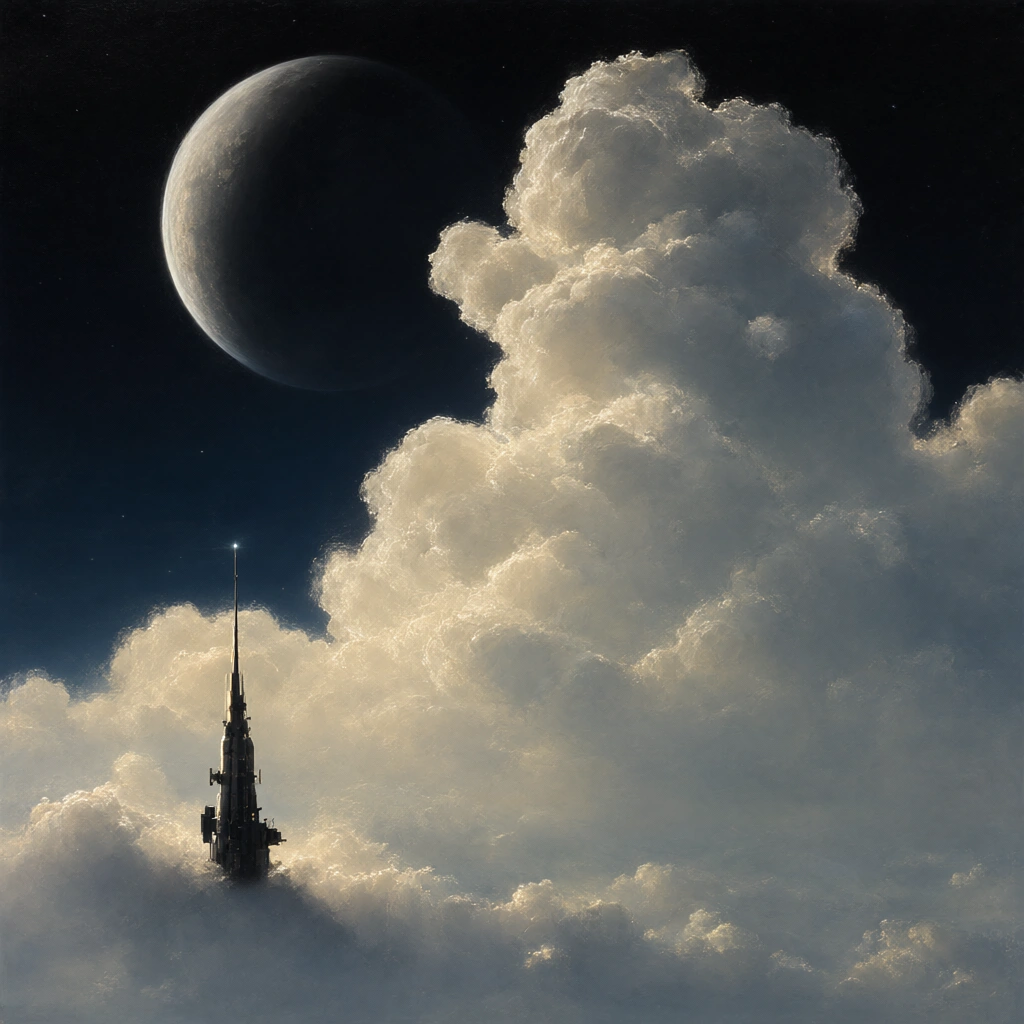 Qwen Image 2.1
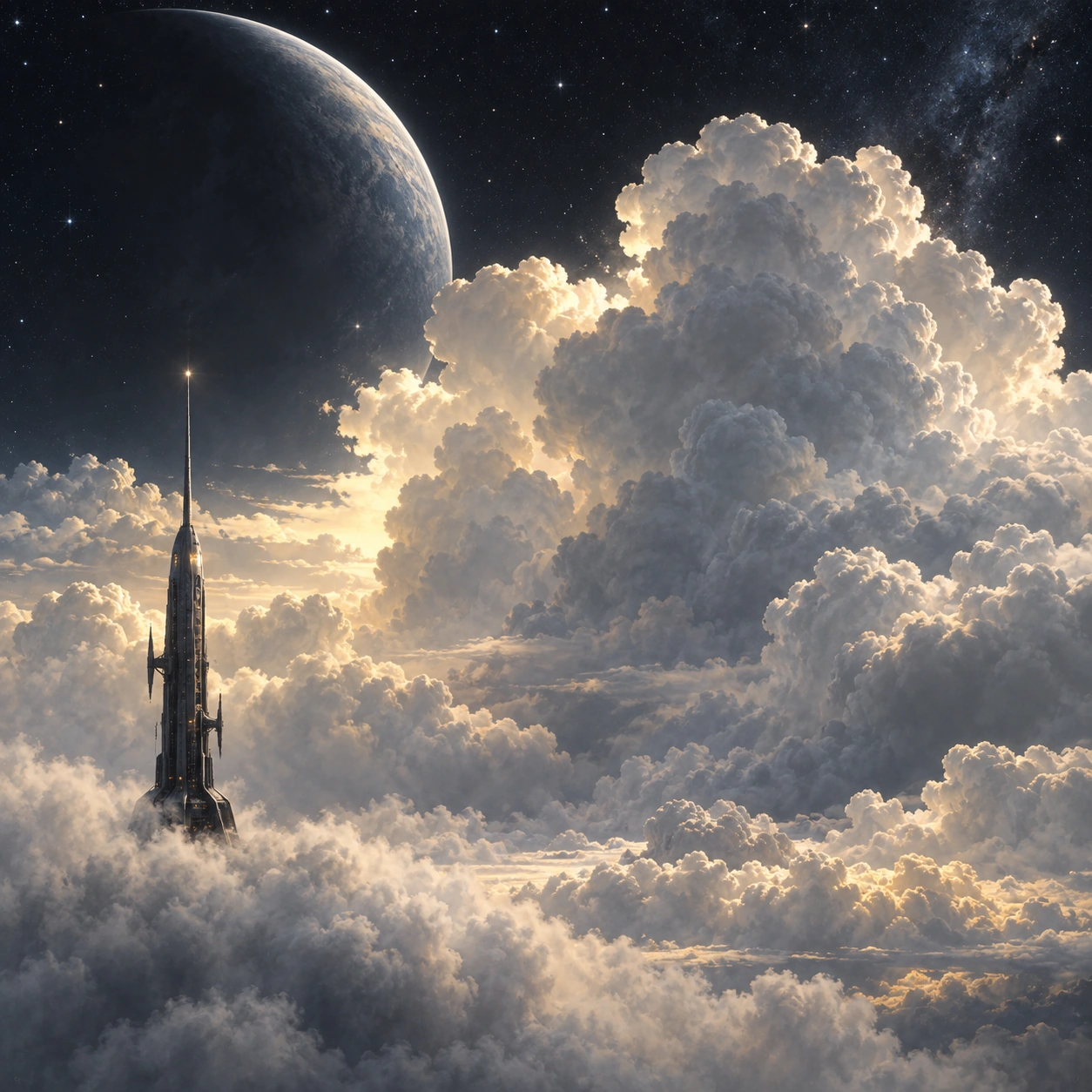 GPT Image 2.5
Reference details
- Reference ID
- 2356
- Category
- Painting
Reference prompts
Style prompt
Science-fiction painting pairs monumental softly modeled volumes with tiny precise silhouettes and points of light. Deep blue-black space gives way to layered cream, slate, and pale gold forms whose edges glow where backlight catches them. Smooth atmospheric blending is enriched by fine granular highlights and small textured strokes, creating scale without uniform sharpness. Cool distant luminescence and restrained warm accents separate depth planes. Large curved masses dominate, while a slender vertical accent supplies focus and human scale. The overall mood is spacious, luminous, and quietly sublime.Full example prompt
A square science-fiction painting shows a slender spacecraft standing amid immense pale clouds beneath a dark, star-speckled sky. Near the upper left, a huge curved planetary body is visible as a softly lit crescent, its shadowed round form fading into black space. Towering clouds fill the center and right, their cream, gray, and pale gold lobes rising high and overlapping one another in intricate layers. At the lower left, the spacecraft appears as a narrow vertical tower with small side projections and a dark base partly surrounded by vapor. A fine mast extends upward from it, ending in a tiny bright point that draws the eye through the cloud field. The lower edge carries a broad bed of mist and scattered illuminated cloud tops, while the vessel's dark silhouette gives the otherwise soft scene a firm scale marker. The sky beyond is nearly black-blue, with faint scattered stars rather than a distinct horizon. Details of the craft are suggested through small geometric protrusions and warm highlights, not through readable markings. The paint surface is carefully blended in large areas but textured by tiny luminous strokes across the cloud edges and atmospheric haze. Light seems to filter from behind the tallest clouds and catch their left-facing rims, while the vessel remains mostly in shadow except for its beacon and narrow upper edges. The planetary crescent supplies another cool, distant glow. The overall composition contrasts a minute upright machine with monumental rounded cloud and planetary forms, giving the scene a spacious, contemplative sense of exploration.