
Styles
#2685
James Rizzi style reference and prompts
Explore the “James Rizzi” reference with ink contours, ornamental detail, and saturated colors. View the images, copy the style or example prompt, and discover related styles on Looksift.
Compare the Qwen Image 2.1 and GPT Image 2.5 examples, choose the visual qualities you want, and copy the style prompt for your own project.
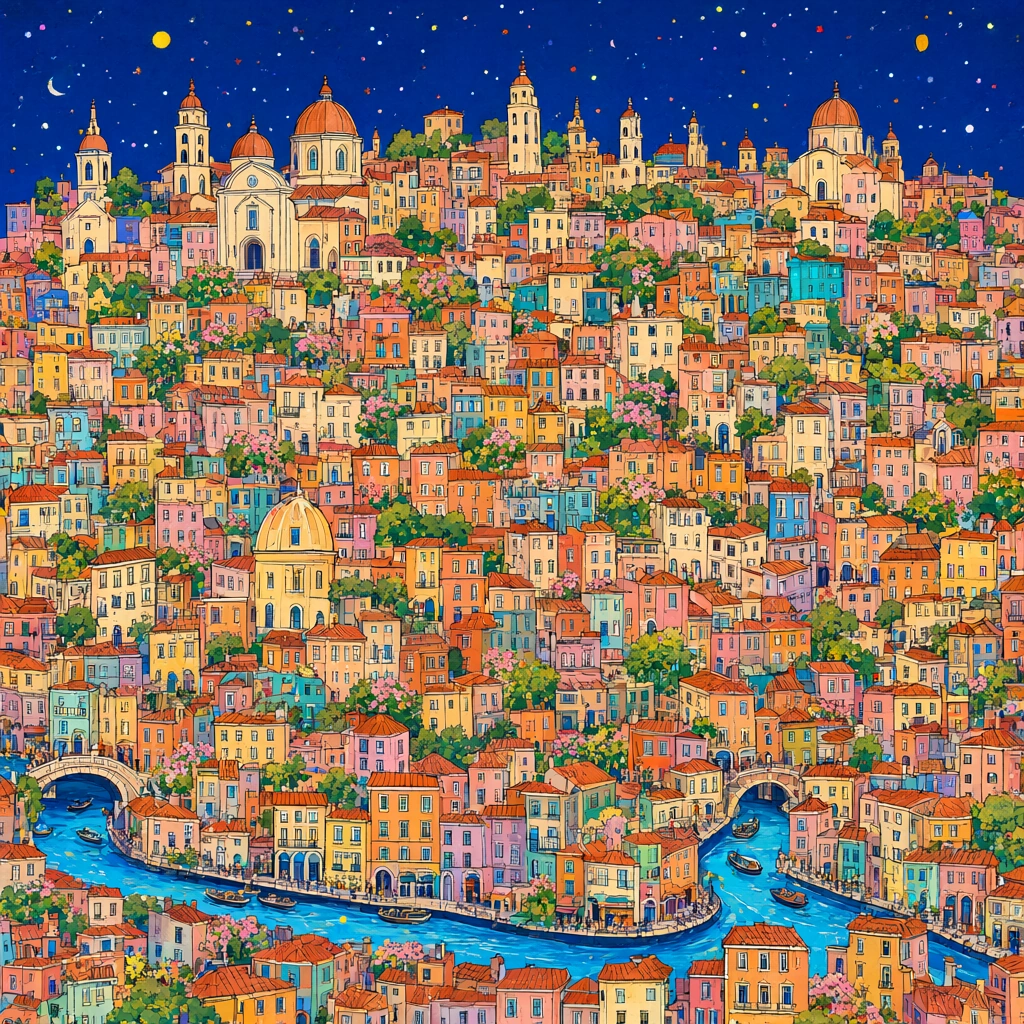 Qwen Image 2.1
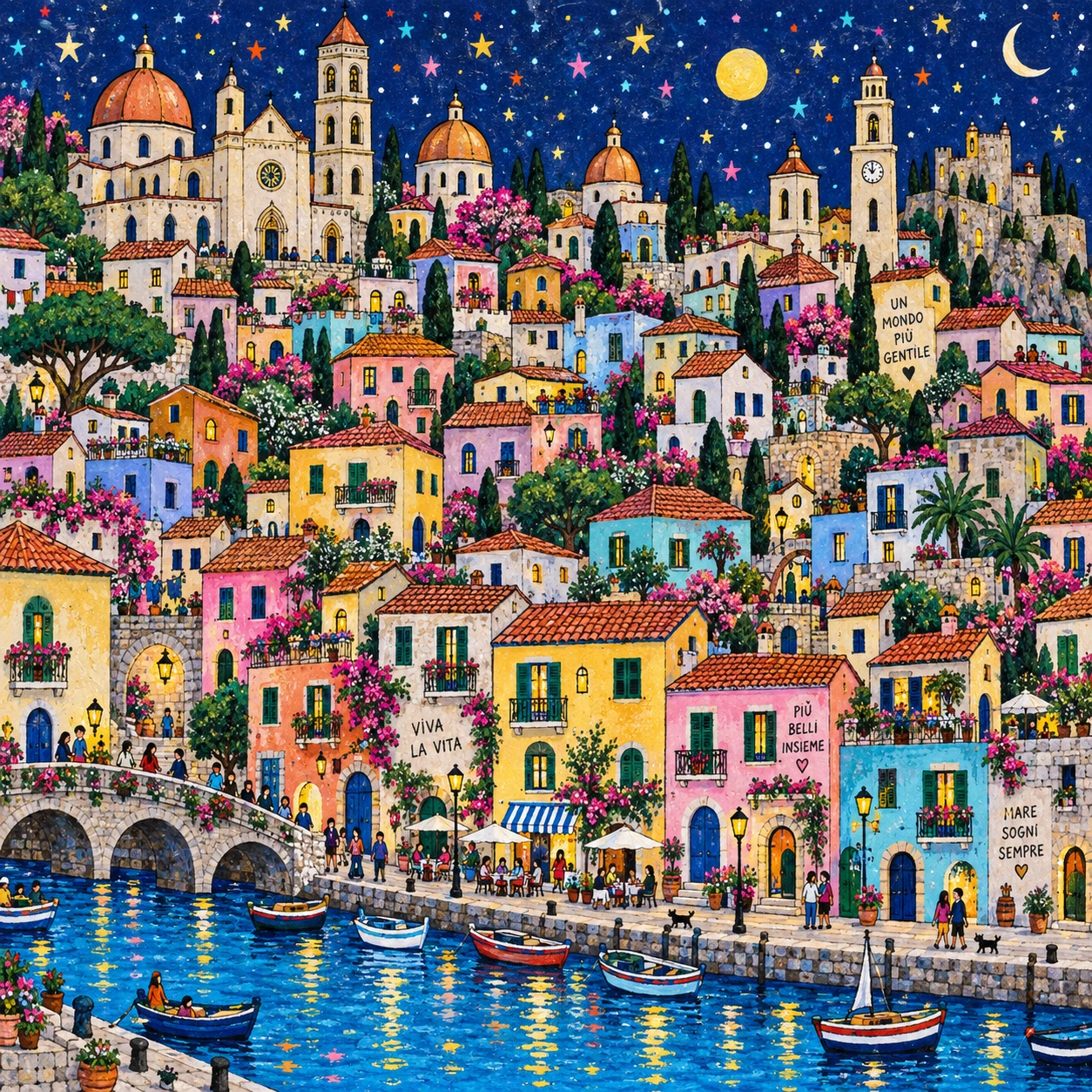 GPT Image 2.5
Reference details
- Reference ID
- 2685
- Category
- Flat illustration
Reference prompts
Style prompt
Hand-drawn, storybook-like illustration built from miniature outlined shapes packed almost continuously across the picture plane. The design favors stacked, overlapping layers and shallow perspective over a single realistic vanishing point. A dark blue ground and nearly black contour lines organize a vivid mosaic of pink, yellow, orange, mint, turquoise, and lavender. Rounded organic marks interrupt the many rectangular forms, and small dots, stars, arches, windows, and patterned bands create a constant decorative rhythm. Painted color can vary slightly within each area, with a light grain and uneven line weight that retain a handmade feel. Large dark areas give the eye a resting place while the remaining field rewards close inspection with small distinct motifs. Scale shifts are playful and compressed; the effect is busy but legible because repeated outlines and saturated color groups hold the whole arrangement together. Aim for exuberance, warmth, and childlike visual curiosity without smoothing away the irregular drawing.Full example prompt
A square, edge-to-edge illustrated cityscape rises in stacked layers from a narrow bright blue canal at the bottom to a dark blue night sky across the top. Dozens of small buildings press together, each simplified into a colorful facade with arched doors, tiny windows, balconies, and patterned roofs. Pale yellow, pink, orange, turquoise, and lavender walls alternate rapidly, so no single building dominates the composition. Taller cream-colored churches and towers punctuate the upper skyline, some capped by warm copper-colored domes and narrow finials. Between the walls, rounded green trees and flowering pink crowns fill gaps and break up the many straight edges. Small figures and decorative details appear along the waterfront and within the streets, but the city is read chiefly as a dense patchwork of buildings rather than one narrative event. The canal curls into the lower left and returns near the lower right, with an arched bridge and tiny boats suggested by a few dark and bright marks. At the upper edge, the sky is crowded with small white dots, multicolored stars, round colored lights, a yellow disk, and a thin crescent moon. Outlined shapes are deliberately compact and varied; facades overlap and climb upward without realistic perspective or a clean street grid. Black or very dark blue contours hold the countless saturated colors apart. The painted or printed surface has a slight grain and handmade irregularity, letting the repeated windows, roof tiles, flowers, and stars feel lively rather than mechanically uniform. The result is festive and exuberant, with a large amount of miniature detail held together by the uninterrupted deep-blue sky and repeating warm roofs.