
Styles
#2802
Phad painting style reference and prompts
Explore the “Phad painting” reference with pale neutral tones. View the images, copy the style or example prompt, and discover related styles on Looksift.
Compare the Qwen Image 2.1 and GPT Image 2.5 examples, choose the visual qualities you want, and copy the style prompt for your own project.
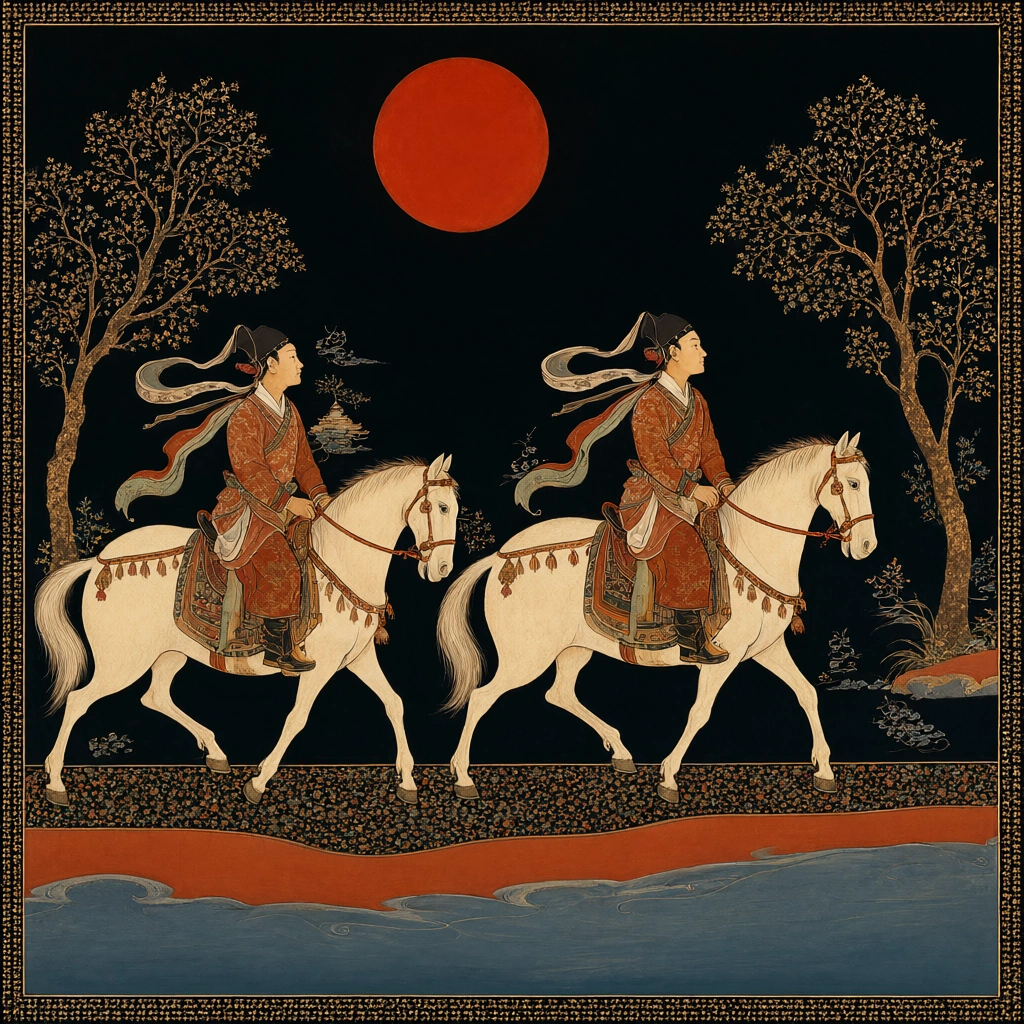 Qwen Image 2.1
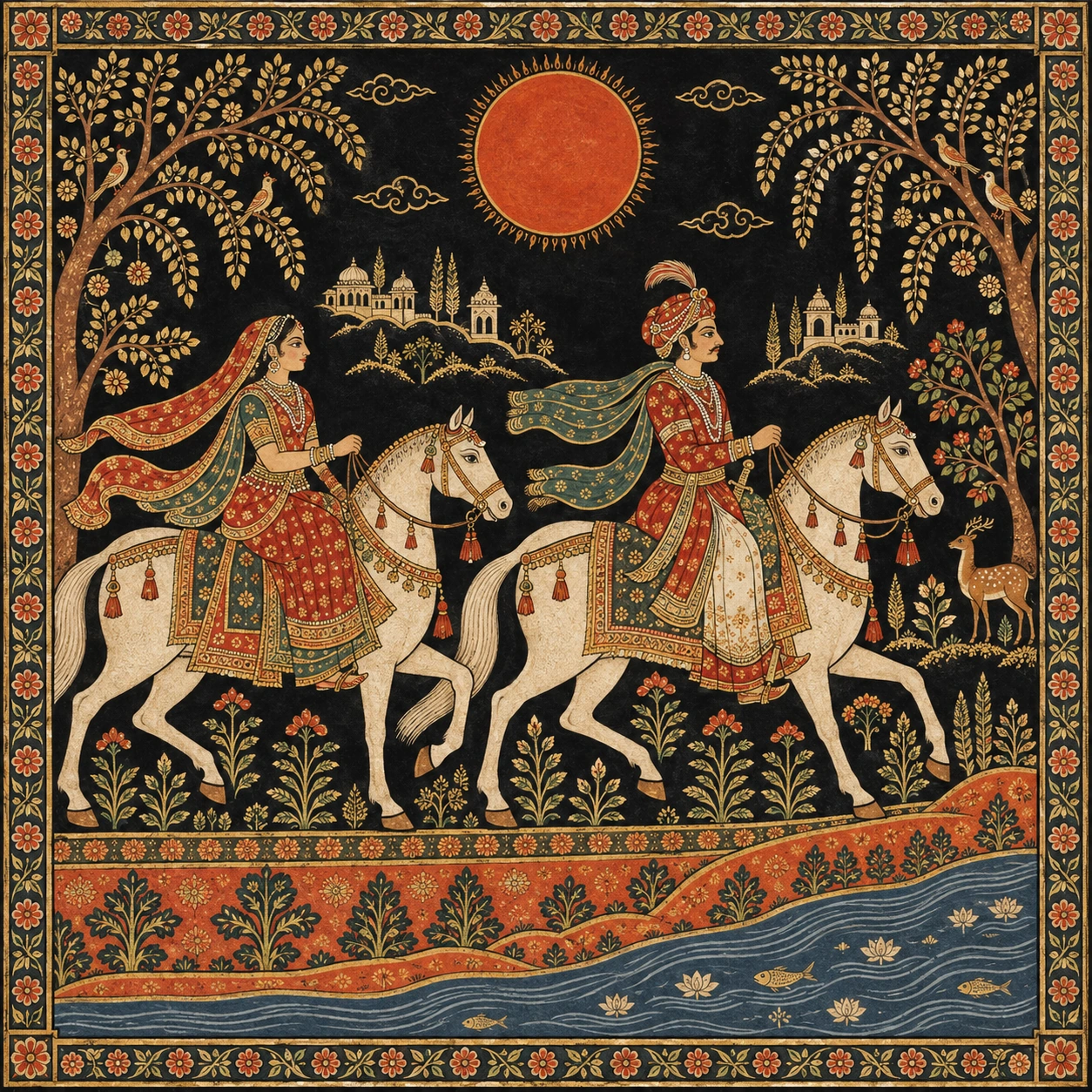 GPT Image 2.5
Reference details
- Reference ID
- 2802
- Category
- Painting
Reference prompts
Style prompt
A traditional folk-painting surface organizes dense narrative ornament within a narrow patterned border. Fine dark contours and repeated tiny marks articulate layered matte areas of rust red, gold, cream, muted teal, and near-black. Forms are flattened and stacked for clear reading rather than arranged in realistic perspective. Symmetrical side accents and a central warm disc give the upper region ceremonial balance, while a curved lower band introduces movement. Empty intervals are filled with small rhythmic motifs, yet strong color blocks keep the main shapes distinct. Illumination is graphic and even, with little cast shadow. The result is intricate, warm, and ordered, its decorative repetition carrying both texture and story.Full example prompt
A square traditional folk-painting-style panel shows two richly dressed riders on pale horses moving from left to right across a narrow patterned band of ground. Each figure has a long flowing scarf and layered warm red, cream, and green garments; the horses have decorated saddles and carefully drawn legs. A large red-orange sun hangs above the center in an almost black sky. Stylized trees rise on both sides, their branches and leaves built from repeated small gold marks. Tiny pale architectural and cloudlike motifs float behind the riders. Along the lower right, a blue-grey water band curves under an orange embankment, while a dense patterned border encloses the entire scene. The figures are shown in a flattened profile rather than realistic perspective, with forms stacked clearly and every empty interval filled by small ornament. Fine dark outlines define faces, tack, and textile patterns, and gold, rust red, muted teal, and cream sit in matte areas over the black ground. Light is symbolic and even: the sun is a graphic disc rather than a source of cast shadows. The border's repeated tiny marks give the scene a rhythmic frame. No readable lettering appears. The overall composition is ceremonial and narrative, dense but ordered, with warm ornament shining against a dark field.