
Styles
#3024
Biological illustration style reference and prompts
Explore the “Biological illustration” reference with transparent washes, negative space, and translucent color layers. View the images, copy the style or example prompt, and discover related styles on Looksift.
Compare the Qwen Image 2.1 and GPT Image 2.5 examples, choose the visual qualities you want, and copy the style prompt for your own project.
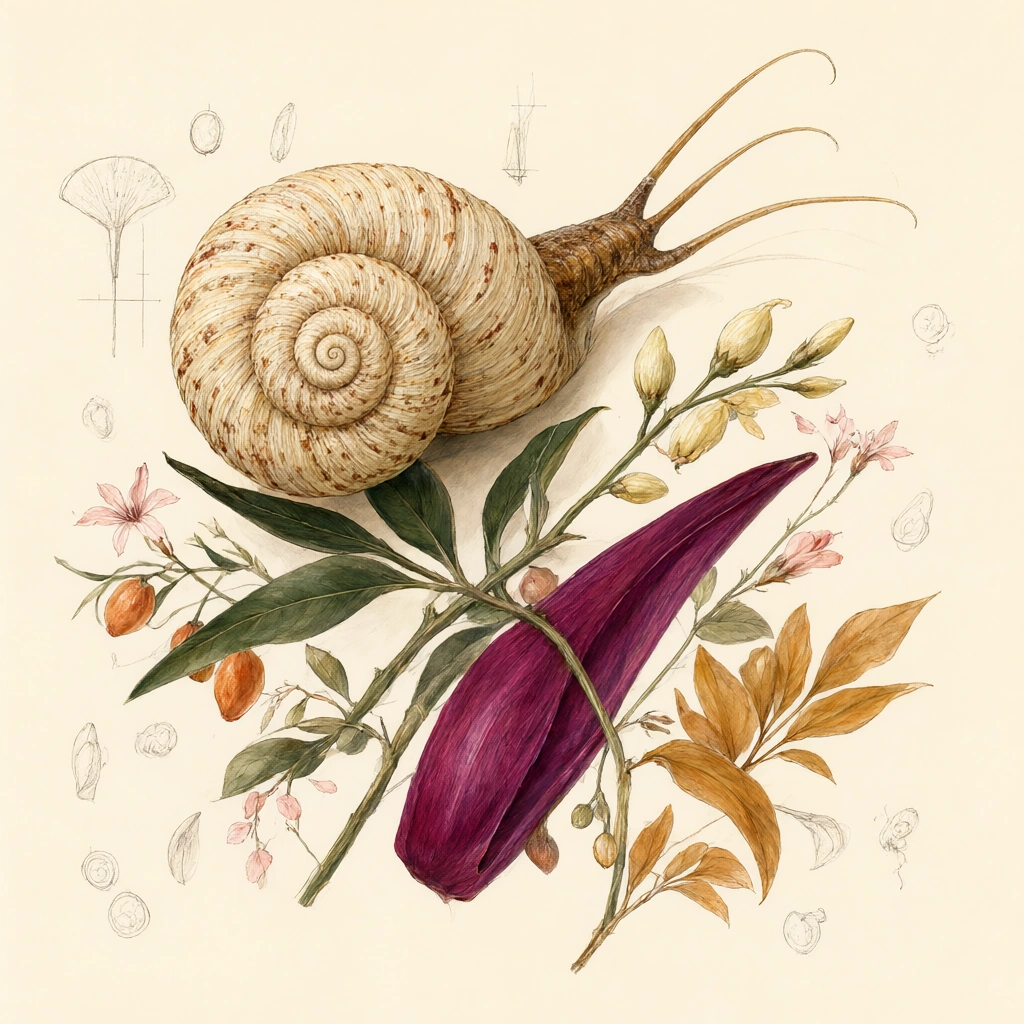 Qwen Image 2.1
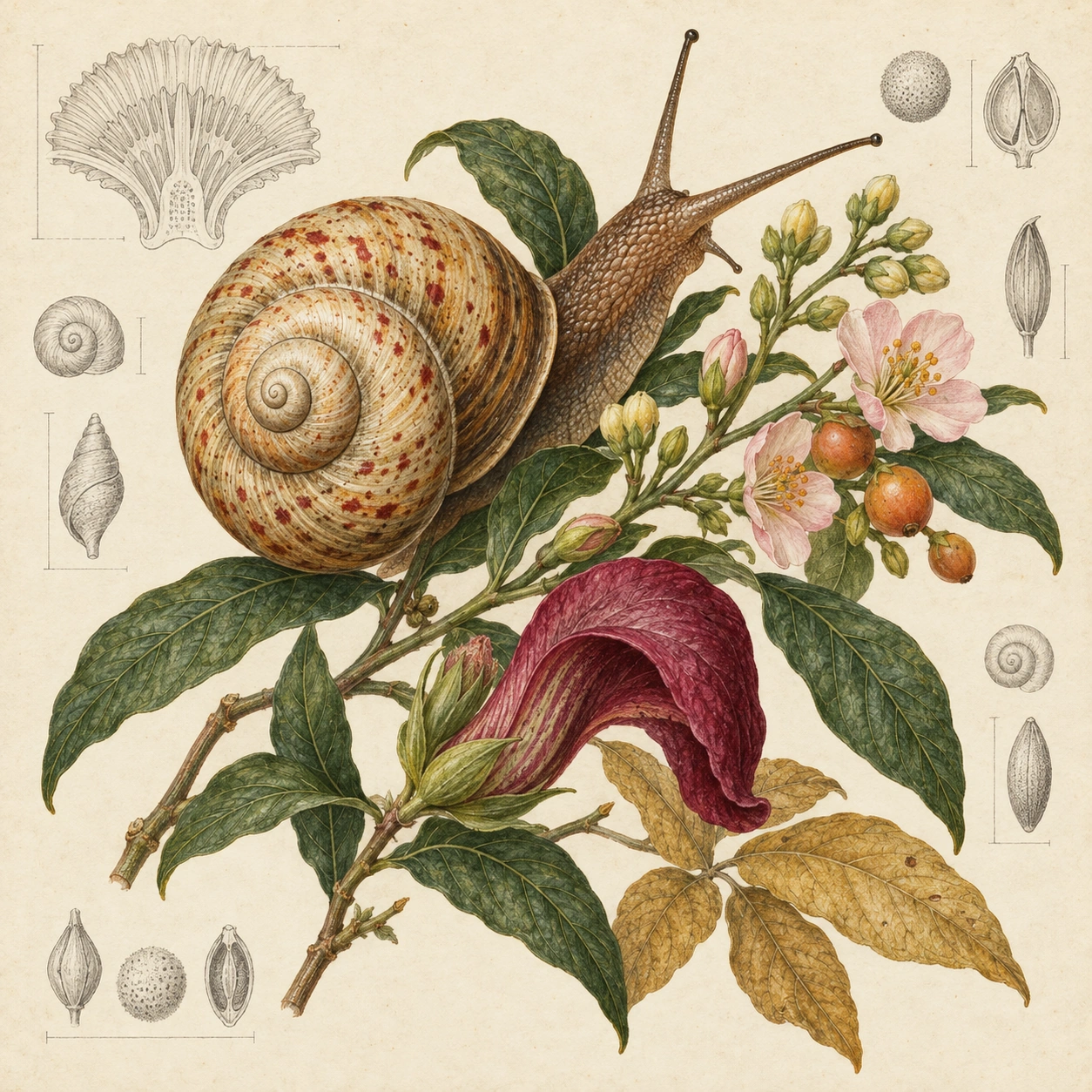 GPT Image 2.5
Reference details
- Reference ID
- 3024
- Category
- Painting
Reference prompts
Style prompt
The image has a natural-history illustration finish, combining fine contour drawing, restrained translucent color, and pale auxiliary diagram marks on cream paper. A dense central cluster is surrounded by generous negative space, with thin guide lines and faint circular notes staying subordinate to the colored forms. Ochre, olive, beige, muted rose, and one stronger magenta accent create a measured hierarchy. Delicate hatching, stippling, and watercolor-like washes describe ridges, veins, and folds without heavy black outlines. Even warm light keeps the surfaces readable, while small overlap shadows provide depth. The overall effect is precise and graceful, joining scientific observation to a gently decorative arrangement.Full example prompt
A square biological illustration arranges a large spiral-shelled creature among leaves, flowers, and small specimen sketches on a warm cream paper ground. The main shell sits left of center, its tight raised coil rendered in beige, ochre, and small rust-red speckles. A brown segmented body and long slender feelers project from behind the shell toward the upper right. Below and beside it, dark green lance-shaped leaves cross a branching stem, carrying pale yellow buds, a few small orange fruits, and delicate pink blossoms. A deep magenta curved flower or pod occupies the lower center-right, creating the strongest color accent against the otherwise muted plant tones. Near the lower right, a cluster of ochre leaves spreads outward. The composition floats without a depicted table or landscape, so each overlapping stem and specimen remains easy to inspect. Around the central grouping, faint gray diagrams and thin measuring or alignment lines sit almost ghostlike on the paper. A pale fan-shaped anatomical sketch appears at the upper left, and small circular forms and seedlike shapes are scattered around the margins. These secondary marks stay much lighter than the colored central objects. Fine contour drawing and soft watercolor-like shading describe shell ridges, leaf veins, petal folds, and dry surfaces with careful observation. Light is even and warm, as on a well-lit study sheet, with modest shadows only where forms overlap. No clearly readable labels appear. The overall composition combines a precise natural-history plate with a decorative central bouquet, balancing quiet paper space and intricate organic detail.