
Styles
#3105
Emil Nolde style reference and prompts
Explore the “Emil Nolde” reference with visible brushwork and warm and cool tones. View the images, copy the style or example prompt, and discover related styles on Looksift.
Compare the Qwen Image 2.1 and GPT Image 2.5 examples, choose the visual qualities you want, and copy the style prompt for your own project.
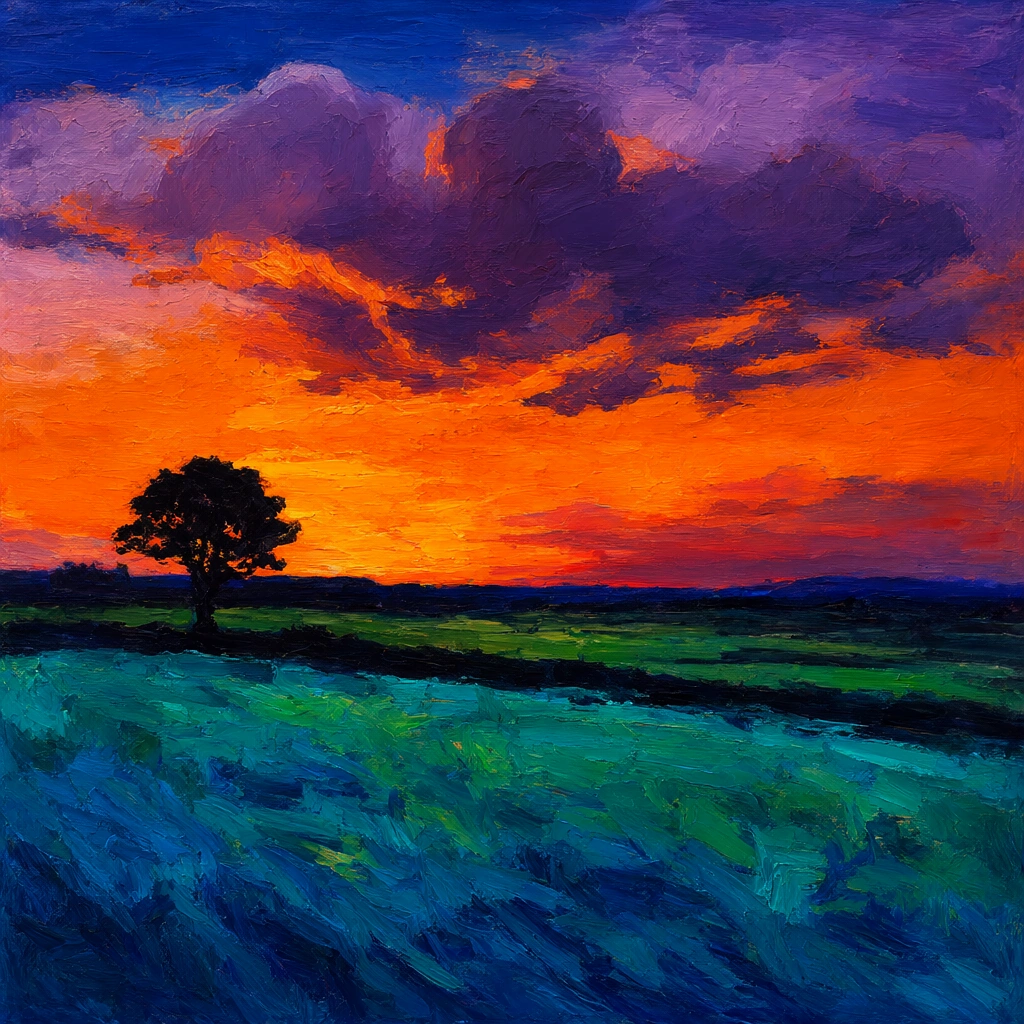 Qwen Image 2.1
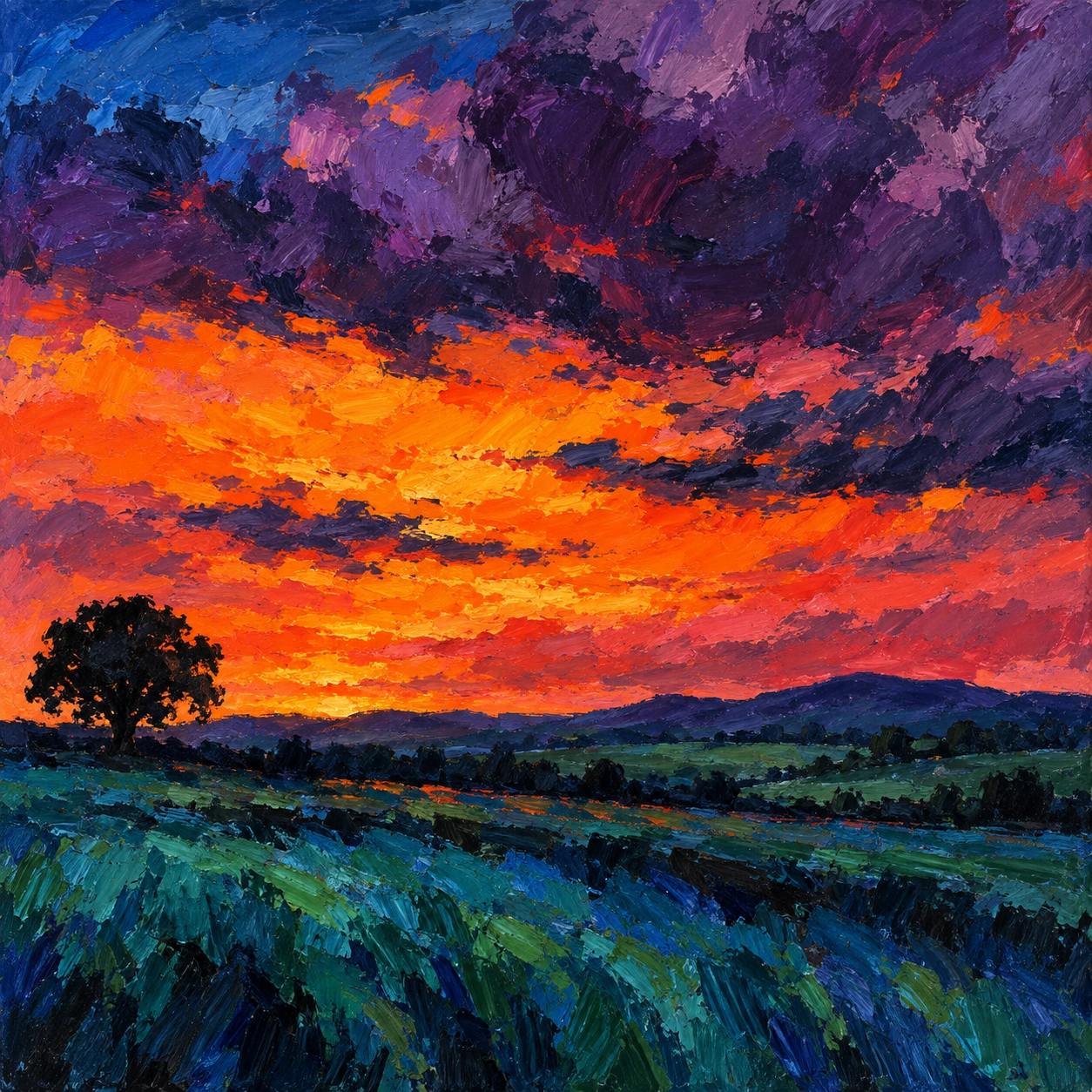 GPT Image 2.5
Reference details
- Reference ID
- 3105
- Category
- Painting
Reference prompts
Style prompt
The painting uses thick broken color, visible brush edges, and strongly opposed warm and cool areas. Orange, vermilion, and magenta glow against violet, cobalt, teal, and near-black, with colors meeting in rough patches rather than blended gradients. Large horizontal bands hold a simple spatial structure while a few small dark accents sharpen scale. The light feels internal to the pigment; warm areas flare and cooler masses absorb them. Texture remains active across the surface, from broad loaded strokes to short jagged interruptions. The overall effect is emotionally charged, direct, and deliberately less concerned with exact detail than with color rhythm.Full example prompt
A square expressionist landscape painting shows a fiery orange sunset beneath heavy violet clouds, with a dark solitary tree on the left horizon. The sky fills most of the upper two thirds. A narrow deep blue strip reaches across the top left, while large purple and plum cloud masses crowd the upper center. Below them, a broad band of saturated orange and vermilion glows across the middle, its lower edge dissolving into pink and dusky red. Dark blue and black strokes cut through the bright colors, making the light look turbulent rather than smooth. Along the horizon, the tree stands as a compact near-black silhouette on the far left, its rough crown and trunk just visible against orange. Low hills and a line of green fields stretch to the right, separated by deep blue-black bands. The lower foreground consists of broad turquoise, emerald, and cobalt strokes, unevenly laid so the ground feels windswept and somewhat abstract. No people or buildings are visible. The sky seems to emit its own warm light, illuminating the horizon from behind while the land remains dark and cool. Paint is applied in thick, broken patches; individual strokes and rough transitions remain obvious, especially where orange meets violet. The scene favors color energy over exact topographic detail, yet the low horizon, tree, and fields keep it recognizable as landscape. The overall composition balances one small dark vertical accent against huge opposing fields of hot orange and cold blue-violet, creating a bold, unsettled evening mood.