
Styles
#3582
Vasily Vereshchagin style reference and prompts
Explore the “Vasily Vereshchagin” reference with directional brush marks, negative space, and a nearly monochrome palette. View the images, copy the style or example prompt, and discover related styles on Looksift.
Compare the Qwen Image 2.1 and GPT Image 2.5 examples, choose the visual qualities you want, and copy the style prompt for your own project.
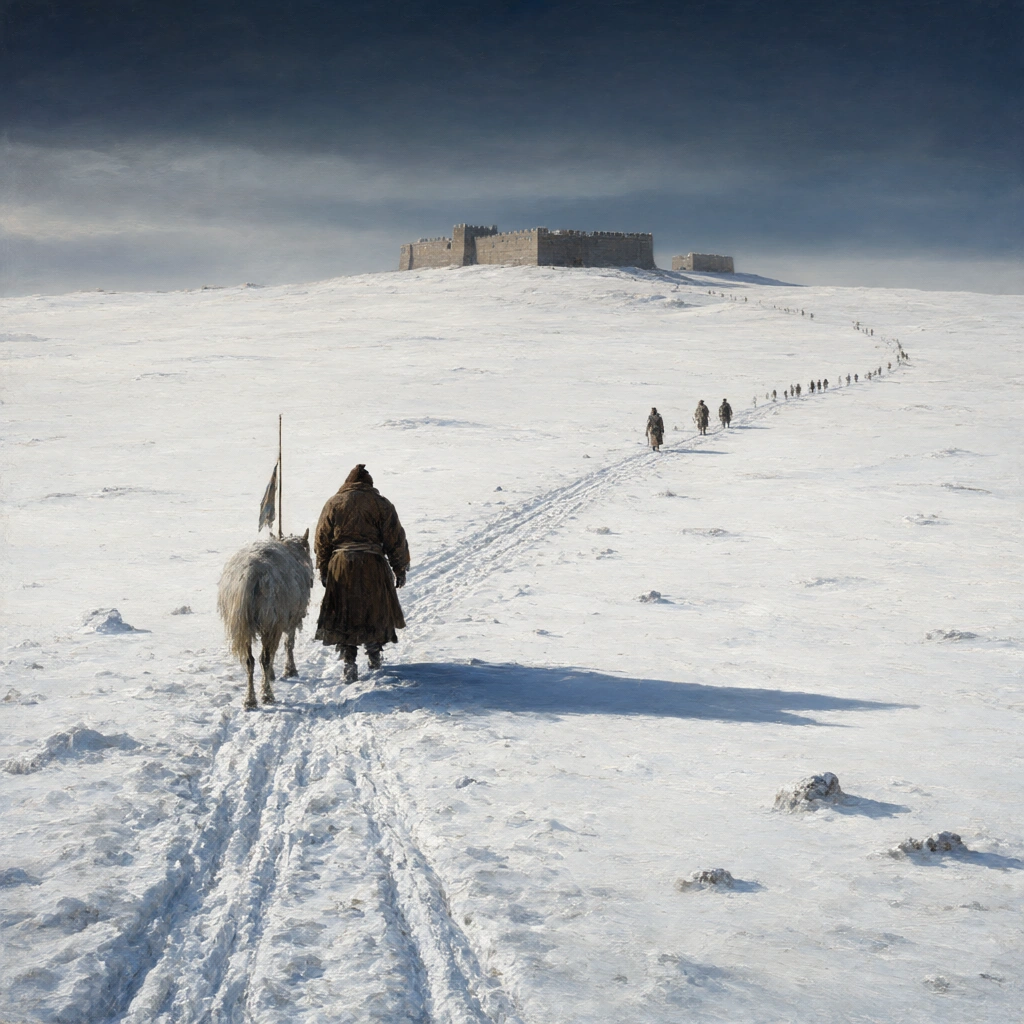 Qwen Image 2.1
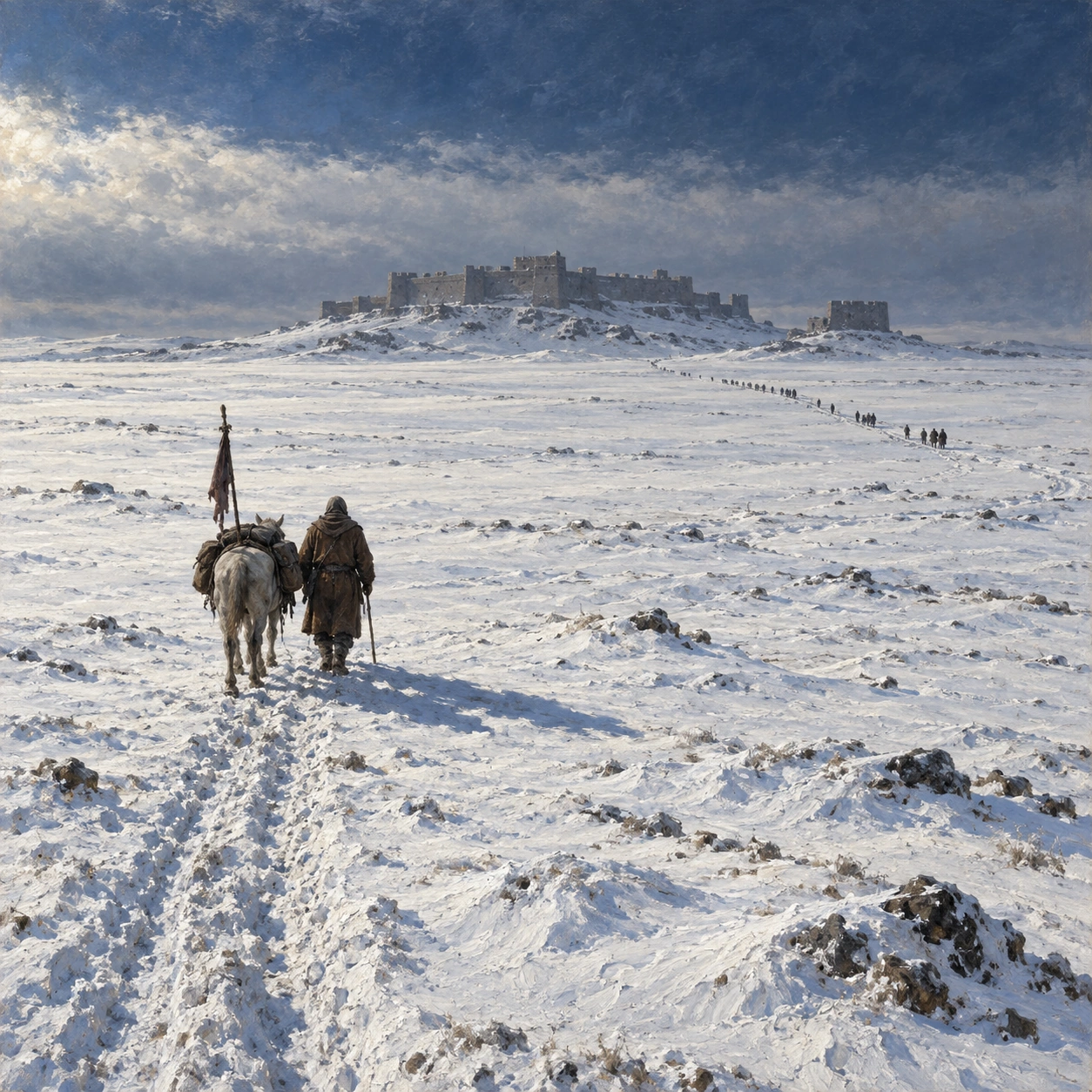 GPT Image 2.5
Reference details
- Reference ID
- 3582
- Category
- Painting
Reference prompts
Style prompt
The painting has a realist oil surface that joins precise foreground observation to a broad atmospheric distance. Blue-white and slate-gray occupy most of the field, with restrained earthy darks forming small, decisive accents. Near textures are built from short directional strokes, rough clumps, and sharp cast shadows; far masses soften into thin low-contrast silhouettes. Diffuse cool daylight makes pale open planes luminous, while shadows carry clear blue depth rather than pure black. A tapering linear route crosses wide negative space toward a low horizontal focal mass, producing immense scale from sparse details. The overall treatment is austere, spacious, and quietly monumental, with subtle temperature shifts keeping the near-monochromatic palette alive.Full example prompt
A square realist oil landscape shows a vast snow-covered plain under a deep blue-gray sky, with a lone traveler and pale pack animal moving along a track toward a distant fortified structure. The sky takes the upper third, its dark blue at the top thinning into soft gray cloud bands above the horizon. Near the center of that horizon, a long low stone fort rises on a snowy mound. Its crenellated upper edge and block-like walls remain muted by distance, and a smaller detached mass sits to its right. The middle ground is a broad white expanse crossed by low tracks, scattered dark stones, and a thin winding procession of tiny figures approaching from the right. In the lower-left half, the nearest traveler is seen from behind in a brown outer garment. A pale gray animal walks just to the traveler's left, with a slim vertical pole and a narrow hanging cloth rising beside it. Their paired dark blue shadows fall to the right across the snow and make their contact with the ground unmistakable. A textured track begins at the bottom edge and narrows toward them, its parallel compressed marks guiding the eye inward. The snow is far from blank: cool blue furrows, gray clumps, and small warm-gray ridges give the foreground a rough, wind-worked surface. Light comes from the left under the cloud cover, keeping the open snow luminous while leaving the traveler, animal's shaded side, and fort walls cooler and darker. The painting balances meticulous terrain marks in front with broad nearly empty fields behind, allowing scale and distance to feel severe. The overall composition uses a small moving pair and a tapering path to draw the eye through blue-white space toward the quiet monumental fort.