
Styles
#3602
Kazuki Takamatsu style reference and prompts
Explore the “Kazuki Takamatsu” reference with hatching, negative space, and a monochrome palette. View the images, copy the style or example prompt, and discover related styles on Looksift.
Compare the Qwen Image 2.1 and GPT Image 2.5 examples, choose the visual qualities you want, and copy the style prompt for your own project.
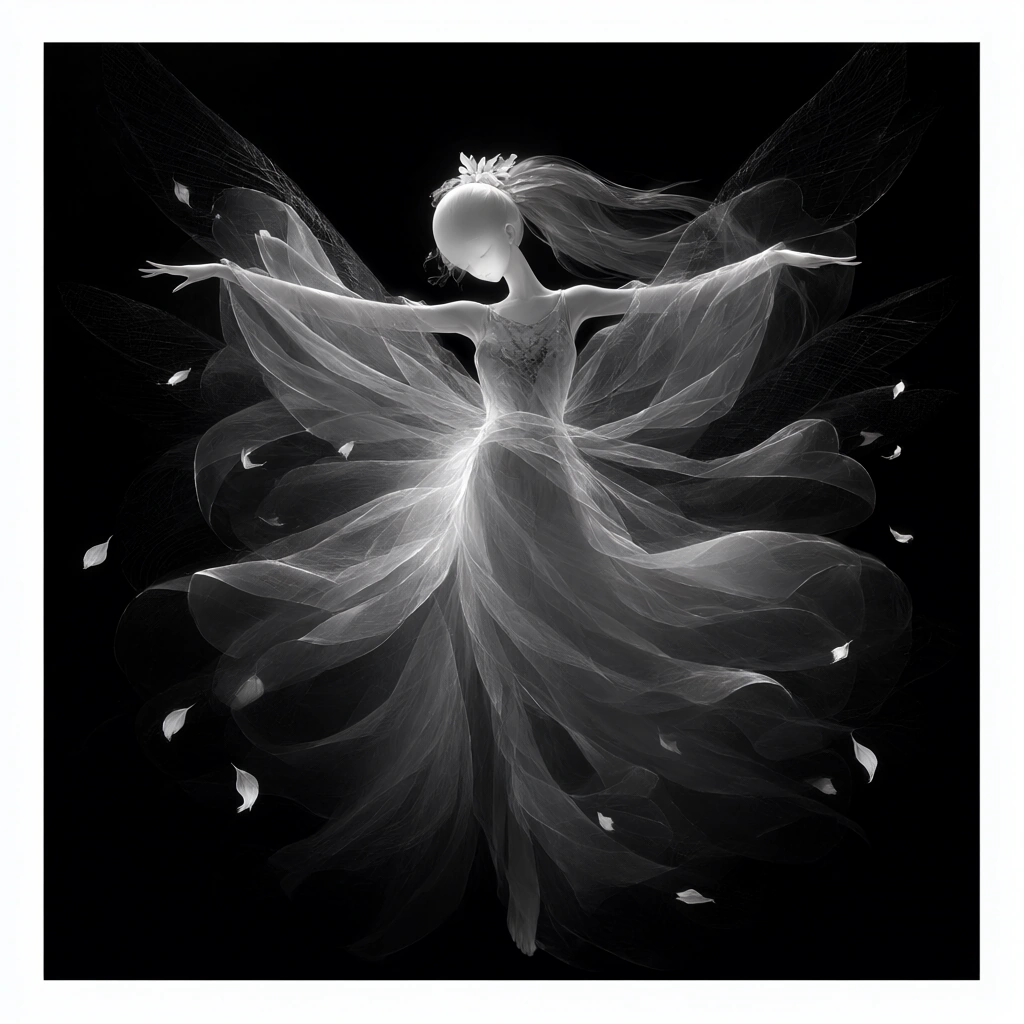 Qwen Image 2.1
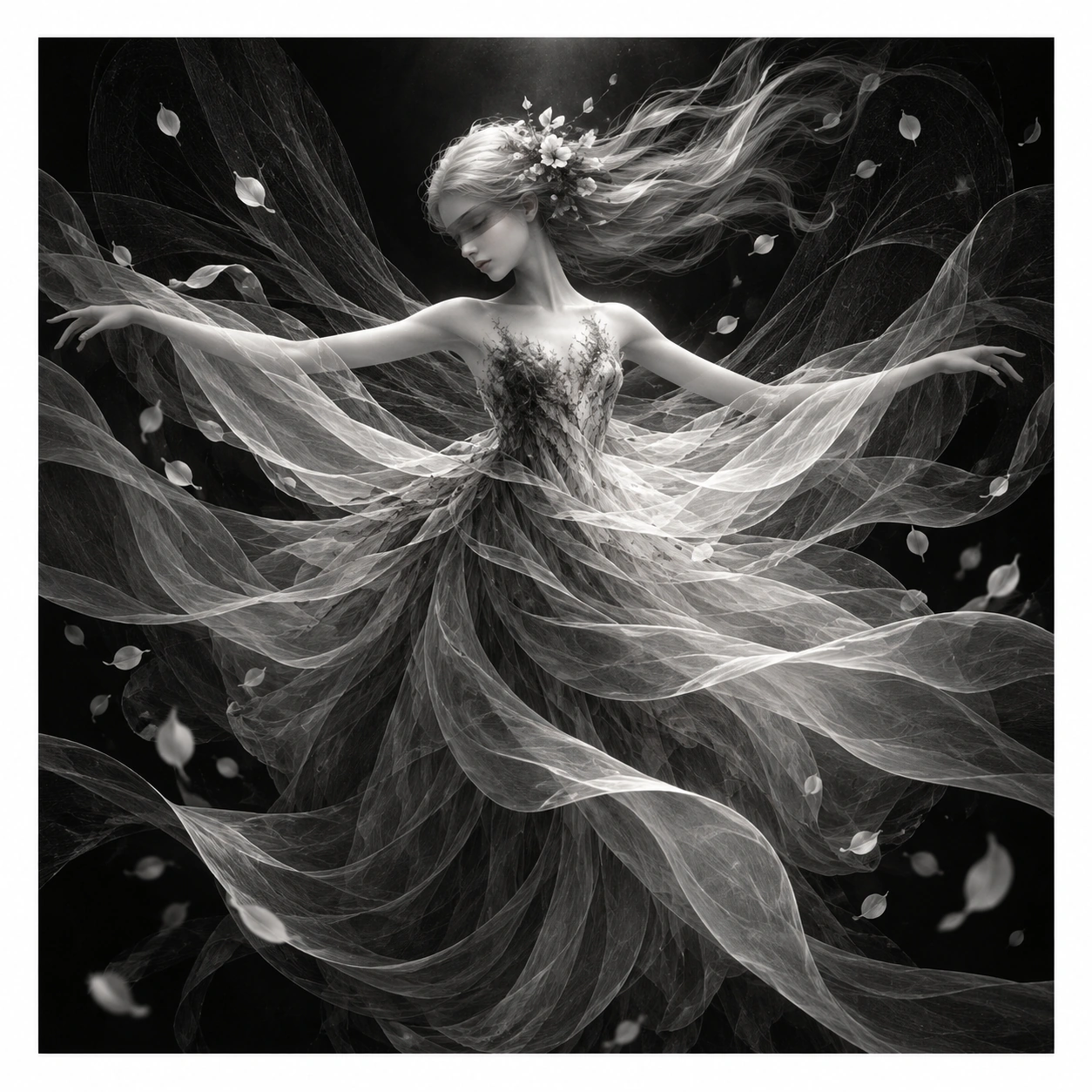 GPT Image 2.5
Reference details
- Reference ID
- 3602
- Category
- Flat illustration
Reference prompts
Style prompt
The monochrome digital illustration relies on near-black negative space and a concentrated range of silver-white, soft gray, and smoke tones. A smooth pale center expands into layered transparent arcs whose thin bright edges stay visible as their interiors fade into darkness. Fine line hatching and mesh-like texture give larger dark curves structure without filling the background. Light appears internally generated or strongly backlit, producing luminous rims and quiet tonal gradients rather than conventional colored shading. The rhythm moves from a compact central form into wide, almost symmetrical sweeps with small scattered accents. The overall effect is ethereal and weightless, with delicate edge control and transparency carrying most of the depth.Full example prompt
A square monochrome fantasy illustration shows a slender dancer-like figure with both arms extended amid translucent flowing layers on a deep black ground. A clean white margin surrounds the dark image, giving the internal composition the look of a framed print. At the upper center, the figure's smooth pale head tilts down toward the left, with the eyes obscured by a soft band of shade. Long hair streams to the upper right in translucent gray ribbons, and small pale petal-like forms gather behind the crown. The narrow torso sits near the center, gently modeled in gray-white, with a darker patterned area at the chest. Both arms reach outward at shoulder height, their delicate shapes partly lost where they meet the fabric. From the waist, many gauze-like sheets fan across the middle and lower portions, curving from left to right and crossing in overlapping veils. Some edges are bright silver-white; others fade to dark smoke, allowing a sense of layered depth despite the strictly limited palette. Behind the figure, larger dark mesh or wing-like arcs rise at both sides, carrying faint linear hatching that becomes visible only against the black. Scattered pale leaves or petals float through the middle and lower edges, reinforcing the same outward movement as the drapery. The surface feels digitally smooth yet finely lined in the transparent areas, with soft gradients across the face and sharply luminous edges on the fabric. Light appears to emanate from above and behind the central figure, leaving the head, shoulders, and selected folds glowing while the surrounding space stays almost entirely black. The overall composition is nearly symmetrical in its outward sweep, balancing a calm central silhouette with delicate, airborne motion and a silvery monochrome atmosphere.