
Styles
#3672
Maurice Utrillo style reference and prompts
Explore the “Maurice Utrillo” reference with rhythmic lines, soft pastel colors, and atmospheric depth. View the images, copy the style or example prompt, and discover related styles on Looksift.
Compare the Qwen Image 2.1 and GPT Image 2.5 examples, choose the visual qualities you want, and copy the style prompt for your own project.
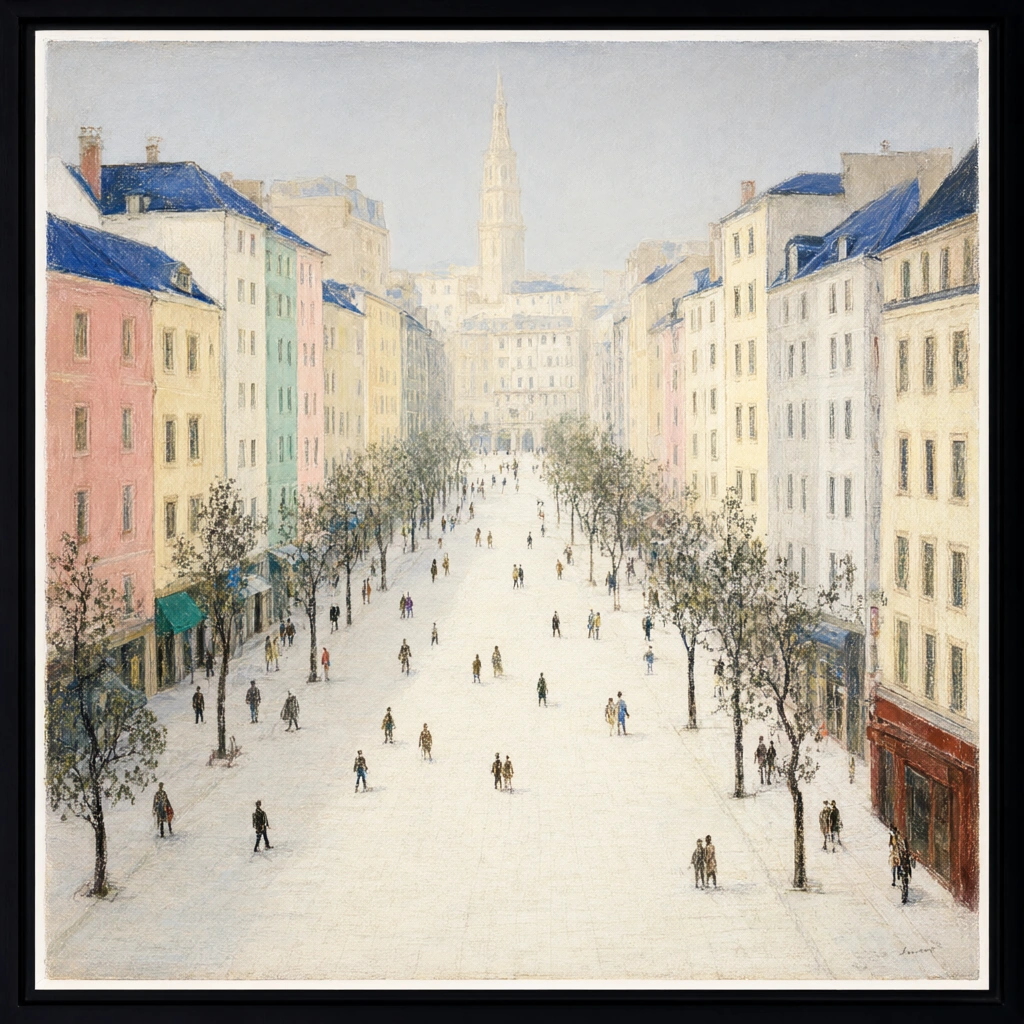 Qwen Image 2.1
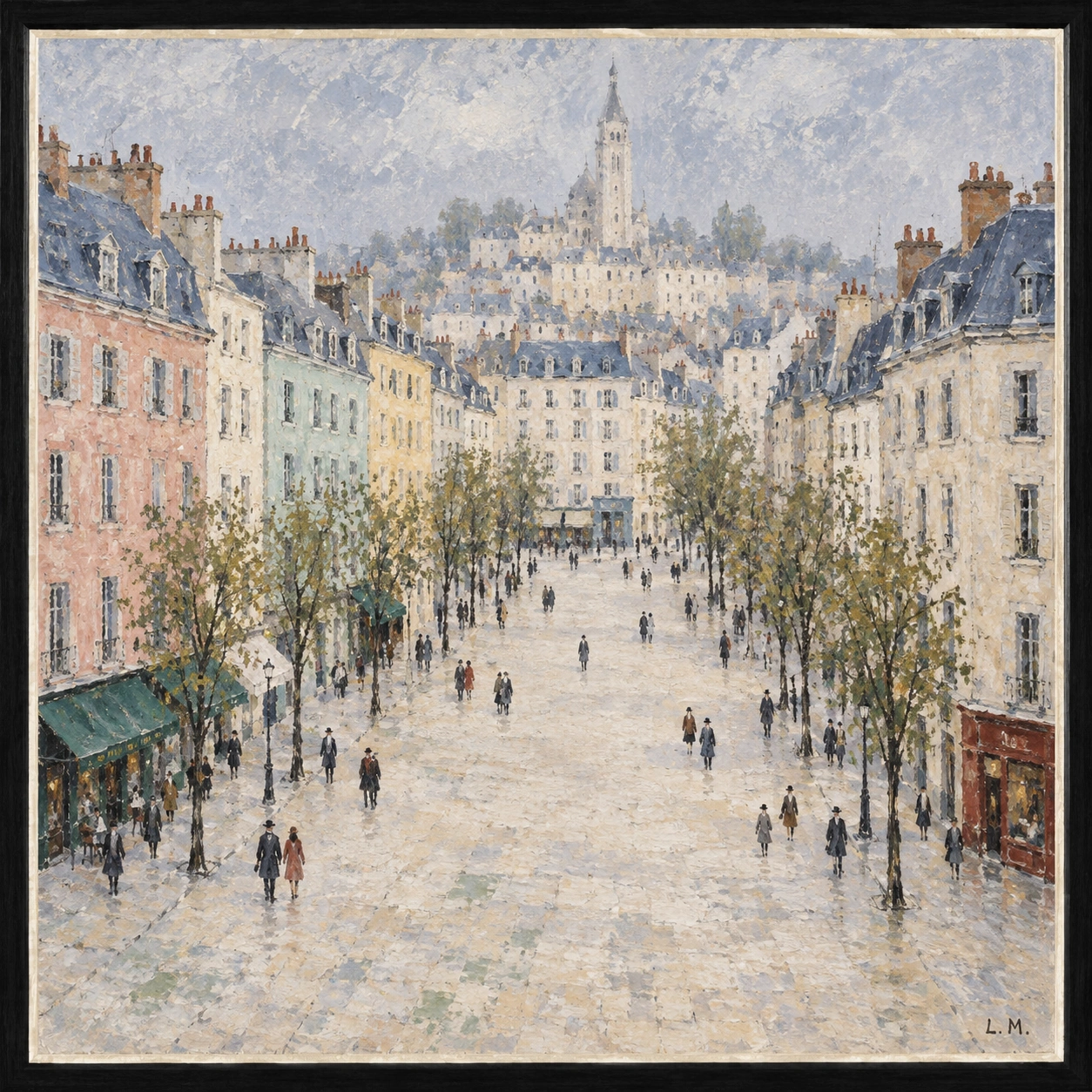 GPT Image 2.5
Reference details
- Reference ID
- 3672
- Category
- Painting
Reference prompts
Style prompt
This gently textured urban painting uses chalky off-white space and low-saturation pastel blocks to create an airy, ordered composition. Pale rose, mint, butter yellow, powder blue, and warm cream remain slightly grainy, while fine charcoal lines and a few dark red accents establish rhythm. Forms have simple upright edges softened by rubbed paint and atmospheric distance; remote areas lose contrast before they lose their basic geometry. Small repeated marks animate a broad central opening without filling it. Light is overcast and even, making pale planes luminous and leaving only mild local shade. Depth comes from converging edges and reduced scale rather than strong shadow. The overall effect is quiet, nostalgic, and delicately handmade.Full example prompt
A square painted city view shows a broad pale square or street opening between rows of pastel buildings, seen from a slightly elevated viewpoint. The artwork is contained within a thick black surround and a narrow pale inner margin. At the upper center, misty cream buildings rise toward a slender pale tower, its spire fading into a gray-blue sky. Roofs step down from this distant landmark toward the nearer street fronts on both sides. On the left, a rose-colored building with a blue roof stands beside cream, mint, and butter-yellow façades. On the right, pale stone fronts with dark blue roofs end at a small red-brown shopfront near the lower edge. Windows appear as small dark rectangles, and a few green awnings give the lower left a deeper accent. The open center begins narrow beneath the distant block and widens toward the bottom. Its off-white paving is lightly streaked with beige, gray, and faint green rather than described tile by tile. Thin trees stand in loose rows along either side of the open space, their dark trunks and sparse muted leaves breaking up the pale walls. Many tiny pedestrians are scattered across the square as black, brown, and occasional red strokes; no one dominates the scene. The buildings and street are painted with small, grainy marks and gently uneven outlines, creating an aged chalky surface. Overcast daylight falls broadly from above, leaving façades and paving luminous with only mild shadows under eaves and along the shops. Depth comes from shrinking figures, converging building edges, and increasingly pale distant color. A small signature-like mark appears near the lower right of the artwork, but it is not reliably legible. The overall composition is orderly and airy, with a wide white center framed by soft pastel verticals and sparse dark accents.