
Styles
#3782
Rube Goldberg style reference and prompts
Explore the “Rube Goldberg” reference with construction lines, a composition divided into fields, and pale neutral tones. View the images, copy the style or example prompt, and discover related styles on Looksift.
Compare the Qwen Image 2.1 and GPT Image 2.5 examples, choose the visual qualities you want, and copy the style prompt for your own project.
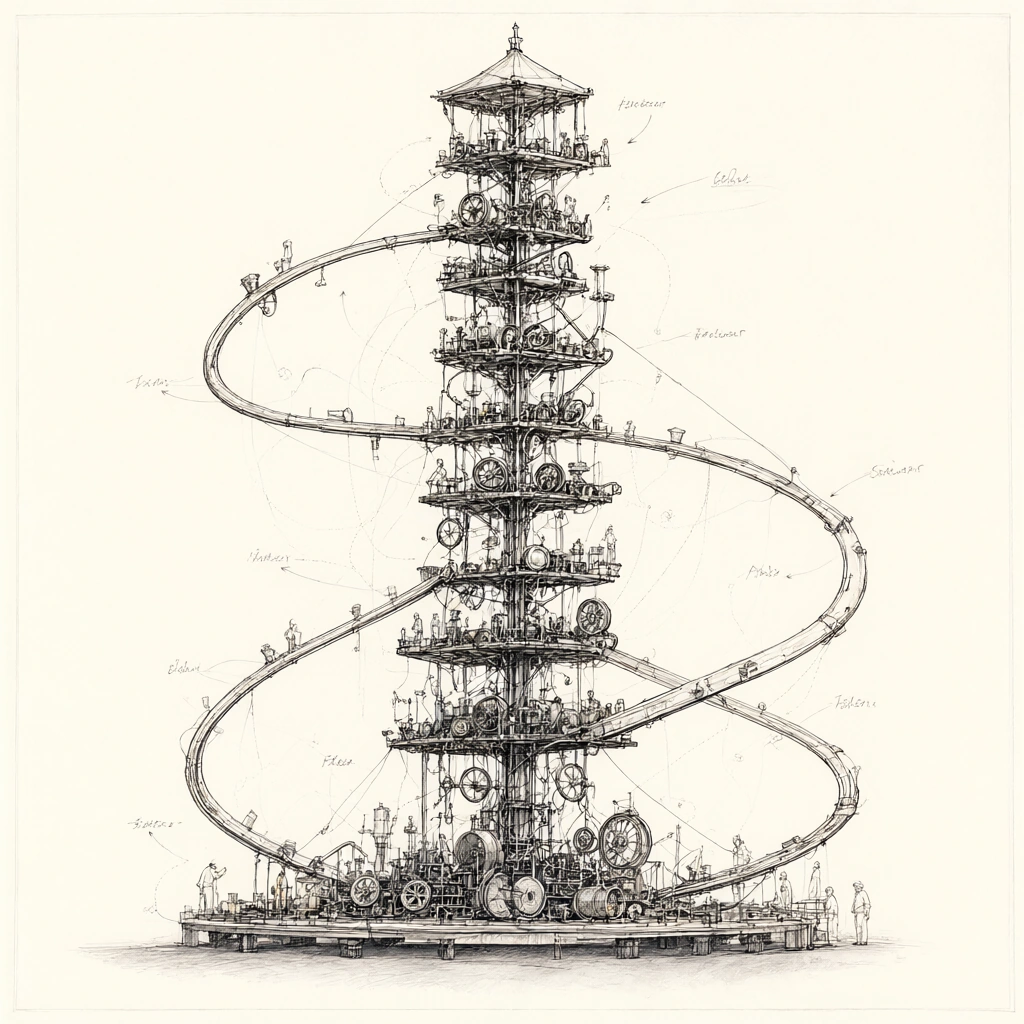 Qwen Image 2.1
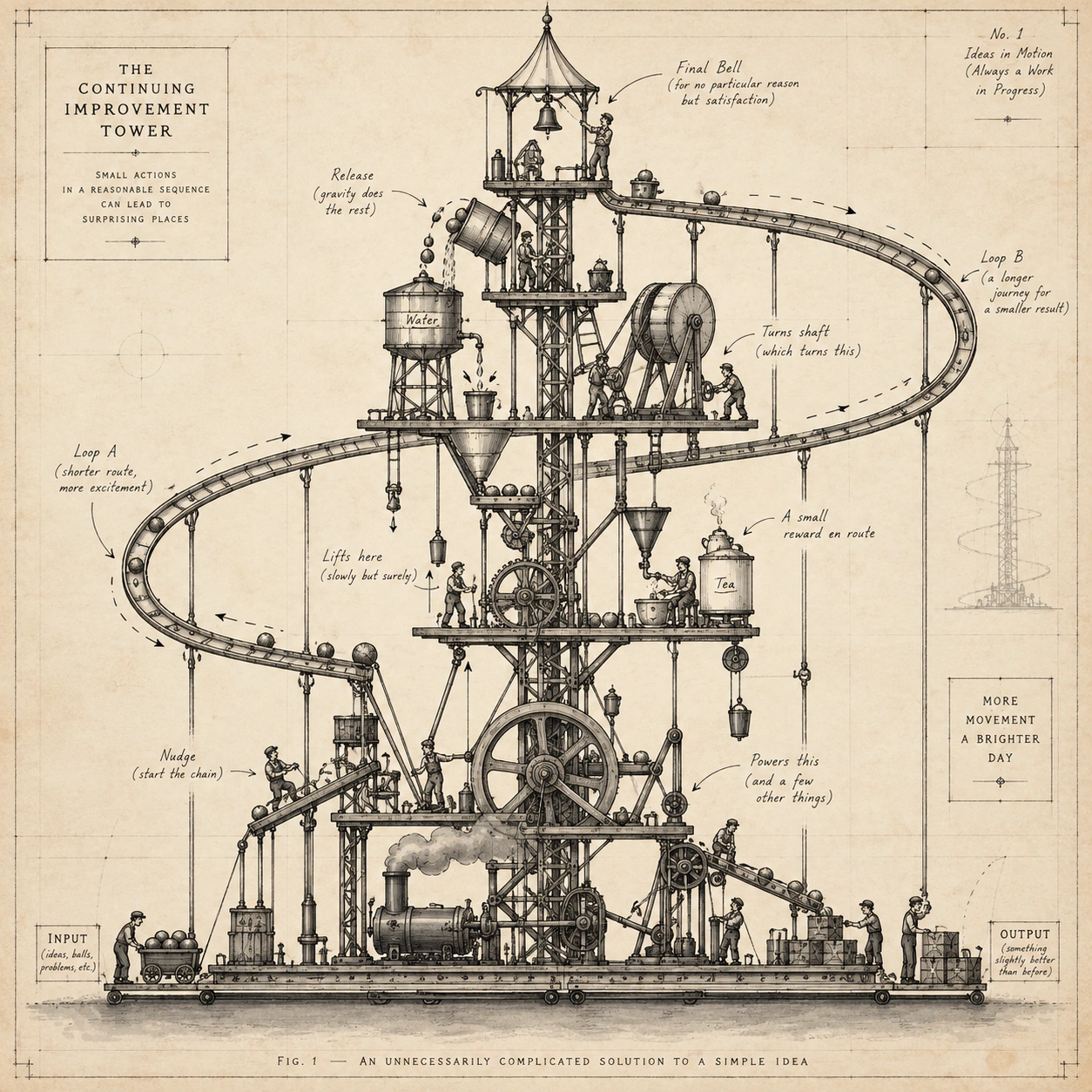 GPT Image 2.5
Reference details
- Reference ID
- 3782
- Category
- Ink & line
Reference prompts
Style prompt
Fine pen-and-ink drawing combines precise technical construction lines with the loose wit of an old explanatory cartoon. Charcoal marks on warm off-white paper carry nearly the entire image; pale gray shading and slight tan aging add restrained depth. Hairline rods, dotted paths, arrows, leader strokes, and tiny handwritten annotation textures create dense local information, while generous unmarked margins preserve overall legibility. An upright stacked silhouette is steadied by a broad low base and enlivened by sweeping looped arcs across its sides. Crosshatching gathers at junctions and under horizontal layers, with lighter broken lines allowed to fade into the paper. Spatial depth is diagrammatic rather than atmospheric, and illumination remains even, without strong highlights or cast shadows. Faint border lines and visible drafting irregularities maintain the sense of a carefully imagined, handmade sheet. The visual rhythm alternates crowded miniature clusters with calm cream openings, leaving a playful impression of rigorous invention just beyond comprehension.Full example prompt
An intricate pen-and-ink technical cartoon depicts an imaginary chain-reaction tower on a cream drafting sheet. A narrow central framework rises from a long horizontal base, supporting several stacked platforms crowded with small wheels, belts, drums, cranks, little vessels, and tiny operators. Two broad curved tracks sweep around the structure at different heights; their looping arcs give the otherwise upright composition a playful movement from side to side. The highest platform ends beneath a delicate pointed canopy. Fine arrows, dotted travel paths, leader lines, and faint handwritten labels hover around individual components, hinting at a complicated sequence without asking the viewer to decode every step. Thin black lines distinguish rods and cables, while darker hatch clusters and overlapping contours weight the central supports and crowded lower level. Much of the paper remains open around the machine, so its dense tiny marks retain a clear silhouette. The palette is almost entirely warm off-white and charcoal black, with a soft gray wash beneath the base and slight tan aging in the sheet. There is little naturalistic lighting; depth comes from nested linework, slight tonal accumulation, and tiny shadows under each shelf. A faint rectangular border and pale construction lines reinforce the look of an annotated invention drawing. The large looping track at right counters the small clutter at left, and the broad stable foot anchors the rising, eccentric apparatus. The mood is clever and gently absurd, precise at a glance yet full of unexpected, hand-drawn detours.