
Styles
#4012
Astrophotography style reference and prompts
Explore the “Astrophotography” reference with layered surface texture, pale neutral tones, and atmospheric haze. View the images, copy the style or example prompt, and discover related styles on Looksift.
Compare the Qwen Image 2.1 and GPT Image 2.5 examples, choose the visual qualities you want, and copy the style prompt for your own project.
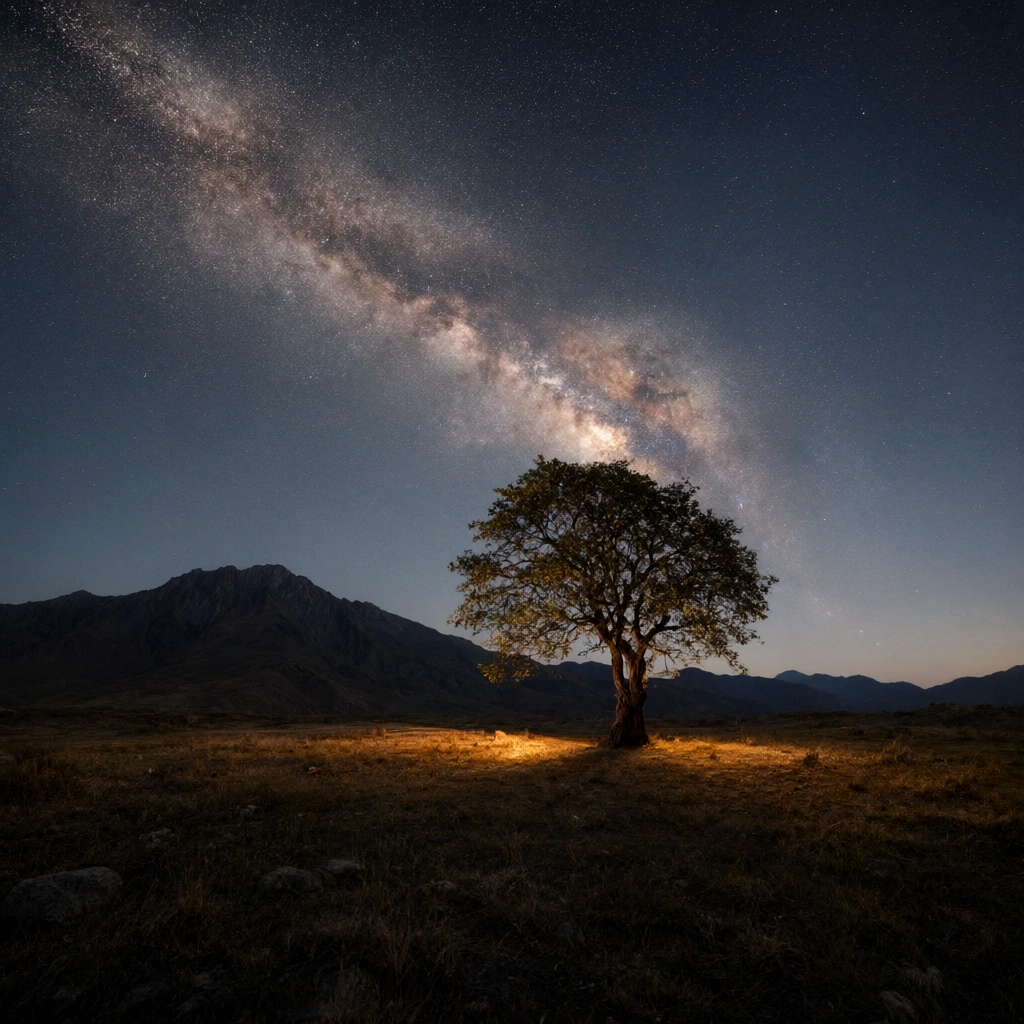 Qwen Image 2.1
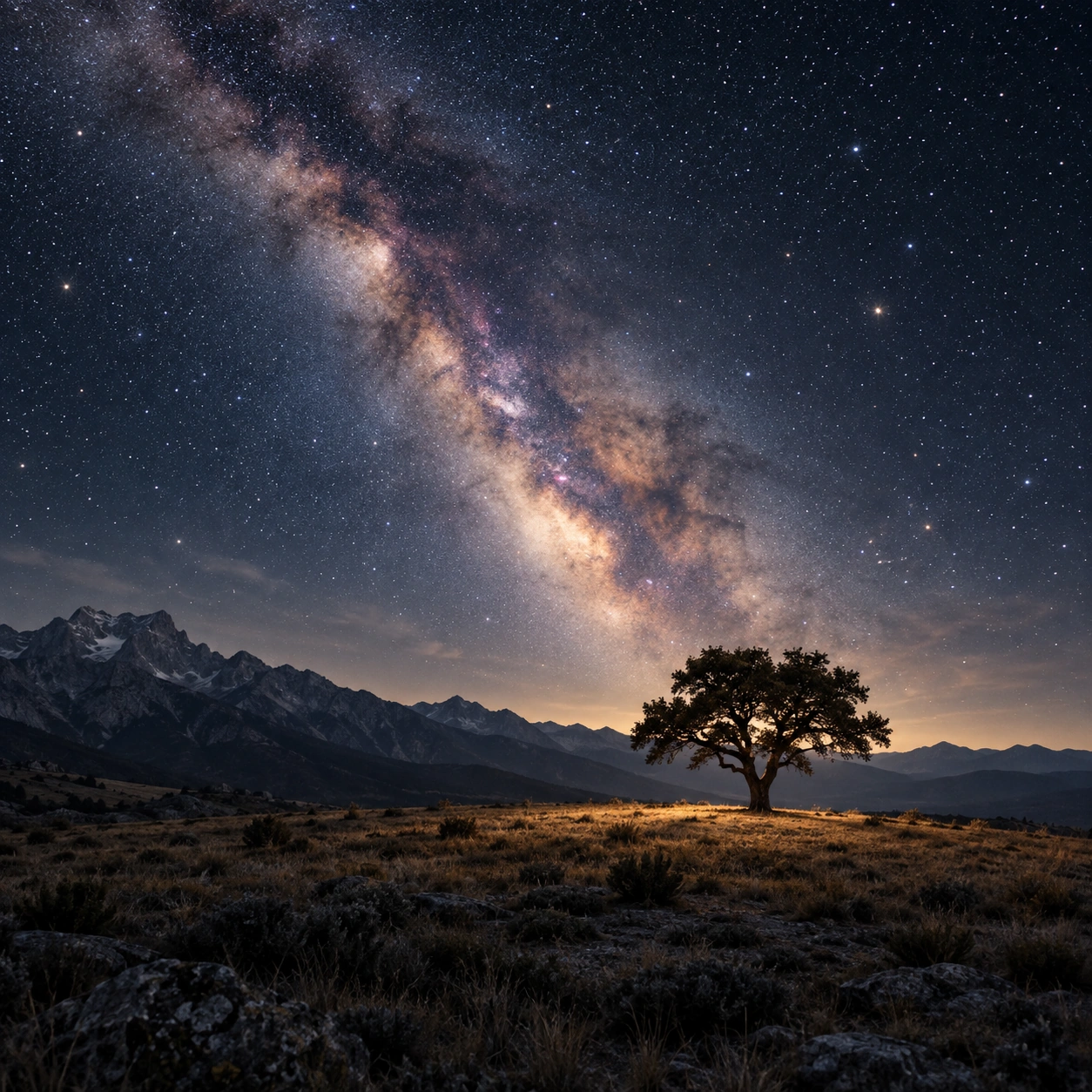 GPT Image 2.5
Reference details
- Reference ID
- 4012
- Category
- Photography
Reference prompts
Style prompt
Apply a long-exposure night-photography treatment with a very wide field, deep blue-black atmosphere, and a luminous diagonal band of fine star texture. Render bright celestial areas as layered cream, pale peach, and cool lavender clouding, preserving darker internal dust lanes and many small distinct points of light. Keep the terrestrial zone low in the frame, largely silhouetted, with one restrained pool of amber illumination to reveal grass or surface relief. Let the horizon and distant forms fade into gray-blue haze. Maintain a stable, quiet composition and believable photographic noise; avoid overly crisp artificial sparkles or uniform brightness. The visual rhythm comes from the contrast between dense cosmic detail and simple, dark foreground shapes.Full example prompt
A square night landscape photograph places a lone broad-canopied tree just right of center on a gently rolling mountain plain. The tree is small enough to leave the sky dominant, yet its dark trunk and irregular branches create a clear silhouette. A low, jagged mountain ridge runs across the middle distance, rising more strongly on the left and descending behind the tree. Sparse dry grass and rounded patches of bare ground occupy the foreground. A pool of warm amber light illuminates the grass around the tree and a short stretch of the plain, while the near foreground remains dark and cool. Above, the Milky Way crosses diagonally from the upper left toward the center-right horizon as a dense, softly glowing band of countless stars and cloudy dust lanes. Its brightest central portion is cream, pale peach, and faint lavender against a deep blue-black sky. Smaller stars are distributed across the rest of the sky rather than arranged as decorative sparkles. The sky fades to a lighter gray-blue near the mountains. A few wisps of atmospheric haze soften the galactic band without hiding its layered structure. The camera uses a wide field of view from a low, stable position, with the horizon slightly below center and enough depth of field to hold the tree and ridge recognizable. The image feels like a careful long-exposure astrophotograph: delicate star detail, restrained noise, natural terrestrial darkness, and a measured warm accent that links the foreground to the celestial light. No buildings, people, lettering, or artificial constellations are visible.