
Styles
#4078
Paul Klee style reference and prompts
Explore the “Paul Klee” reference with simplified forms and a monochrome palette. View the images, copy the style or example prompt, and discover related styles on Looksift.
Compare the Qwen Image 2.1 and GPT Image 2.5 examples, choose the visual qualities you want, and copy the style prompt for your own project.
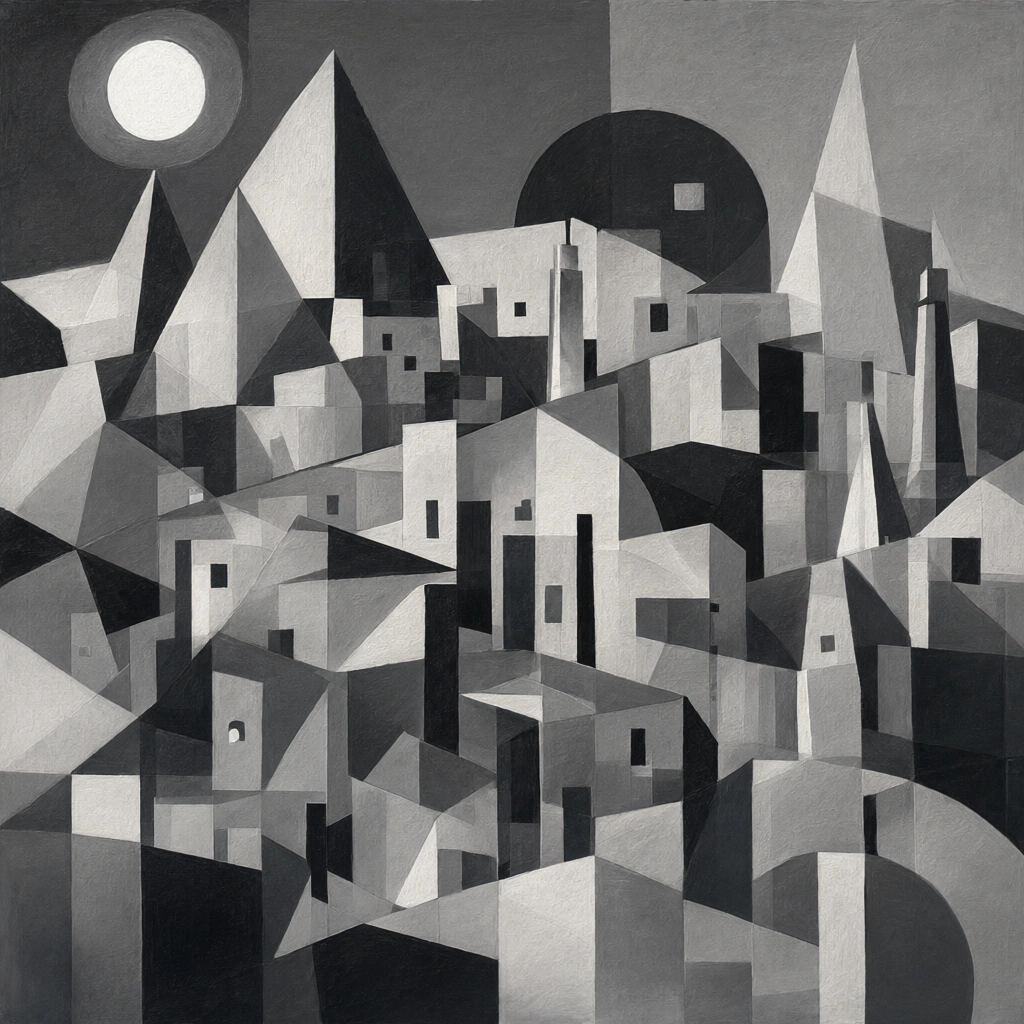 Qwen Image 2.1
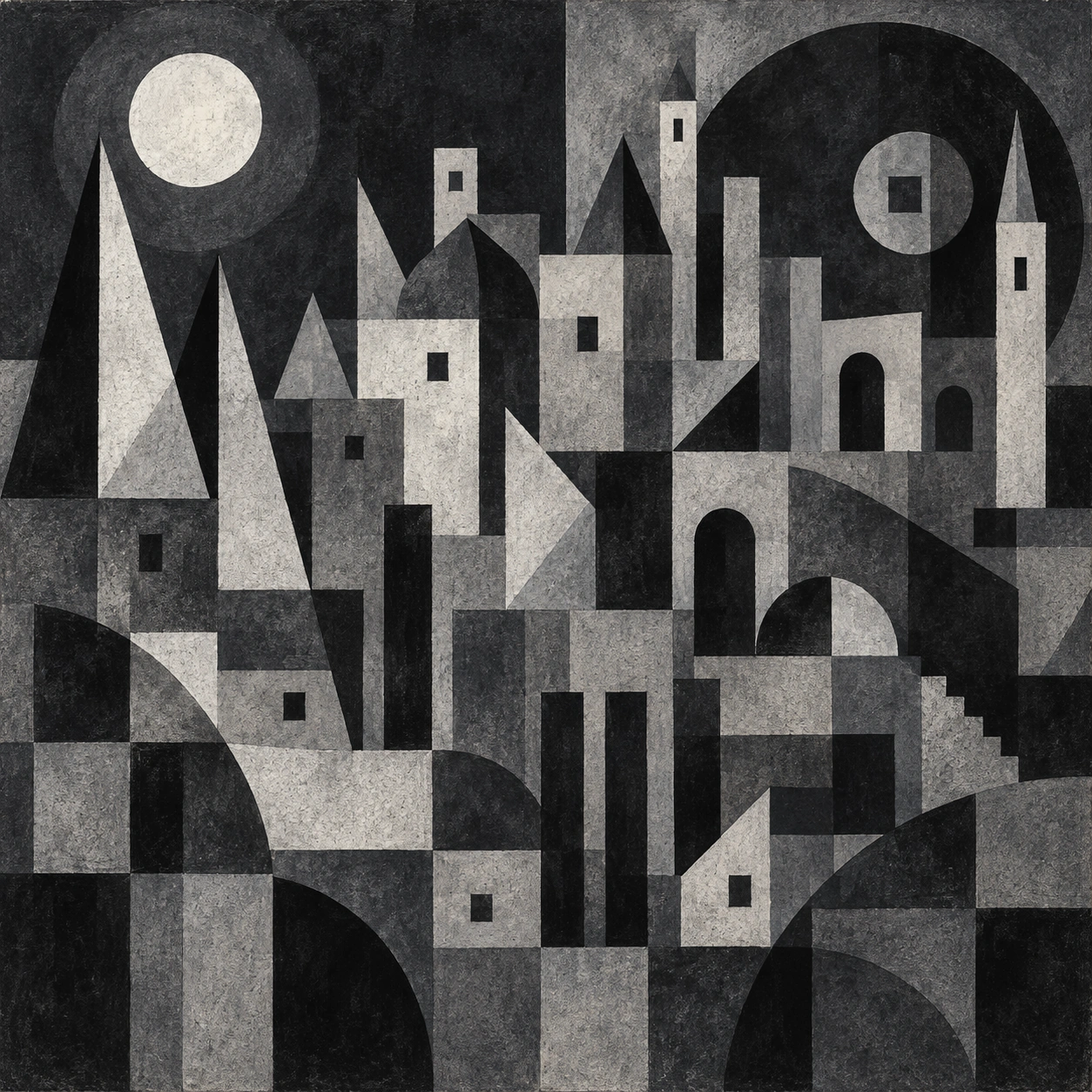 GPT Image 2.5
Reference details
- Reference ID
- 4078
- Category
- Painting
Reference prompts
Style prompt
The image has a grainy modernist painting surface made from interlocking geometric planes. Fine paper-like speckle and uneven wash soften otherwise crisp triangles, rectangles, arcs, and circles. A narrow grayscale palette ranges from luminous off-white to charcoal, with midtones placed between hard dark accents and pale open areas. Shapes overlap in shallow layers, sometimes with translucent tonal shifts that complicate front and back. Illumination is pictorial: small bright disks and pale facets create local glow, while neighboring planes turn sharply into gray or black. Dense clusters occupy the center, and larger simple forms give the eye pauses around them. Straight verticals, steep diagonals, and rounded counterforms establish a varied but measured rhythm. The overall effect is cerebral, playful, and quietly atmospheric, with abstraction retaining a suggestion of constructed depth.Full example prompt
A square monochrome modernist painting assembles a dense imaginary city from overlapping triangles, squares, arches, and narrow tower-like rectangles. At the upper left, a bright circular moon or sun floats within a darker halo against a charcoal sky. Below it, tall triangular forms rise sharply, their pale faces divided from black shadowed sides. Across the middle, block-like structures stack at uneven heights, interrupted by tiny square windows and rounded openings. Near the upper right, a broad dark circular segment encloses a smaller geometric mark, giving the layered skyline a second round counterweight. The lower half is a patchwork of curved and rectangular planes, with several dark vertical bars anchoring the busy center. Some forms resemble walls and roofs, yet they remain deliberately abstract and do not define one literal street. The palette runs from off-white through soft silver and middle gray to near black, with no accent hue. Rough paper or painted-board grain shows within nearly every polygon, softening edges that might otherwise feel mechanically exact. Rectangles overlap transparently in places, so one tonal patch can seem to sit both behind and in front of another. The image reads as flat design and shallow stage-like space at once. Pictorial light concentrates in the bright circle and pale vertical planes, while deeper dark values gather around arcs, corners, and the lower edge rather than obeying a single real-world source. There are no figures or readable words. The overall composition is compact and musical, balancing round shapes against sharp peaks and turning a limited grayscale into an intricate rhythm of value and geometry.