
Styles
#4133
Tarsila do Amaral style reference and prompts
Explore the “Tarsila do Amaral” reference with rhythmic lines and pale neutral tones. View the images, copy the style or example prompt, and discover related styles on Looksift.
Compare the Qwen Image 2.1 and GPT Image 2.5 examples, choose the visual qualities you want, and copy the style prompt for your own project.
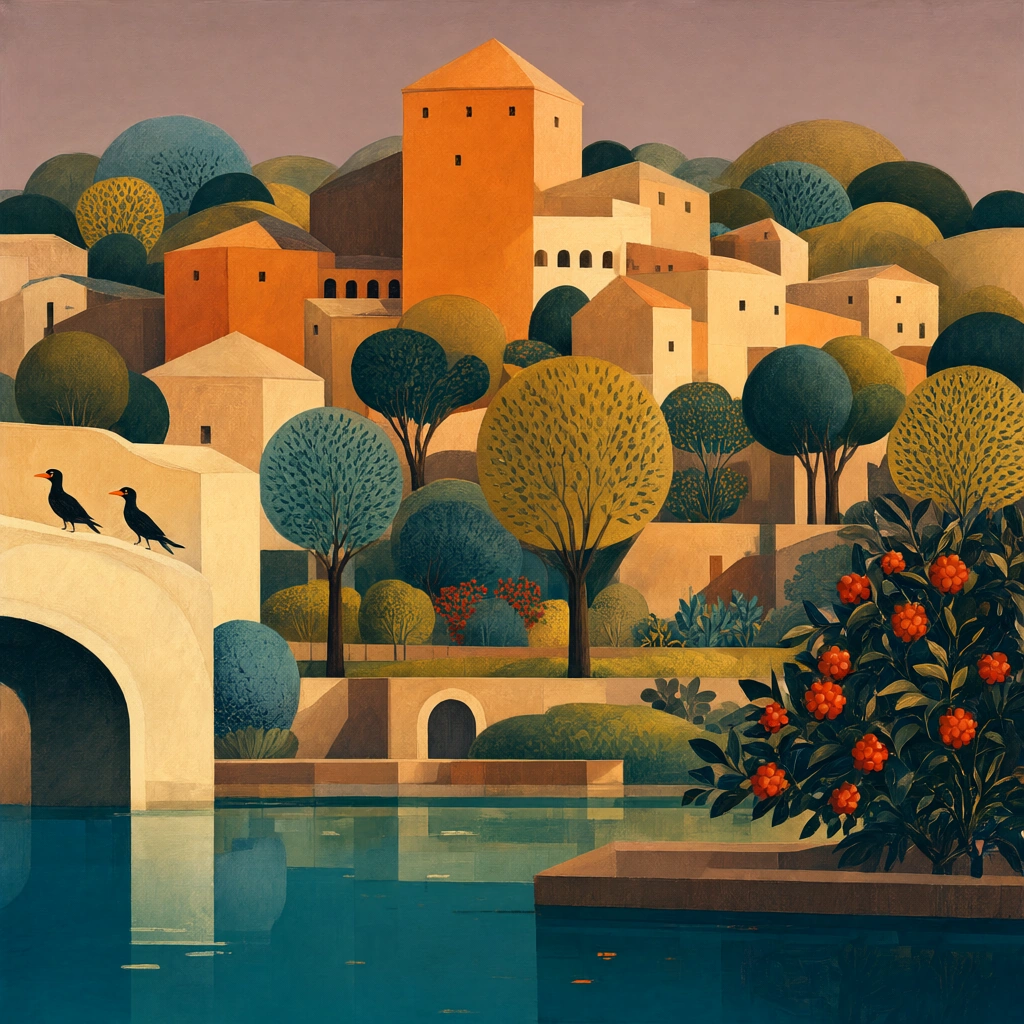 Qwen Image 2.1
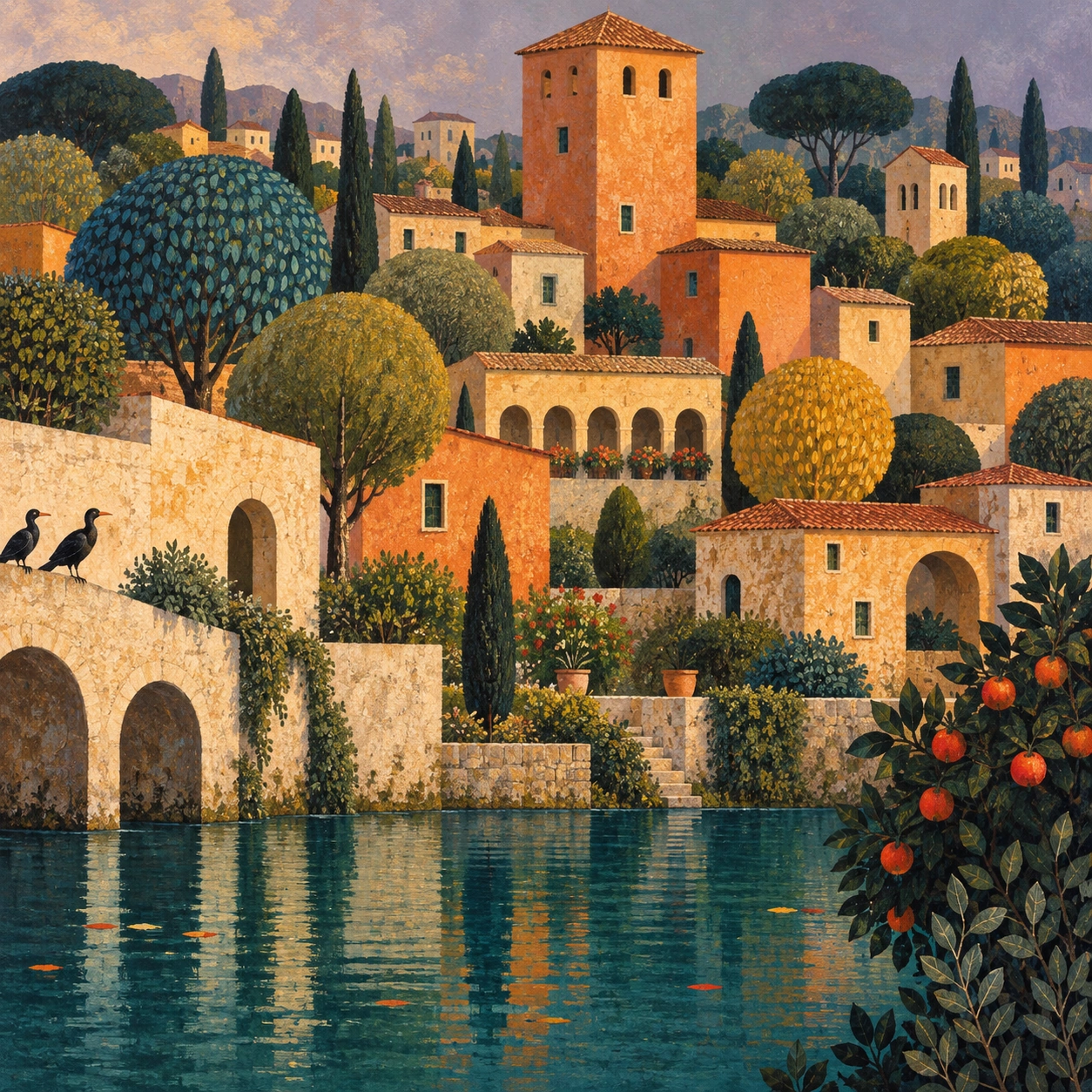 GPT Image 2.5
Reference details
- Reference ID
- 4133
- Category
- Painting
Reference prompts
Style prompt
The image has a decorative modernist painting surface that reduces complex forms to clear arcs, blocks, tapers, and rounded masses. Edges are mostly firm, while internal stipple and short repeated marks lend a velvet texture to broad matte fields. Warm terracotta, ocher, cream, teal, olive, and blue-green are arranged in neighboring areas of substantial size, with tiny red-orange accents sparingly distributed. Shallow overlapping layers create depth without strict linear perspective. Soft pictorial light raises pale and warm planes, while cool dark masses hold the lower values; shadows are tonal rather than sharply cast. Repetition of circles against upright and horizontal geometry gives the surface a steady, varied rhythm. The overall effect is abundant, poised, and quietly luminous, with small ornamental marks enriching a strongly simplified structure.Full example prompt
A square stylized painting presents a compact village of warm ocher and terracotta buildings rising beyond still turquoise water. The view is nearly frontal but layered vertically, with the dark water at the bottom, small garden terraces in the middle, and squared towers behind. At left, two black birds with orange beaks stand on a pale arched wall, their simple silhouettes sharply set against the cream masonry. The largest tower rises near the upper center, its roof a low pyramid and its small dark openings arranged sparingly on orange walls. Lower blocks and arcades gather around it, with a row of tiny arches across a middle balcony. Rounded tree crowns in blue-green, olive, dark teal, and golden yellow punctuate the built forms. Their trunks are narrow and straight, while some foliage is filled with repeated small leaf-like marks rather than smooth color. At the right foreground, a dark shrub bears clusters of glowing red-orange fruit beside patterned leaves. Below, narrow reflections and a few tiny colored marks break the still water. The background carries more overlapping hills, treetops, and low roofs beneath a muted mauve-gray sky. Shapes are simplified into arcs, rectangles, pyramids, and circles, but fine decorative grain gives each surface depth. The paint edges remain mostly clear, while the internal texture is stippled and softly blended. Pictorial light warms the pale walls and orange towers from the upper left, deepening the blue-green water and tree shadows without a sharp cast-shadow system. There is no readable text. The overall composition feels abundant yet orderly, balancing flat geometric architecture, rounded foliage, and small bright accents within a rich, quiet color pattern.