
Styles
#4231
Ernst Haeckel style reference and prompts
Explore the “Ernst Haeckel” reference with clear linework, a matte finish, and backlighting. View the images, copy the style or example prompt, and discover related styles on Looksift.
Compare the Qwen Image 2.1 and GPT Image 2.5 examples, choose the visual qualities you want, and copy the style prompt for your own project.
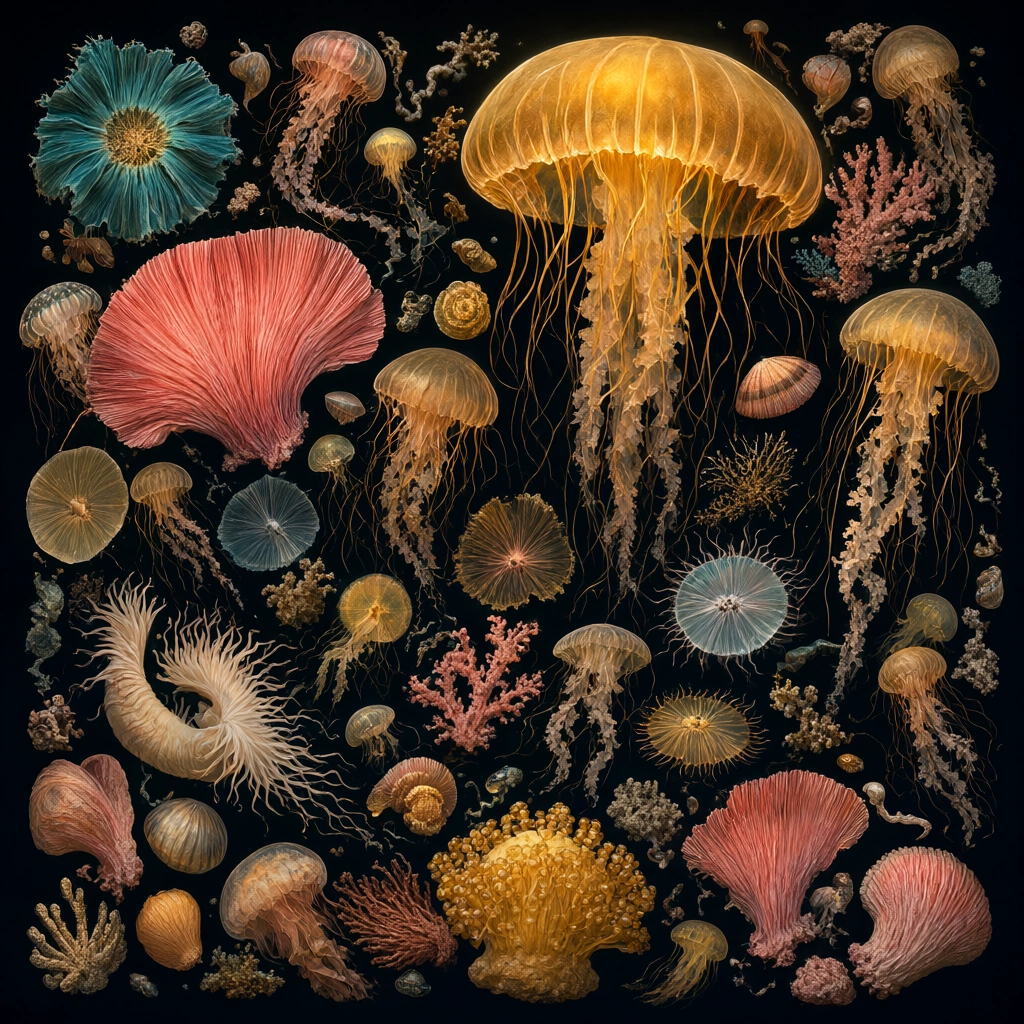 Qwen Image 2.1
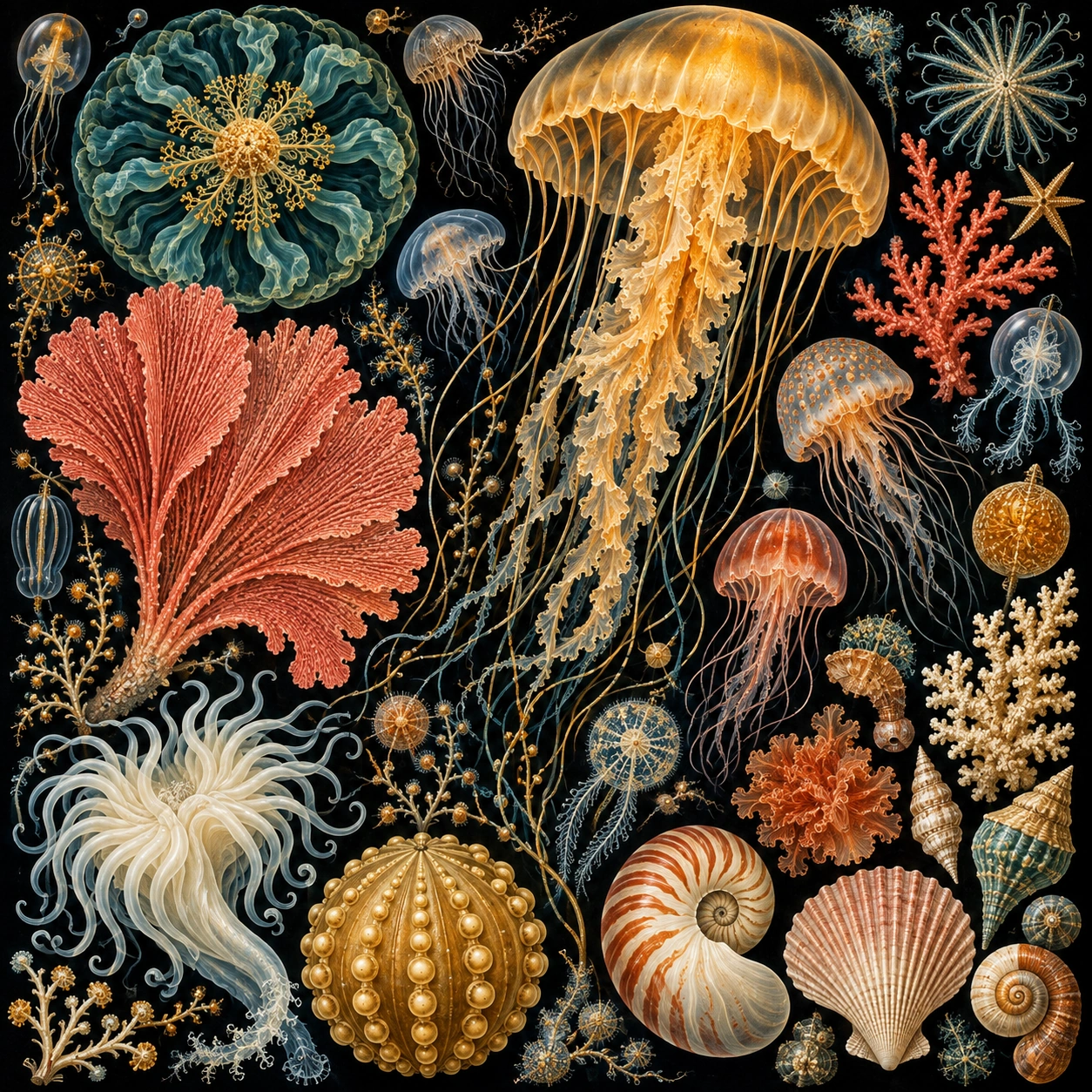 GPT Image 2.5
Reference details
- Reference ID
- 4231
- Category
- Flat illustration
Reference prompts
Style prompt
The natural-history illustration combines specimen-level precision with an ornamental, edge-to-edge arrangement. Many shapes vary in scale and radial structure, but narrow dark gaps preserve their individual contours. Warm amber, coral, gold, and rose glow against cool teal and a near-black ground. Translucent membranes, ribbed folds, granular surfaces, and hairlike filaments are differentiated through fine linework and selective shading. Backlit highlights make thin forms luminous, while opaque forms hold softer matte color. The space is shallow and suspended, organized by repeated circular centers, branching lines, and undulating edges rather than a horizon. The overall effect is encyclopedic and fantastical, turning careful anatomical detail into a dense yet readable decorative field.Full example prompt
A square natural-history-style illustration shows many jellyfish, corals, shells, and other marine forms floating against a nearly black field. The organisms fill the frame from edge to edge but remain separated by thin dark channels. Near the upper center-right, a large amber jellyfish opens like a translucent umbrella; delicate long tentacles descend into the middle of the picture. At the upper left, a blue-green circular organism with a lacy golden center spreads radial folded lobes. A broad coral-pink fan rises from the left middle, its pleated surface lined with fine warm ridges. Smaller bell-shaped jellyfish, branching coral pieces, spiral shells, and orange-gold globes cluster across the lower half. One pale curled form at lower left resembles a floating anemone, while a golden rounded structure near the bottom center bears repeated beadlike protrusions. Hair-thin tendrils and spines connect the larger specimens without turning them into a single solid mass. The forms are carefully outlined and shaded, with transparent amber membranes, matte pink fans, ridged shells, and granular coral each possessing a distinct surface. A warm yellow light seems to shine through the transparent specimens from above and behind, while cooler blue-green edges recede into the black. There is no seabed, horizon, or readable label, so the arrangement reads as a suspended specimen plate rather than a literal underwater view. Despite the density, varied sizes and small gaps keep individual silhouettes discernible. The overall composition is ornate and investigative, using warm coral and gold against cool teal and deep black to celebrate intricate natural geometry.