
Styles
#4308
Russ Mills style reference and prompts
Explore the “Russ Mills” reference with dry-brush texture, paper collage textures, and negative space. View the images, copy the style or example prompt, and discover related styles on Looksift.
Compare the Qwen Image 2.1 and GPT Image 2.5 examples, choose the visual qualities you want, and copy the style prompt for your own project.
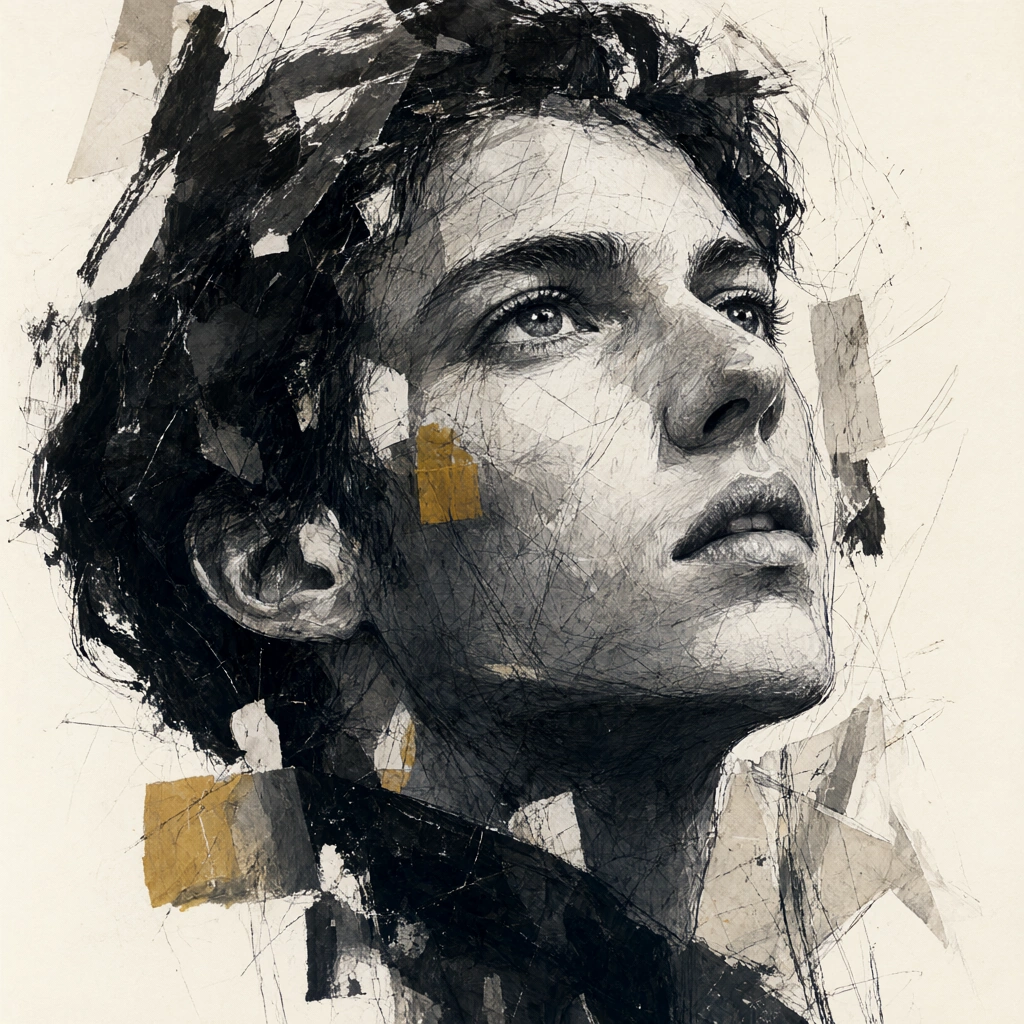 Qwen Image 2.1
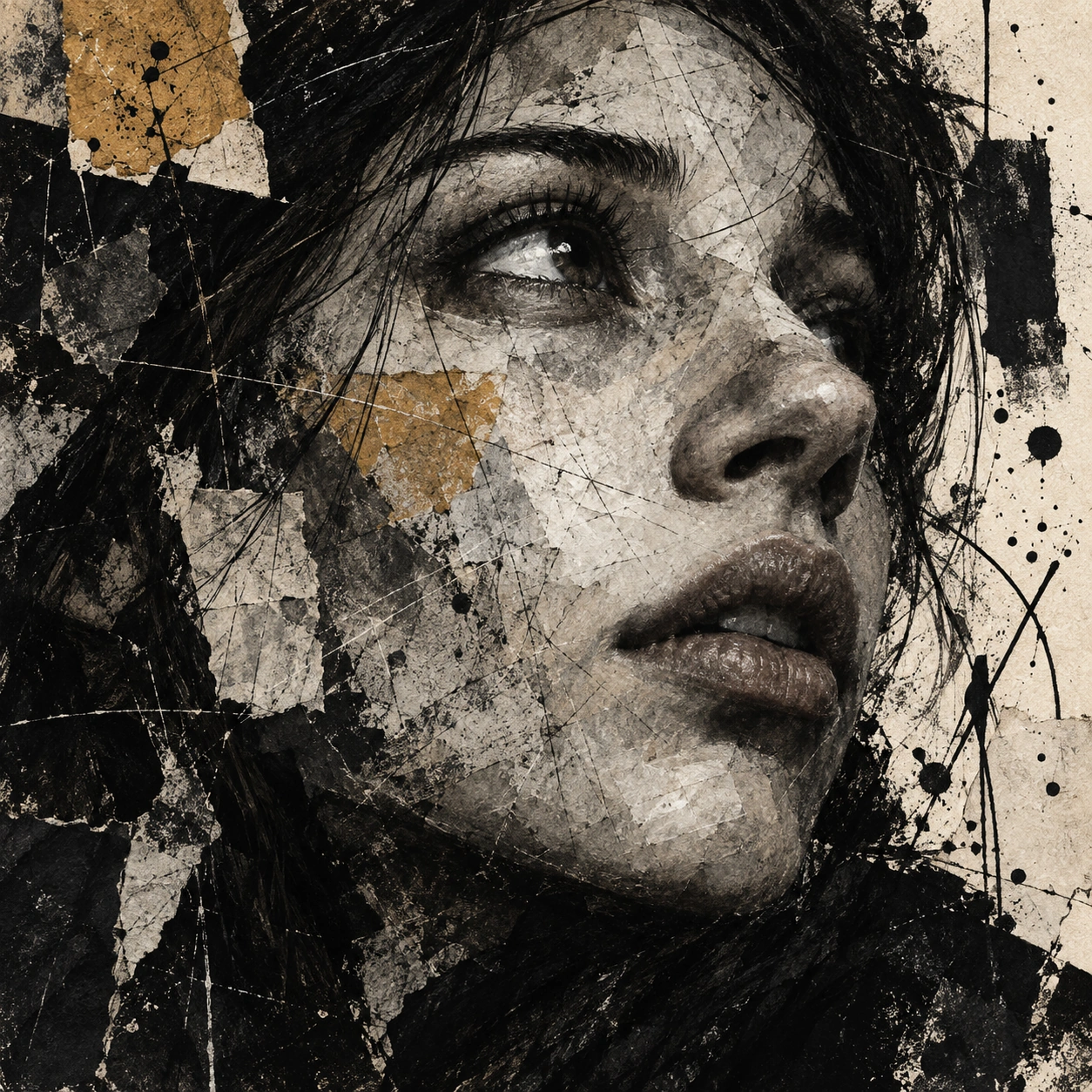 GPT Image 2.5
Reference details
- Reference ID
- 4308
- Category
- Collage & mixed media
Reference prompts
Style prompt
Combine precise grayscale tonal modeling with distressed ink, charcoal, dry-brush sweeps, paper fragments, and long scratch-like lines. Set a dense near-black mass against cream-white open space, then interrupt the boundary with torn angular pieces and translucent gray patches. Place a few muted ocher marks as warm accents within an otherwise monochrome field. Let one small area remain sharply resolved while adjacent surfaces fracture into abstraction. Crop closely and asymmetrically, allowing marks to spill past contours and into negative space. Keep the layering rough, tactile, and visibly revised. The result should feel intense and introspective, with coherence emerging from conflict between careful rendering and spontaneous graphic disruption.Full example prompt
A square mixed-media illustration shows a large face in three-quarter view, filling almost the entire frame. The gaze turns upward and toward the left, while the nose projects toward the right edge. Full lips remain slightly parted. Dark hair and shadowed clothing merge into a rough near-black mass along the top, left, and lower edges. The face itself is constructed from gray washes, angular white planes, charcoal-like shading, and many crossing scratch lines. One eye is carefully defined with a dark iris and gleam, establishing a sharp focal point amid the broken surface. Areas of warm ocher appear as small paint patches near the cheek and upper left, while most color remains black, white, and gray. Around the head, torn-paper rectangles, broad ink swipes, dry brush streaks, splatters, and spidery drawn marks interrupt the outline. A cream paper ground remains visible at the right and between fragments. Thin linear scratches cross the cheek and forehead, yet they do not erase the underlying features. The composition is dense and asymmetrical, with the face tilted and cropped so closely that conventional background space nearly disappears. Contrasting methods coexist: precise tonal rendering in the eye and nose, abrupt graphic blocks, and uncontrolled marks at the perimeter. The surface is distressed and layered rather than a smooth digital portrait. No lettering, frame, or decorative motif appears. The overall impression is intense and introspective, as if the image were repeatedly revised by ink, erasure, and collage until a coherent gaze emerged from visual noise.