
Styles
#4458
Nathan Wirth style reference and prompts
Explore the “Nathan Wirth” reference with light bloom, silhouette shapes, and a low horizon. View the images, copy the style or example prompt, and discover related styles on Looksift.
Compare the Qwen Image 2.1 and GPT Image 2.5 examples, choose the visual qualities you want, and copy the style prompt for your own project.
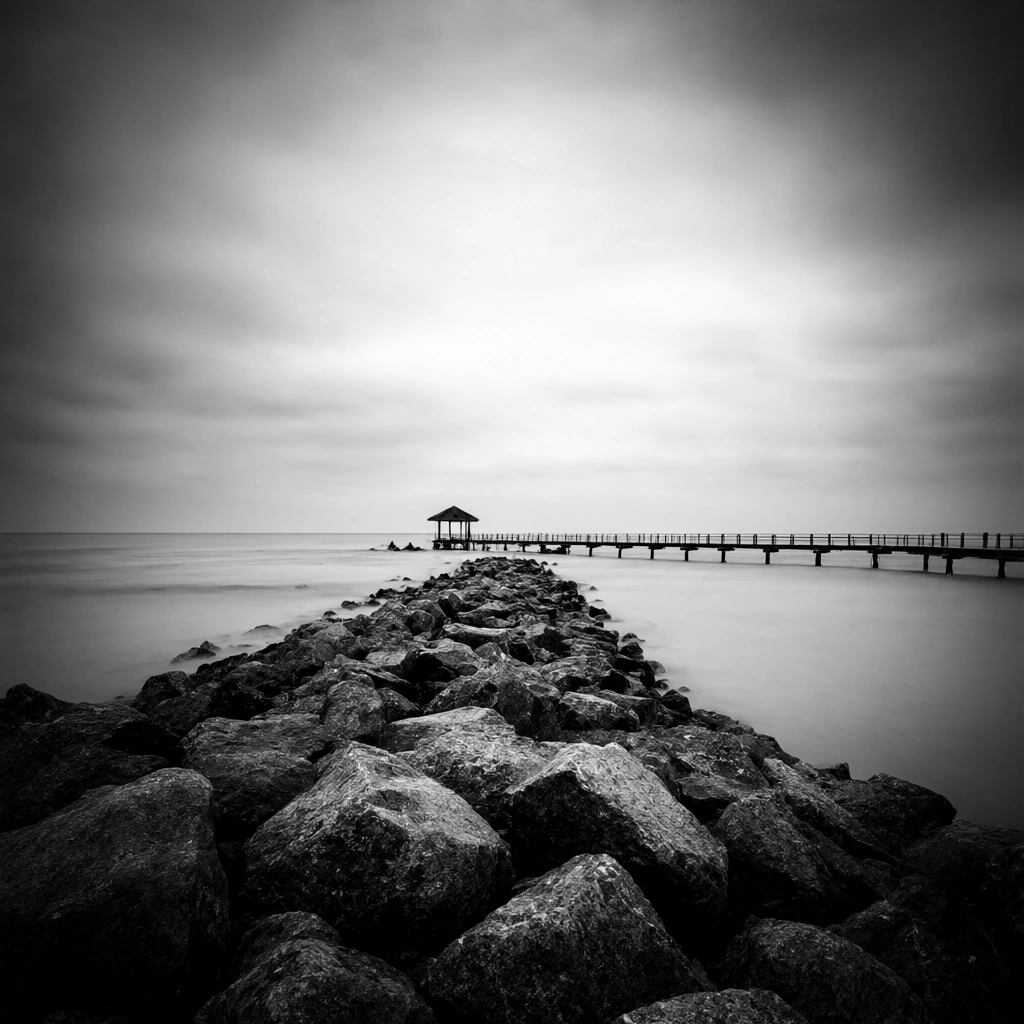 Qwen Image 2.1
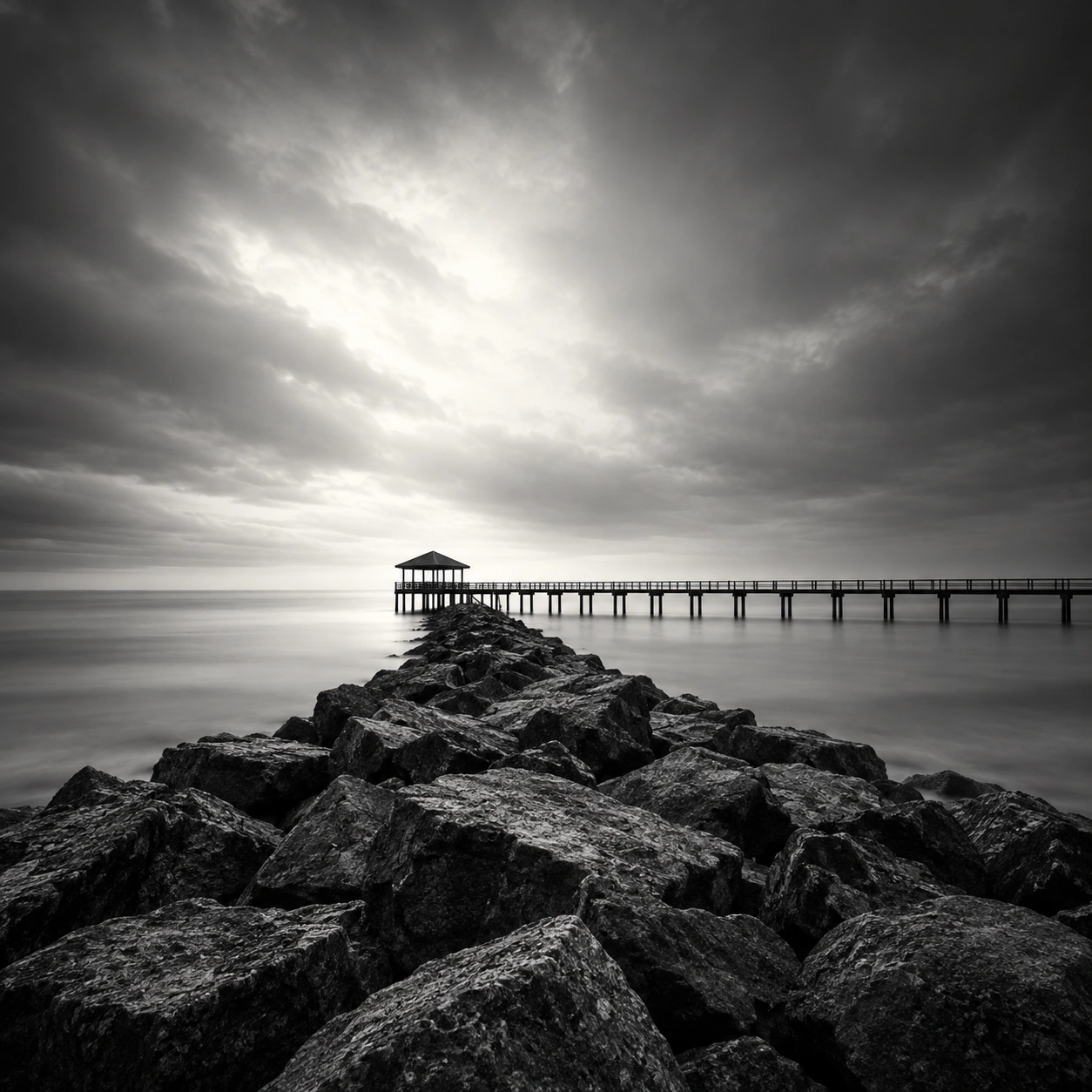 GPT Image 2.5
Reference details
- Reference ID
- 4458
- Category
- Photography
Reference prompts
Style prompt
Minimal black-and-white long-exposure photography with rough dark foreground texture, a thin crisp horizontal structure, and vast silver-gray atmospheric gradients. Smooth water dissolves wave motion while cloud light blooms softly around a low horizon. A restrained vignette and strong silhouette hierarchy hold the composition. Fine stone detail contrasts with the almost featureless luminous field.Full example prompt
A square black-and-white long-exposure photograph looks along a jagged rock breakwater toward a narrow pier extending far out over calm water. Large dark angular rocks fill the lower foreground and lead the eye from center toward a small roofed pavilion near the left of the horizon. From that pavilion, the pier continues horizontally to the right edge, its slim railings repeating in an orderly line. The sea is rendered nearly smooth by long exposure, with faint gray bands but no distinct waves. Above, an enormous luminous area opens in the heavy cloud cover, fading toward darker charcoal corners. The horizon sits low, giving the sky more than half the image. The pavilion and pier remain crisp black silhouettes against the brighter water and horizon haze. A slight vignette deepens the upper corners and the rocks, while the center glows silver. No people or readable signs are visible. The camera's viewpoint is low enough that the boulders feel massive and rough, yet distant enough to show the pier's complete length. The picture feels still, austere, and meditative; detailed stone texture anchors the foreground while water and cloud melt into soft tonal gradients.