
Styles
#0072
Elise Palmigiani style reference and prompts
Explore the “Elise Palmigiani” reference with tonal contrast, soft edges, and warm highlights. View the images, copy the style or example prompt, and discover related styles on Looksift.
Compare the Qwen Image 2.1 and GPT Image 2.5 examples, choose the visual qualities you want, and copy the style prompt for your own project.
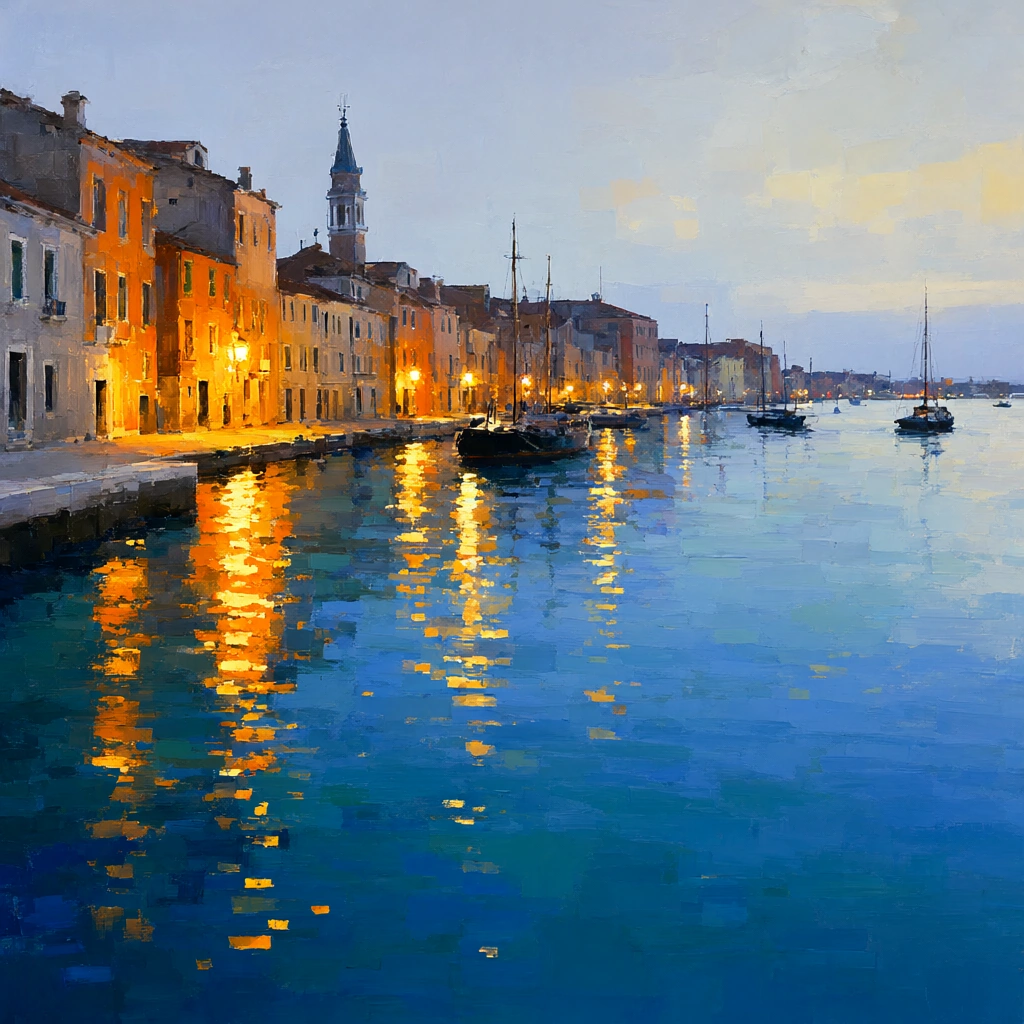 Qwen Image 2.1
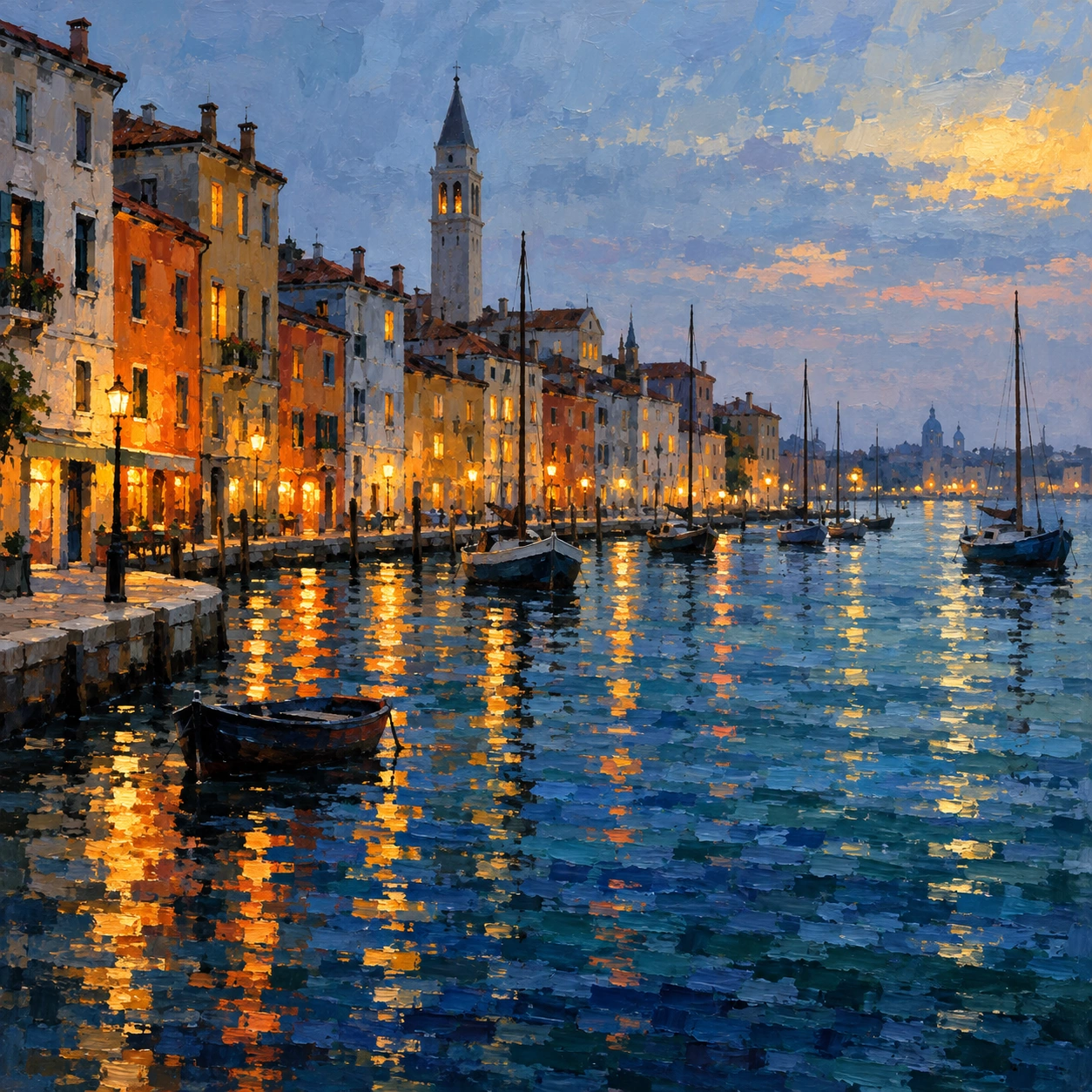 GPT Image 2.5
Reference details
- Reference ID
- 0072
- Category
- Painting
Reference prompts
Style prompt
The painterly treatment uses broken rectangular strokes, softened edges and a strong contrast between warm highlights and cool fields. Orange and yellow accents sit against blue, teal and slate tones, often repeated as short reflective marks or small luminous blocks. Vertical marks provide rhythm within broad horizontal bands, while forms remain recognizable without crisp outlining. Light diffuses through pale atmosphere, and textured marks gather near the lower edge. The overall style feels luminous and impressionistic, balancing structured geometry with loose, fragmented colour.Full example prompt
The square image is a painterly waterside city at dusk, with warm-lit buildings lining a blue-green canal. The water occupies the lower half, broken into broad horizontal strokes of cobalt, teal and deep navy. Orange and yellow reflections stretch downward from the shore lights, fragmenting into short vertical marks and rippling bands. Several small boats sit across the water, some dark and low in the foreground, others near the opposite bank; thin masts rise from a few vessels and intersect the skyline. Along the left shore, tall façades in pale grey, muted ochre and vivid orange form an irregular row. Their windows glow warmly, and their edges soften into the evening haze. A narrow quay projects from the lower-left corner, its pale top plane bordered by a dark edge above the water. Farther back, slightly left of centre, a slender bell tower rises above the rooftops, its pointed cap silhouetted against a washed blue sky. Smaller roofs and vertical poles continue toward the right, where the canal opens into a broader distance. The sky is mostly pale blue-grey with faint cloud bands and a subtle yellow area near the upper right. Loose square-edged brush marks break the buildings and reflections into painterly blocks, while the overall shoreline remains legible. The warmest light sits in a few windows and on the water directly below them, balancing the cool blue field. Shadows gather along the lower corners and under the quay, but no hard black outline encloses the scene. The image contains no readable signage; tiny façade marks remain indistinct. The brightest reflections gather beneath the orange-lit façades and break into small blocks as they approach the foreground. Dark blue patches between them preserve the depth of the water and keep the reflected light from reading as a continuous stripe. The boats are modest in scale and spaced unevenly, with several hulls close to the centre and smaller shapes farther away. Their masts appear as fine upright lines against the pale sky. The bell tower remains the tallest vertical form, while the waterfront roofs step down gradually toward the right side. The waterline stays low enough for the façades and pale sky to remain clearly separated. The tower cap is dark and narrow, distinct against the hazy sky. The overall composition layers a bright left bank, a receding central tower and a broad reflective canal, using vertical masts and horizontal water bands to create a calm, luminous urban evening.