
Styles
#0098
Alice Kettle style reference and prompts
Explore the “Alice Kettle” reference with paper collage textures, angular planes, and asymmetric composition. View the images, copy the style or example prompt, and discover related styles on Looksift.
Compare the Qwen Image 2.1 and GPT Image 2.5 examples, choose the visual qualities you want, and copy the style prompt for your own project.
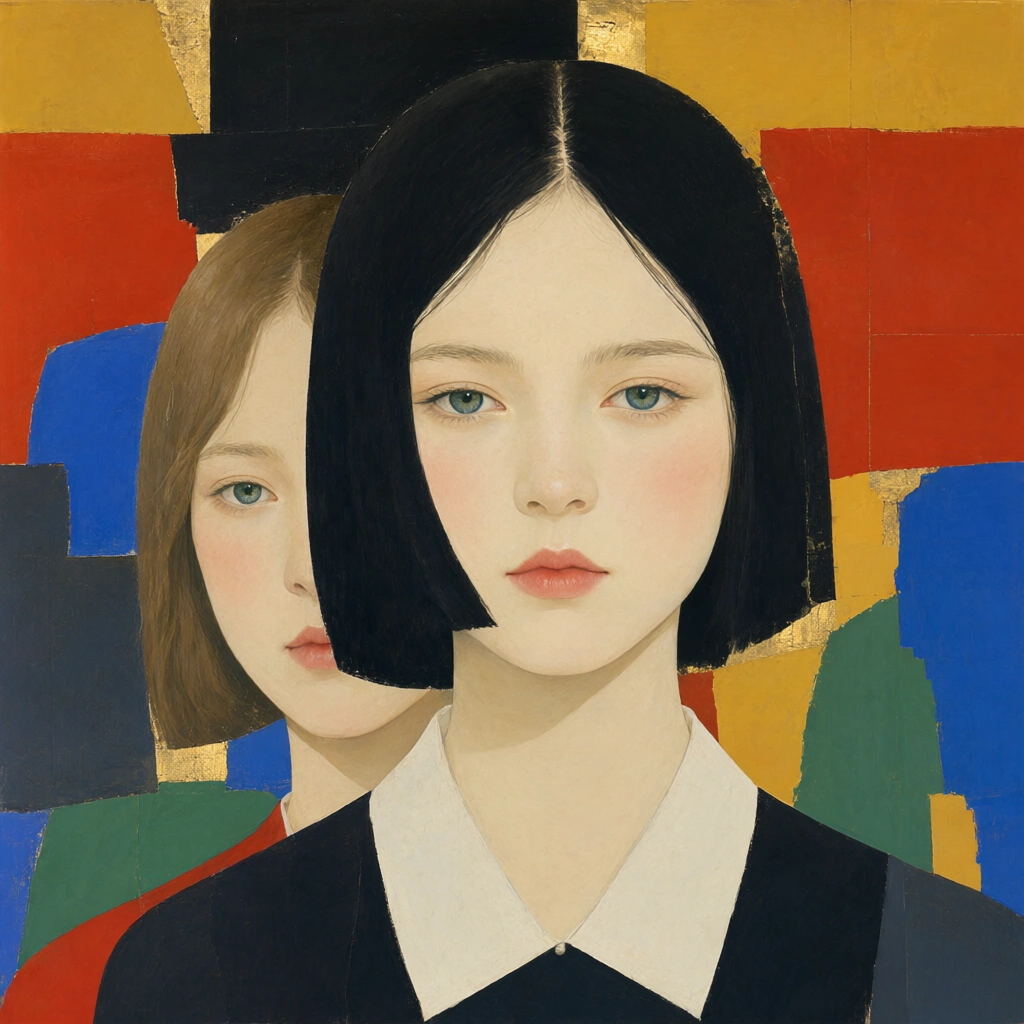 Qwen Image 2.1
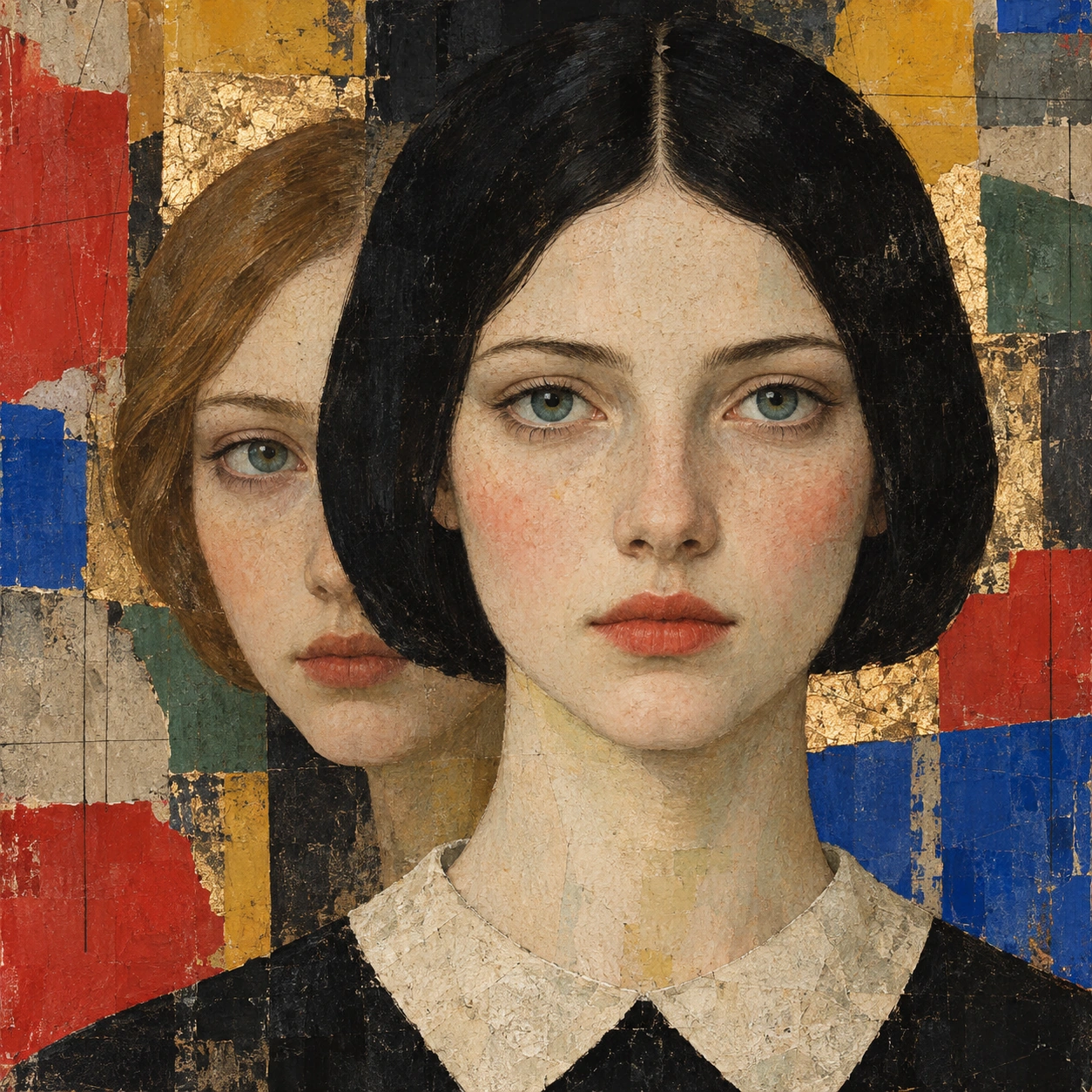 GPT Image 2.5
Reference details
- Reference ID
- 0098
- Category
- Collage & mixed media
Reference prompts
Style prompt
The style assembles forms from angular planes, irregular colour blocks, and lightly abraded surface marks, with broken metallic-gold accents. Edges shift between crisp geometry and scuffed, hand-worked transitions, while fine linear seams add a cut-paper quality. Saturated red, blue, ochre, and charcoal sit beside pale neutral fields, creating contrast through both hue and value. Light stays frontal and even, so broad shapes remain legible without dramatic modelling. The composition layers larger masses behind smaller, sharper accents and uses asymmetrical blocks to make a dense but orderly visual field.Full example prompt
The image is a square collage-like portrait of two young women’s faces layered against irregular blocks of colour. The larger woman occupies the centre and right side, facing forward with a pale oval face, short blunt black hair, blue-green eyes, lightly flushed cheeks, and small coral-red lips. Her hair forms a broad dark cap from the top edge down to her jaw, with a centre part exposing the forehead and rounded sides. Behind her on the left, a second woman’s face is partly hidden; only one blue-green eye, part of her nose and mouth, and a sweep of light brown hair remain visible. The two faces overlap closely, creating a shallow front-to-back arrangement rather than a single figure. Their expressions are neutral and still, with direct gazes and simplified, carefully placed features. The foreground face is larger and sharper, while the rear face slips partly behind the black hair and left cheek. Their brows are fine and level, and the pale skin is lightly stippled with muted peach and yellow-green tones. The bottom crop cuts across the foreground figure's shoulders, keeping attention on the layered faces rather than clothing or gesture. The central face has a softly rounded jaw and a narrow pale neck, while the rear face is partly concealed by the foreground head. The colour patches continue behind both heads and around their lower edges, making the figures appear embedded in the same assembled surface. A long pale neck descends from the foreground face into a pale pointed collar above a dark cropped garment at the bottom edge; the rest of the body is outside the frame. Around them, the background is assembled from uneven rectangles and rough-edged patches in ochre, mustard yellow, brick red, cobalt blue, charcoal, and muted green, with broken gold-toned reflective patches around the heads. A dark vertical area behind the black hair anchors the upper centre, while brighter red and blue shapes show at the left and lower edges. Fine linear marks and faint grid-like seams cross several coloured areas, giving the surface a cut-and-layered appearance. Some patches appear translucent or scuffed, and their edges do not form a regular grid. Flat, frontal light keeps the faces pale and readable, with gentle shadow beneath the fringe, nose, and chin. The eyes and lips provide the sharpest small accents against the broad geometric fields. The overall composition brings one dominant face forward and lets a second partial face emerge behind it, balancing quiet expressions with a fractured, saturated background.