
Styles
#0126
Chien Chung-Wei style reference and prompts
Explore the “Chien Chung-Wei” reference with dry-brush texture, paper texture, and soft overcast light. View the images, copy the style or example prompt, and discover related styles on Looksift.
Compare the Qwen Image 2.1 and GPT Image 2.5 examples, choose the visual qualities you want, and copy the style prompt for your own project.
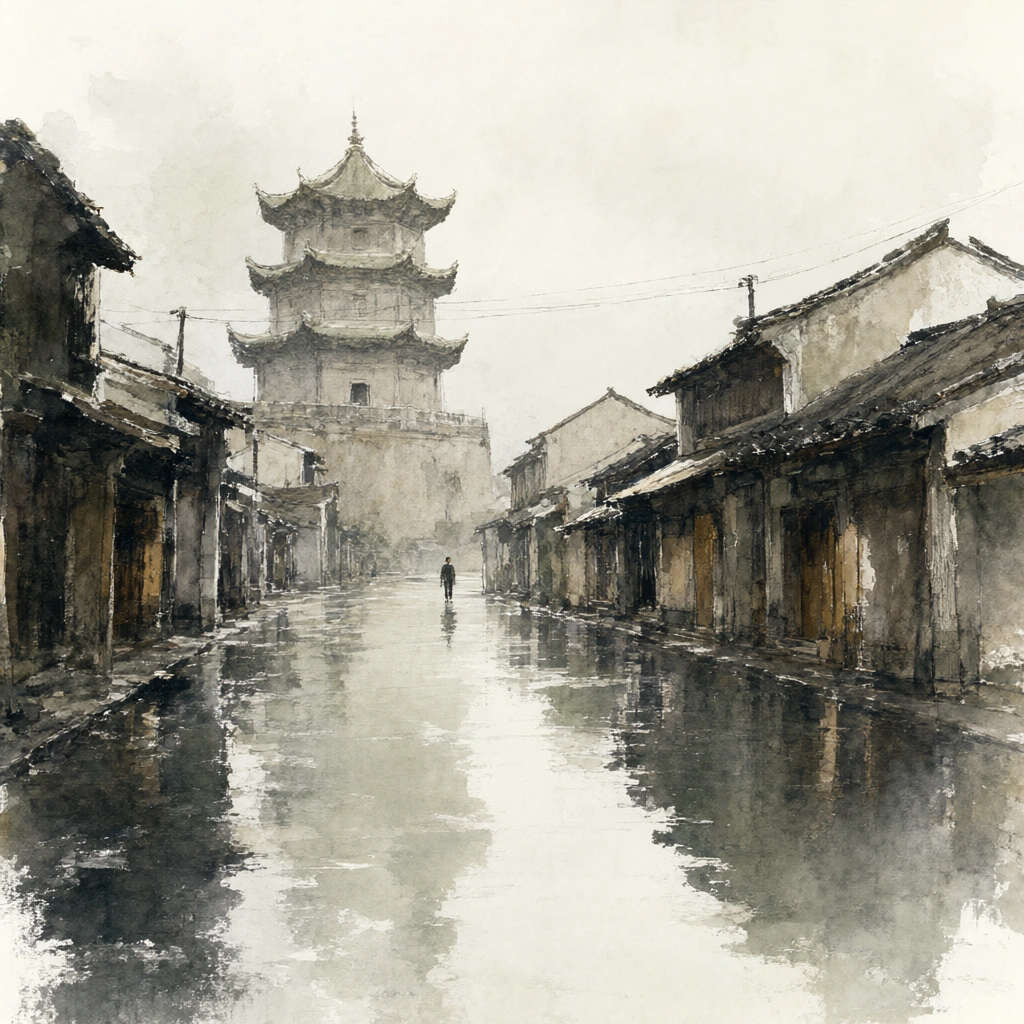 Qwen Image 2.1
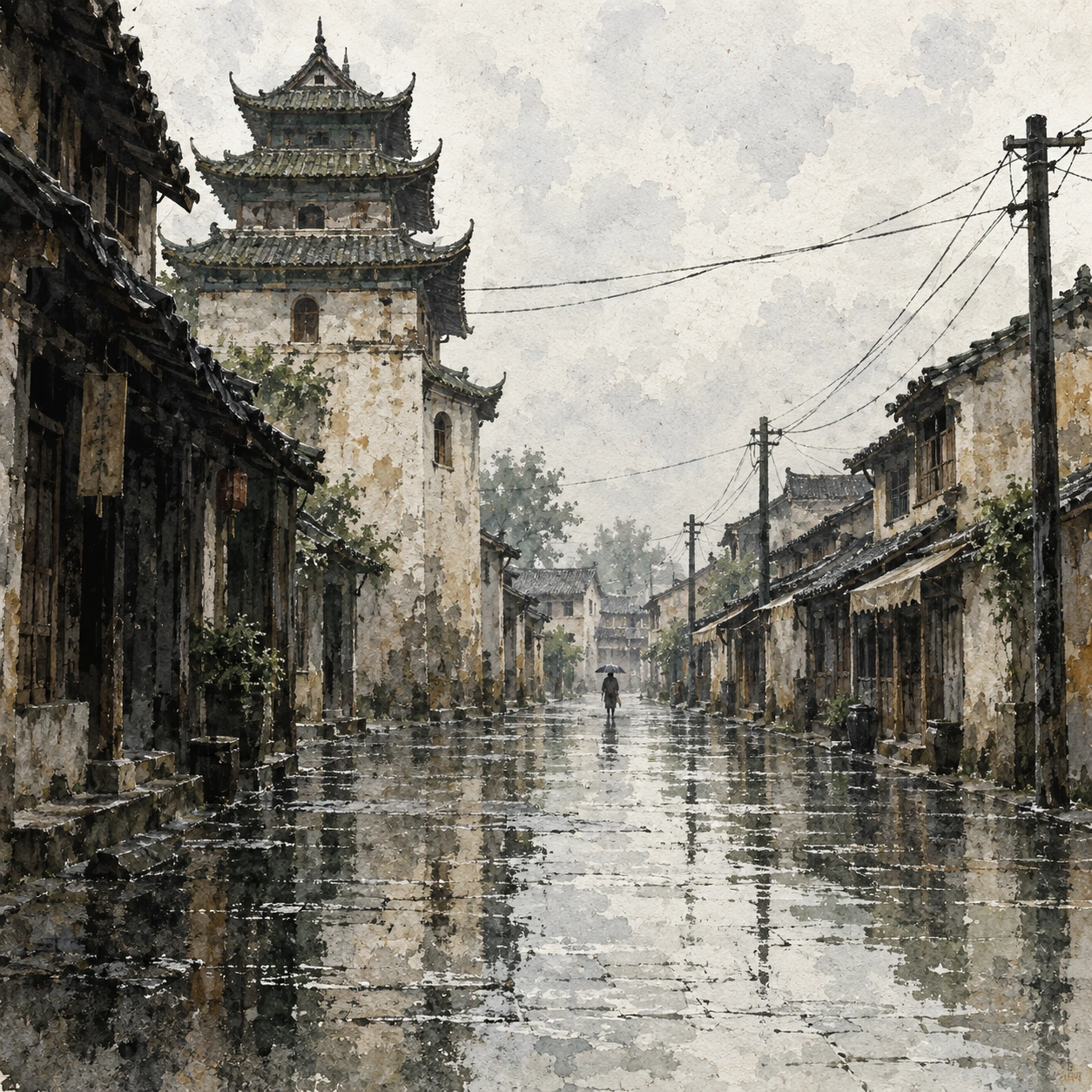 GPT Image 2.5
Reference details
- Reference ID
- 0126
- Category
- Painting
Reference prompts
Style prompt
The watercolour language combines pale washes, broken dry-brush marks and fine ink-like structural lines. Olive-grey, diluted umber and warm paper-white dominate, with small ochre accents embedded in the darker passages. Edges alternate between crisp linear fragments and forms that dissolve into damp pigment, creating atmosphere without losing spatial direction. Diffuse overcast light and broken reflections link upper and lower value fields. Large pale areas provide breathing room around dense, irregular dark clusters, and visible paper grain remains part of the image. The overall effect is restrained and weathered, with depth carried by diminishing contrast and fluid, uneven boundaries.Full example prompt
The image is a square atmospheric watercolour of a rain-darkened old street beside a traditional multi-eaved tower, in olive-grey and warm ivory. The background is a pale, overcast sky with faint washes and scattered paper texture, opening above a narrow street that recedes toward the centre. Across the top, thin utility wires cross between dark poles, their irregular lines contrasting with the soft, nearly empty sky. On the left of centre, a tall multi-eaved tower rises above the street, with pale masonry below several stacked roofs whose corners lift into fine curved points. The roof tiles are suggested by dry dark strokes and softened green-grey washes, while the wall beneath carries diluted brown stains and small shadowed openings. At the far left edge, a closer building forms a dark vertical boundary, its projecting eaves and indistinct shop fronts overlapping the tower's base. On the right, a row of lower buildings steps into the distance, with slanted roofs, rough walls and narrow awnings represented by broken charcoal-brown marks. Beneath these eaves, deep shadow gathers in irregular bands, allowing occasional ochre edges and pale wall fragments to emerge. Near the centre of the street, a tiny upright pedestrian appears in the distance, with clothing reduced to restrained dark strokes rather than an individually described face. This small scale makes the surrounding architecture feel spacious without turning the view monumental. Along the lower half, the wet road becomes a broad reflective plane, its pale grey-green surface interrupted by dark vertical smears from the buildings and tower. Thin horizontal touches break these reflections into shallow ripples and uneven patches, suggesting water on worn paving rather than a smooth mirror. The lower-left corner holds darker pools and loose granular pigment, while the lower-right remains lighter and more open. The street's edges converge gradually toward the distant pedestrian, directing the eye between the left tower and right-hand roofs. Soft overcast daylight illuminates the upper masonry and sky-facing surfaces, with no hard sunbeam or sharply cut shadow. The diffuse light spreads across the wet ground, making it almost as luminous as the sky while preserving the dark architecture above it. Dry-brush edges, delicate ink-like lines and pooled pigment coexist, with some forms dissolving where water and atmosphere soften their boundaries. The overall composition balances an upright architectural landmark against a low receding street, using muted colour, wet reflections and generous pale space to create a quiet, damp and patiently observed urban mood.