
Styles
#0240
Asymmetrical composition style reference and prompts
Explore the “Asymmetrical composition” reference with exposed paper, asymmetric composition, and pale neutral tones. View the images, copy the style or example prompt, and discover related styles on Looksift.
Compare the Qwen Image 2.1 and GPT Image 2.5 examples, choose the visual qualities you want, and copy the style prompt for your own project.
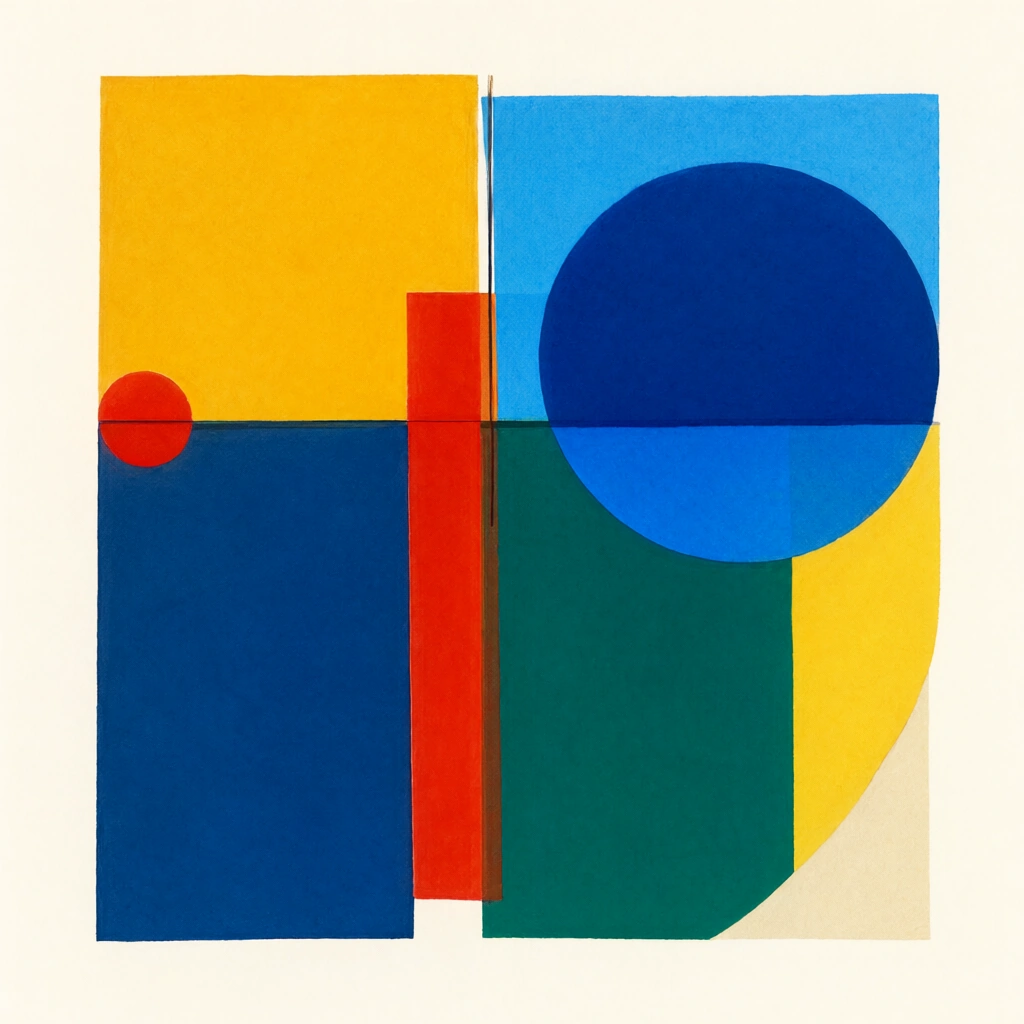 Qwen Image 2.1
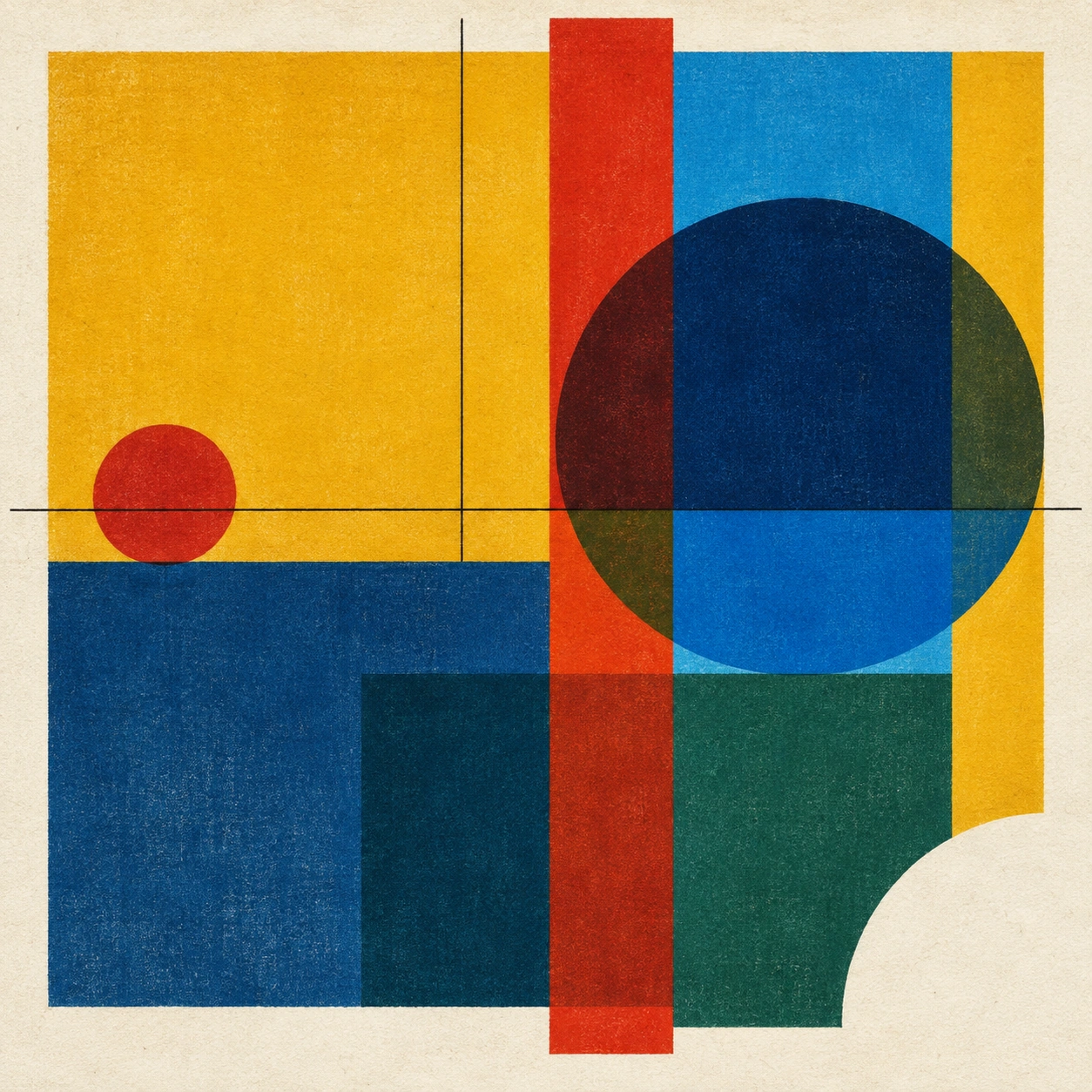 GPT Image 2.5
Reference details
- Reference ID
- 0240
- Category
- Flat illustration
Reference prompts
Style prompt
A tactile geometric print assembles broad flat rectangles and unequal circles in an offset, asymmetrical cluster on warm ivory paper. Mustard yellow and vermilion provide warm thrusts against cyan, marine blue, navy, and dark teal, with exposed paper left visible as an active border. Several planes are opaque, while others overlap transparently to form secondary green, orange, and blue intersections. Thin black rules cross the solid masses horizontally and vertically, creating a precise linear counter-rhythm to the large areas. Fine paper tooth and subtle ink mottling remain visible within each color field, and edges are mostly crisp with slight print-like softness. A larger dark circular mass on one side balances a smaller warm circle on the opposite side; tall and low rectangles stagger rather than align into a centered grid. The lighting is neutral and flat, so color area, overlap, edge, and scale carry all of the depth. The overall image feels measured and lively, turning unequal weights into stable visual tension.Full example prompt
A square abstract geometric print sits on a warm off-white paper ground, with a compact arrangement of overlapping colored planes placed slightly off center. The composition is decisively asymmetrical: a tall mustard-yellow block fills much of the upper left, while a bright cyan-blue block answers it at the upper right. Across the lower half, a darker marine-blue rectangle enters from the left, and a deep teal-green rectangle spreads toward the right, leaving small irregular margins of bare paper around the arrangement. A long narrow vermilion rectangle descends just right of center, crossing several color boundaries and acting as the strongest vertical accent. On the left, a small red circle rests along the top edge of the dark blue plane. On the right, a much larger navy circle overlaps the cyan field, the red strip, and a warm yellow side band. Its lower half becomes brighter blue where a translucent horizontal layer cuts through it. A very thin dark rule passes horizontally across the middle and a hairline vertical rule stands near the upper center, adding delicate measured tension to the solid blocks. At the lower right, a quarter-circle of unprinted paper cuts into the yellow edge. The color fields are opaque in some places and visibly translucent where they overlap, creating green, orange, and deep blue intersections. Fine paper grain and slightly uneven ink density keep the forms tactile rather than digitally pristine. Light is flat and even, with no cast shadows; contrast comes from the collision of warm saturated planes, cool blue weight, and exposed ivory. The whole image feels carefully balanced without symmetry, its large right circle and central red bar held against the smaller left circle and staggered rectangles.