
Styles
#0612
J. E. H. MacDonald style reference and prompts
Explore the “J. E. H. MacDonald” reference with visible brushwork and pale neutral tones. View the images, copy the style or example prompt, and discover related styles on Looksift.
Compare the Qwen Image 2.1 and GPT Image 2.5 examples, choose the visual qualities you want, and copy the style prompt for your own project.
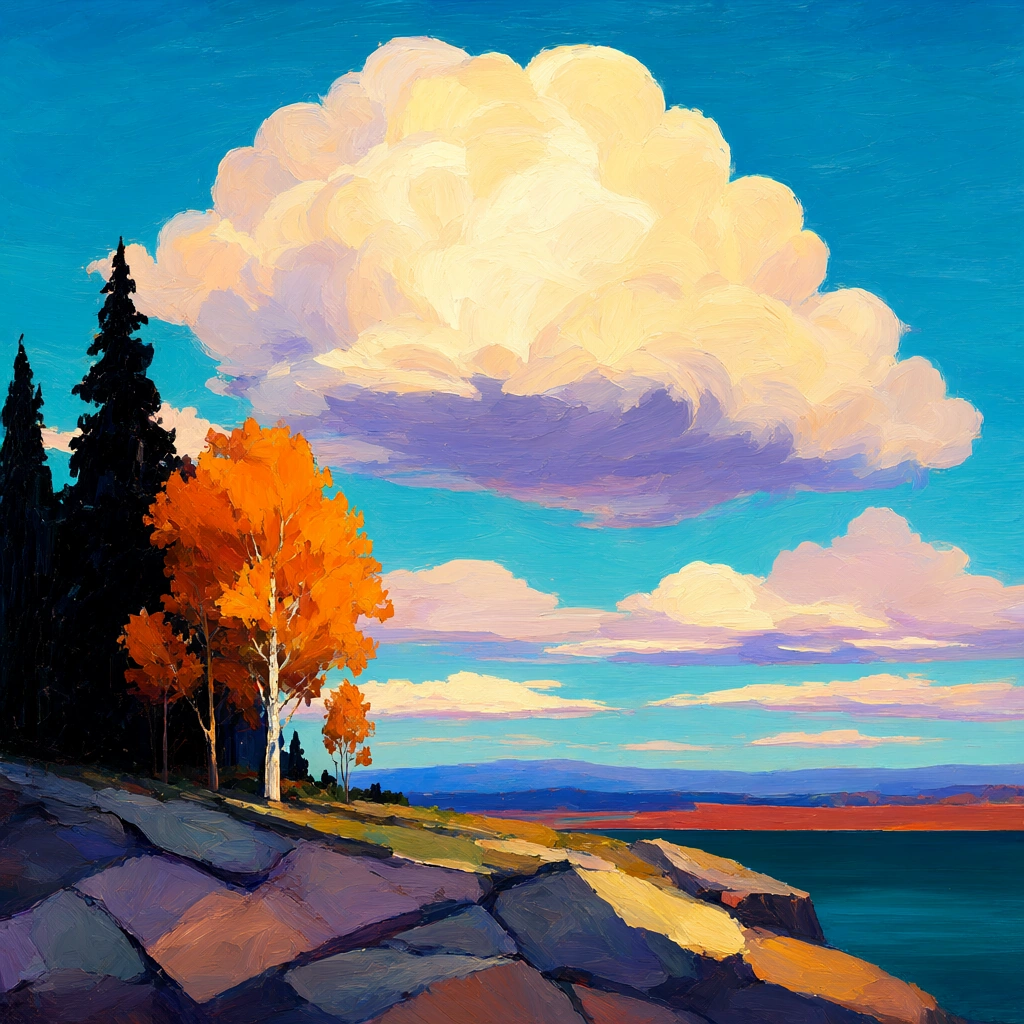 Qwen Image 2.1
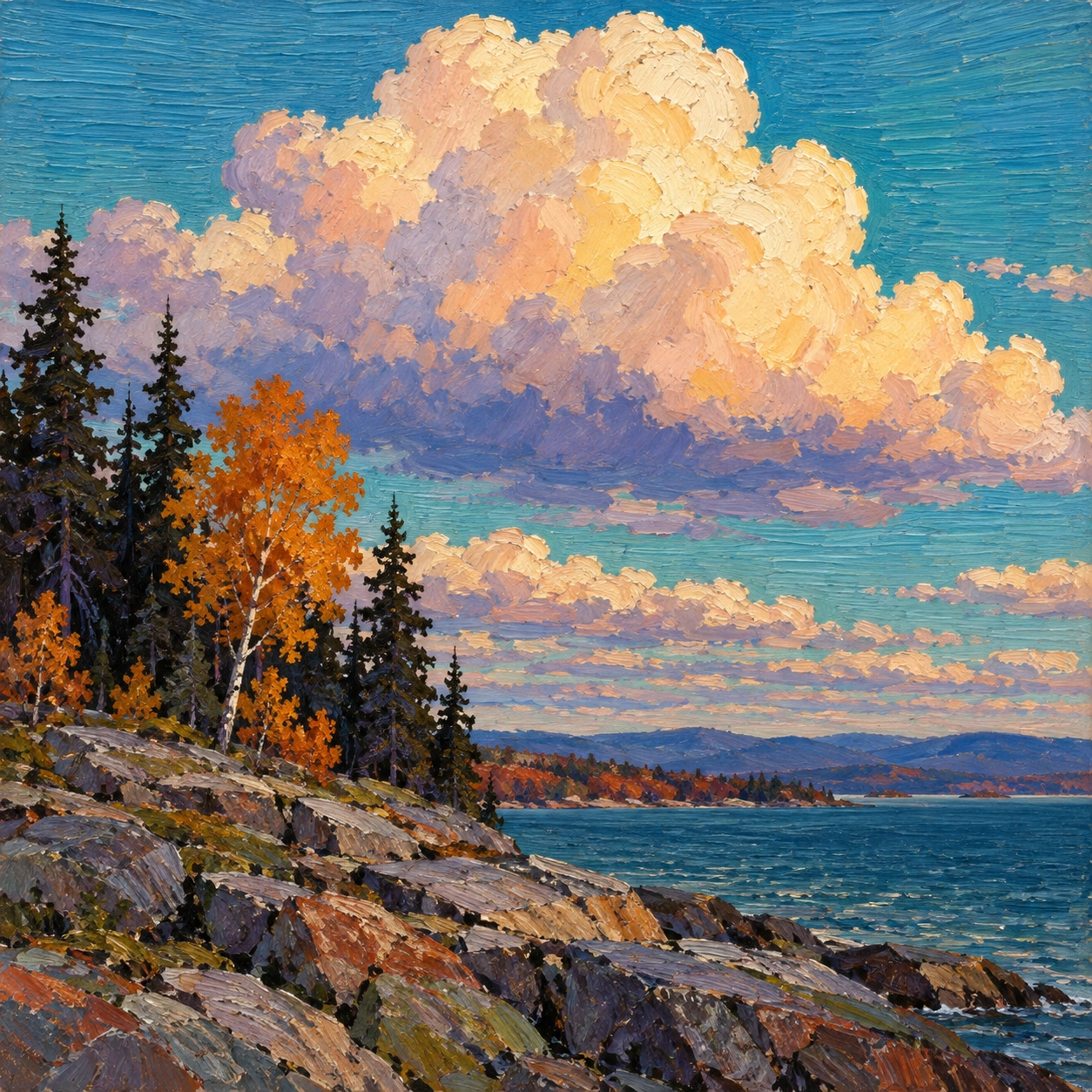 GPT Image 2.5
Reference details
- Reference ID
- 0612
- Category
- Painting
Reference prompts
Style prompt
The oil painting uses assertive visible strokes and simplified color planes rather than smooth naturalistic modeling. Turquoise and teal fields carry the cooler ground, while cream, peach, orange, rust, and ocher provide rounded warm masses and small concentrated accents. Violet, lavender, and deep blue sit along undersides and boundaries, turning shadow into a clear chromatic layer. Broad shapes remain strongly legible across the frame, yet their surfaces are alive with short parallel marks, dragged color, and rough changes in thickness. Rounded forms are piled in the upper area; dark narrow uprights and angular low planes supply a contrasting rhythm below. Overlap and value shifts create shallow but convincing depth without fine detail. Light is open and strong, brightening warm passages while leaving saturated cool shadows intact. The overall effect is bold and buoyant, with hand-worked paint, graphic silhouettes, and warm-cool color structure sharing the expressive load.Full example prompt
A square oil landscape shows a rocky lakeshore with slender orange autumn trees beneath an expansive turquoise sky and towering cream clouds. The upper center is filled by a large rounded cloud mass, piled in luminous peach, ivory, and pale yellow shapes. Lavender and blue-violet strokes trace its underside, giving the light cloud a pronounced shadowed base. Smaller flat clouds stretch across the lower sky in layered pink, cream, and muted purple bands. The sky between them remains a strong blue-green, visibly brushed with fine horizontal texture. A distant low strip of blue land and reddish earth crosses the horizon above a narrow dark teal lake. On the left foreground point, tall almost black conifers rise as tapering silhouettes. Among them stands a brighter deciduous tree with a thin light trunk and a full orange crown; smaller warm orange forms echo it nearby. The trees overlap the patterned sky without filling it, leaving the immense cloud as the dominant shape. Across the lower edge, angular slabs of rock descend toward the water. Their surfaces are divided into slate gray, lavender, rust, ocher, and green planes, with dark seams indicating changes of level. A low reddish bank continues toward the right, and the lake appears in compact horizontal bands beyond it. The painting uses thickly visible strokes and contour-like color boundaries: broad, rounded marks build the cloud, fine parallel marks animate the sky, and short angular touches break up the ground. Daylight illuminates the cloud and orange leaves from above, while the shore and trees settle into cool blue-violet shadow. The overall composition places a huge warm-lit cloud above a low, dark shoreline, producing a buoyant rhythm of saturated color and tactile paint.