
Styles
#0939
Garth Ennis style reference and prompts
Explore the “Garth Ennis” reference with scumbled paint, scratch-like marks, and warm color tones. View the images, copy the style or example prompt, and discover related styles on Looksift.
Compare the Qwen Image 2.1 and GPT Image 2.5 examples, choose the visual qualities you want, and copy the style prompt for your own project.
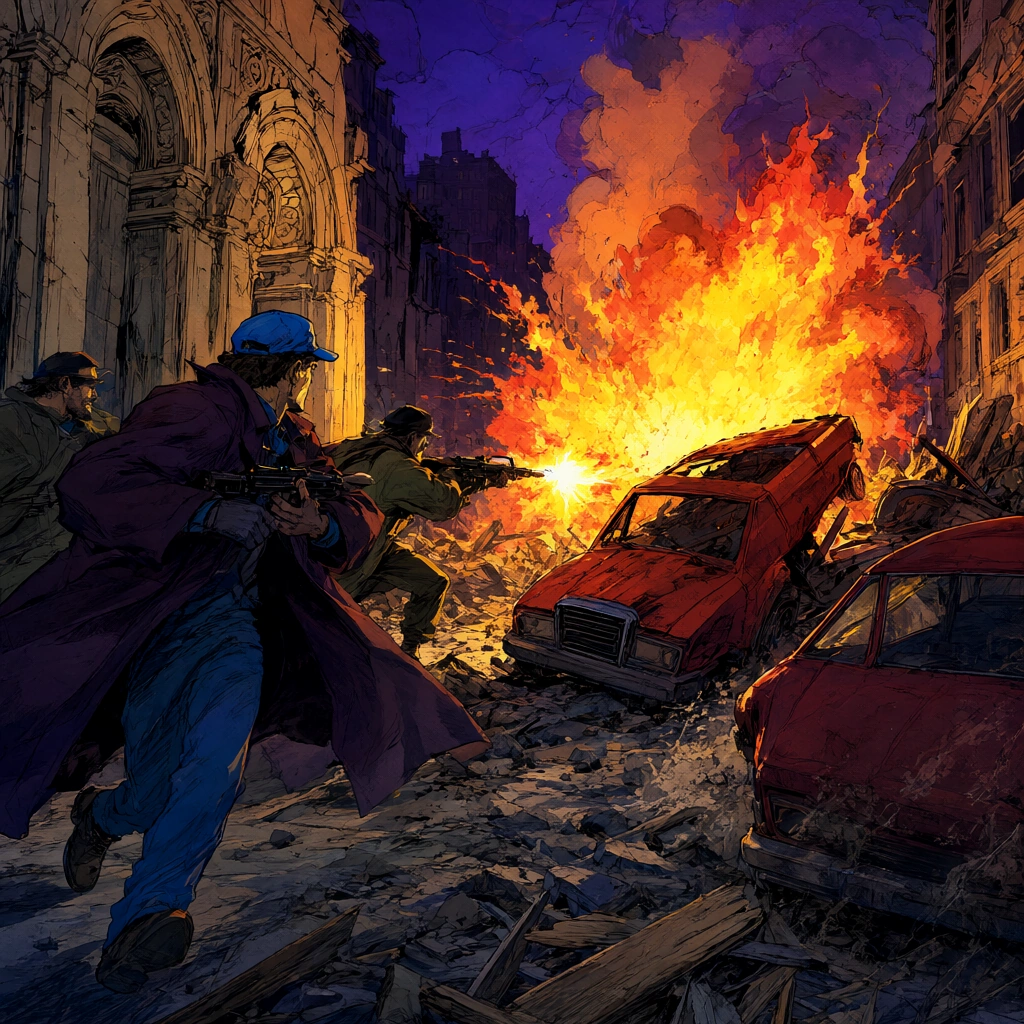 Qwen Image 2.1
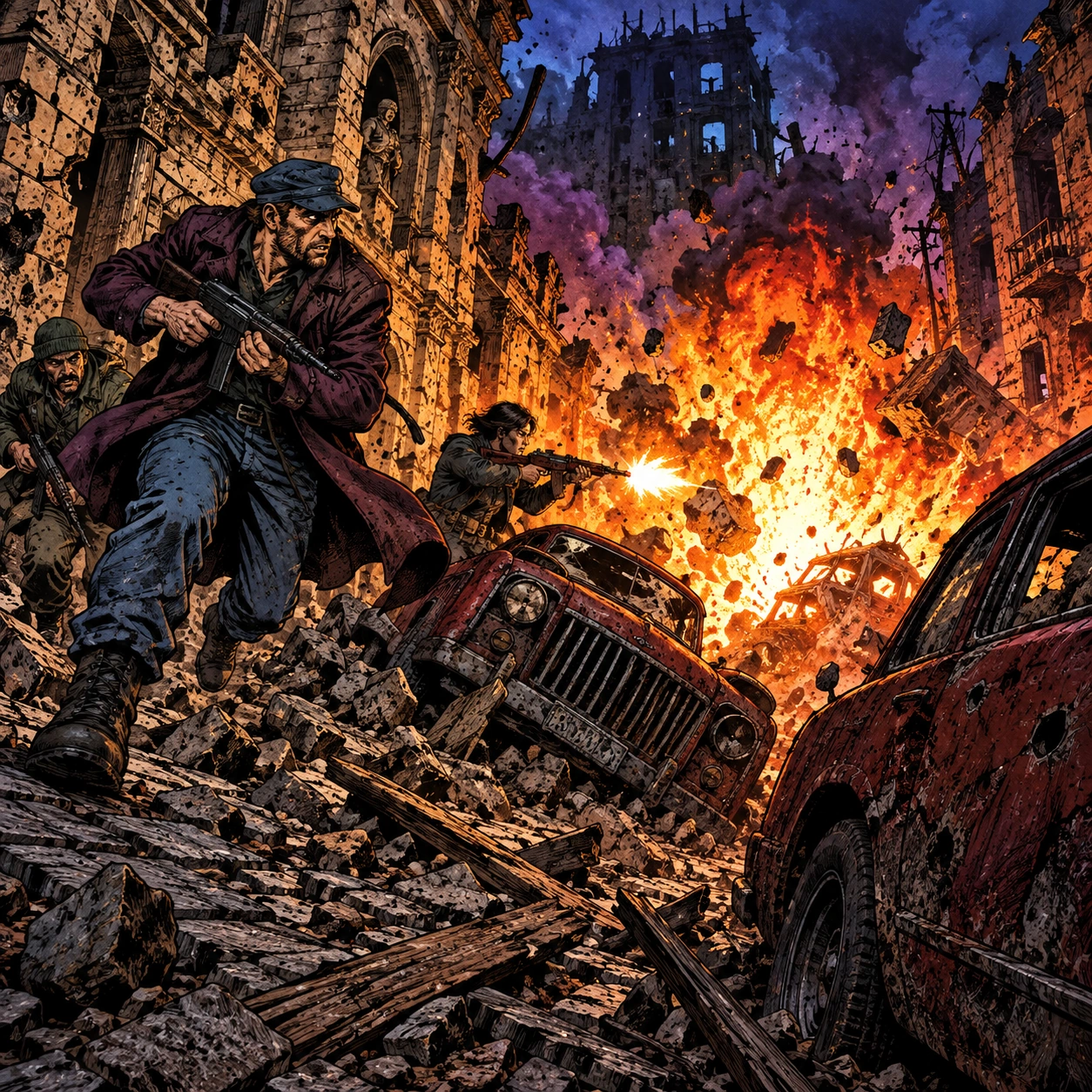 GPT Image 2.5
Reference details
- Reference ID
- 0939
- Category
- Anime & cartoons
Reference prompts
Style prompt
Dramatic comic illustration builds volume with forceful black contours, dense crosshatching, angular line clusters, and rough painted color. Warm yellow-orange light bursts through fields of violet, blue-black, and brown, so the brightest center becomes a strong visual magnet. Hard illumination catches selected edges while nearby recesses remain almost ink-dark. Perspective lines and slanting masses converge rapidly, compressing depth and making the frame feel unstable. Surface damage appears through broken strokes, scratches, smoke-like scumbling, and irregular patches rather than smooth digital gradients. The color is layered but controlled: fiery accents are concentrated, and cooler shadows bind the busy detail together. Near areas have thick contours and coarser texture; distant areas soften into haze while preserving the larger geometry. Overlap and cropped edges imply action continuing beyond the frame. The overall effect is urgent, gritty, and cinematic, with ink structure maintaining clarity amid visual density.Full example prompt
A square dramatic comic-book illustration shows armed figures rushing through a ruined city street as a fireball erupts behind overturned cars. The view is low and slightly tilted, making the broken paving and vehicle bodies lean toward the bright center. On the left, a large stone facade rises out of the frame, its carved arches and damaged masonry described with dense angular ink lines. Purple smoke and a dark distant building fill the upper middle, while the right-hand structures recede behind orange haze. Three figures occupy the left half. The nearest person in a blue cap, long dark plum coat, and blue trousers runs forward with a firearm held across the chest. Behind, another figure in muted green is partly obscured by the coat and wall. Near the center, a smaller figure braces a long gun toward the right, where a white-yellow muzzle flash overlaps the larger orange blast. A red vehicle pitches diagonally in the center foreground, its grille tilted upward from the broken road. At the lower right, another dark red car is cropped by the frame and covered in dust and scratches. The explosion fills the middle distance with layered yellow, orange, and red flames, throwing hard warm light on the cars, faces, rubble, and carved stone. Deep blue, violet, and brown shadows wrap around that incandescent area, giving the action a compressed, high-contrast depth. Rubble and splintered boards cross the lower edge; smoke and debris break up the space above the flames. The artwork uses emphatic black contours, crosshatched surfaces, rough painted color, and selective bright highlights rather than smooth photographic rendering. There is no readable lettering in the chosen panel. The overall composition is crowded and diagonal, using violent warm-cool contrast and dense linework to hold a single explosive focal point.