
Styles
#1006
Pier Luigi Nervi style reference and prompts
Explore the “Pier Luigi Nervi” reference with tactile surfaces, a monochrome palette, and soft diffused light. View the images, copy the style or example prompt, and discover related styles on Looksift.
Compare the Qwen Image 2.1 and GPT Image 2.5 examples, choose the visual qualities you want, and copy the style prompt for your own project.
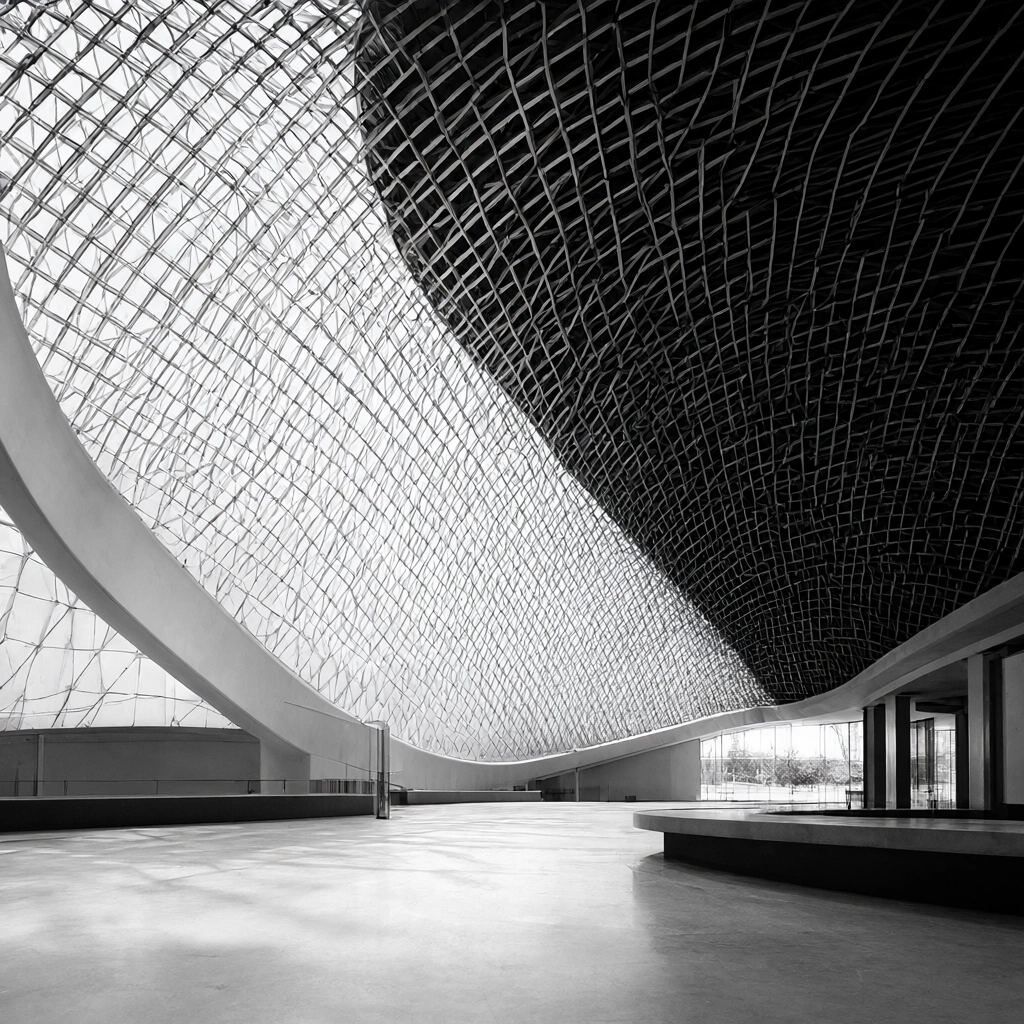 Qwen Image 2.1
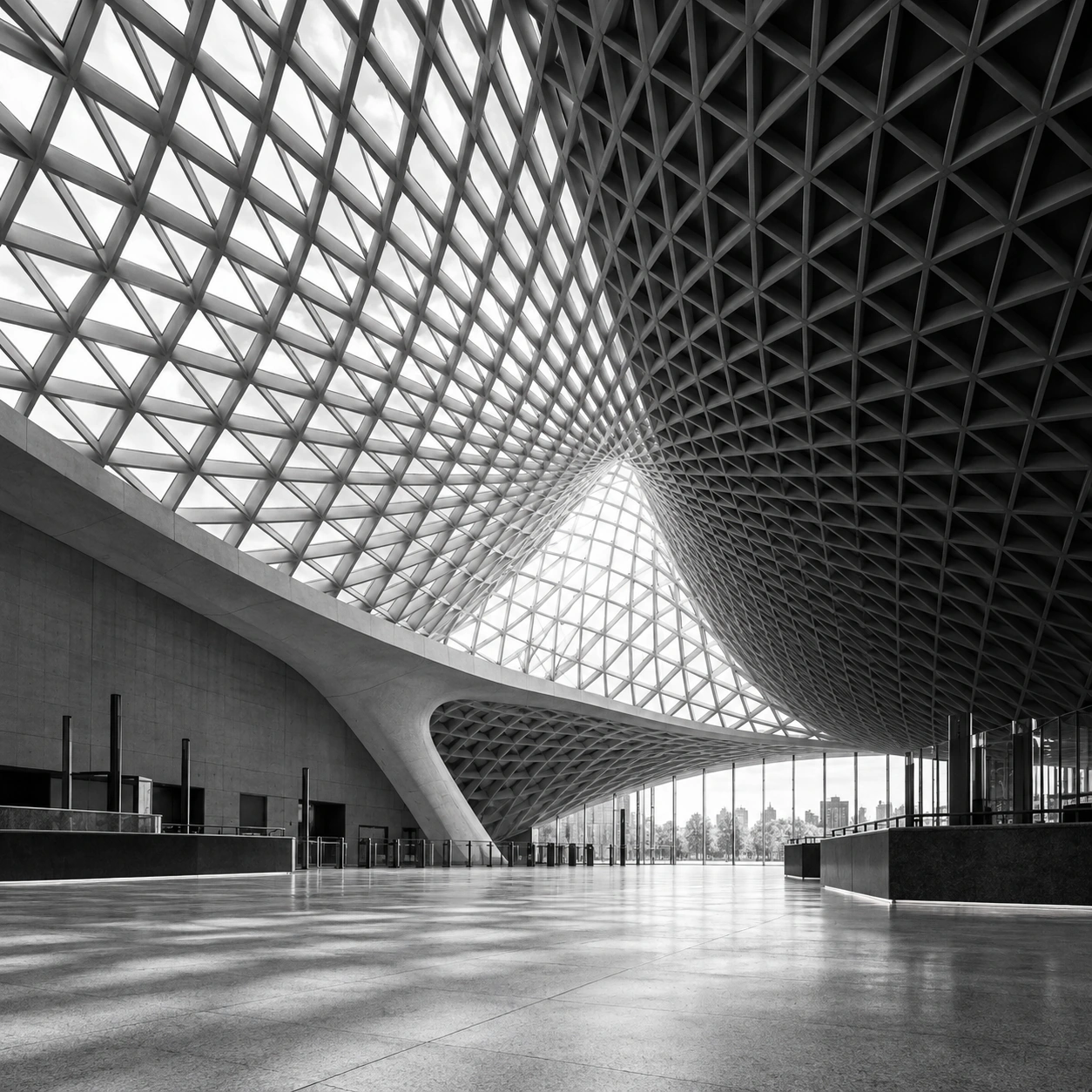 GPT Image 2.5
Reference details
- Reference ID
- 1006
- Category
- Photography
Reference prompts
Style prompt
Monochrome photography emphasizes repeated diagonal geometry, sweeping curvature, and a wide interval between black and white. Gridded lines multiply toward a bright focal opening, so density and scale change carry a strong sense of depth. One side admits luminous diffuse light while the opposite side holds a heavy dark mass, making contrast both structural and atmospheric. Broad smooth planes below allow the intricate upper pattern to breathe; low horizontal bands anchor the frame without competing with it. Crisp edges preserve the precision of the repeating cells, while faint grain and soft reflected light keep the image tactile. Perspective gathers the many lines into a controlled convergence rather than an undifferentiated mesh. Sparse middle-gray surfaces link brilliant highlights to deep shadow. The overall effect is austere, expansive, and sculptural, with geometry and light acting as the main visual subjects.Full example prompt
A square black-and-white architectural photograph shows an empty public hall beneath a sweeping lattice roof. The viewpoint is low and slightly off center, looking across a broad pale floor toward a distant back wall. Overhead, a dense grid of diagonal ribs spans the entire upper frame, curving downward from the left and right toward a bright central opening. The left side admits white daylight through many diamond-shaped cells; the right side falls into darker shadow, where the repeated ribs become a finer web. Near the middle, the ceiling's geometric grid compresses toward a luminous triangular area, creating a strong sense of structural depth. A thick pale curved support sweeps from the left wall toward the center, connecting the roof to the lower architecture. Along the floor, low counters or platforms form dark horizontal bands, one on the left and another more prominent at the right foreground. Slender posts and railings appear around them, but the hall remains largely unoccupied. A glass wall and a bright exterior glimpse sit at the rear right. The open ground plane carries subtle gray reflections and shadow patterns from the overhead lattice. Daylight from above and the far side provides the main light, making the left grid almost white while the right structural mass stays nearly black. The photograph preserves crisp lines and deep monochrome contrast, yet slight grain keeps the surfaces from looking digitally smooth. The recurring diagonal cells create visual rhythm at several scales, and their curvature pulls the eye toward the bright center. No people or readable text appear. The overall composition is monumental and quiet, using repeated structure, a wide empty floor, and controlled light to make engineering feel sculptural.