
Styles
#1666
Medieval Bestiary style reference and prompts
Explore the “Medieval Bestiary” reference with stippled texture, teal and ochre tones, and earth tones. View the images, copy the style or example prompt, and discover related styles on Looksift.
Compare the Qwen Image 2.1 and GPT Image 2.5 examples, choose the visual qualities you want, and copy the style prompt for your own project.
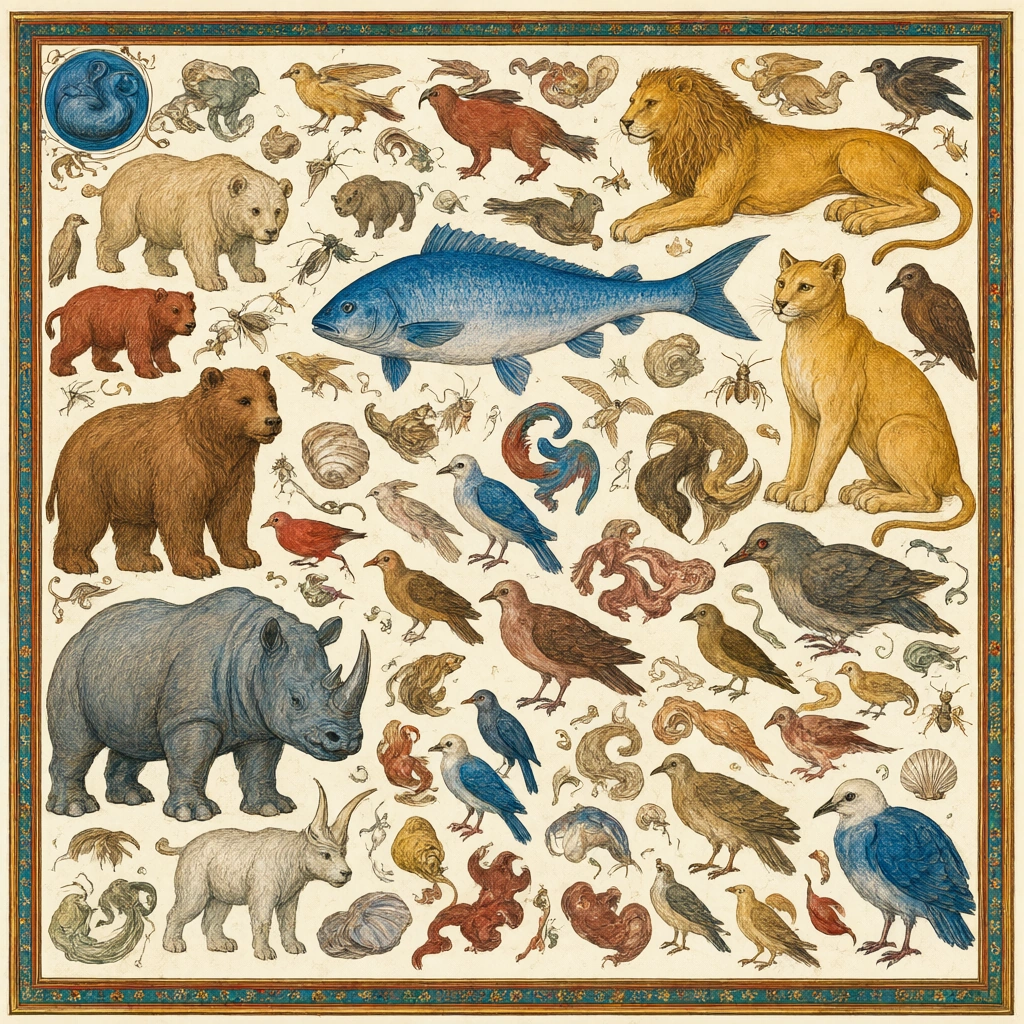 Qwen Image 2.1
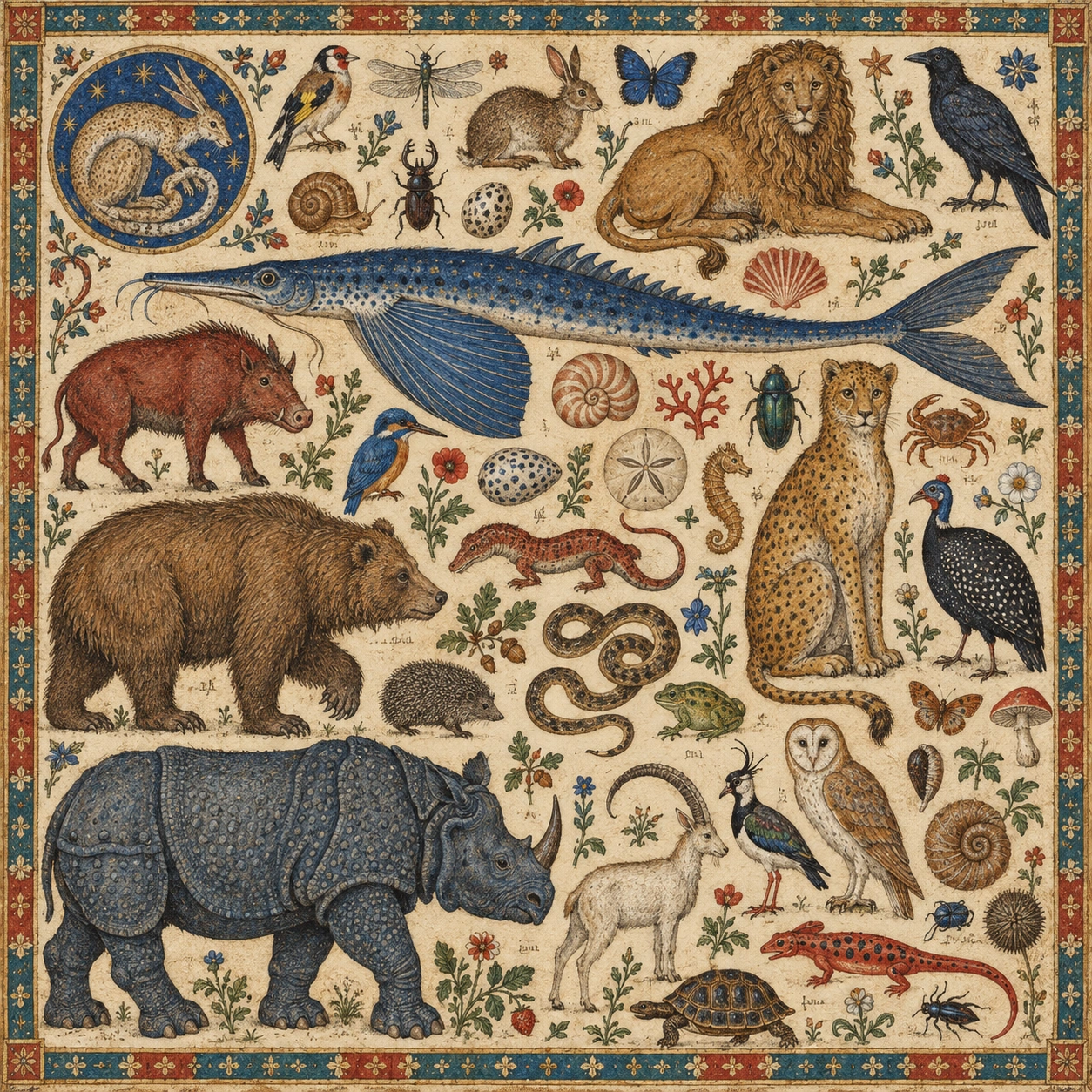 GPT Image 2.5
Reference details
- Reference ID
- 1666
- Category
- Ink & line
Reference prompts
Style prompt
The illuminated manuscript image uses fine ink outlines, flat mineral-like color, and aged parchment grain. Many separate shapes share one shallow plane, held together by a continuous ornamental border and small repeating marks. Scale can vary freely, with a few large dark or cool masses acting as anchors among numerous smaller warm accents. Teal blue, ochre, rust red, muted brown, and cream retain a slightly weathered, matte appearance. Narrow hatching and stippling add local volume without creating a single directional light or natural cast shadows. Edges remain carefully drawn yet uneven enough to preserve the handmade quality of pigment and ink. Open pockets of pale ground prevent the dense distribution from becoming a solid mass, while repeated circular and curling motifs tie distant areas together. The overall effect is encyclopedic and decorative, combining precise miniature detail with a lively, almost playful rhythm across the full surface.Full example prompt
A square illuminated bestiary page fills the frame with animals, birds, and tiny natural specimens arranged across aged cream parchment. A narrow ornamental border runs around all four sides, built from teal, rust red, and ochre bands with small repeating floral marks. Inside it, the page has no single horizon or landscape setting; each creature occupies its own pocket of pale space within a dense all-over arrangement. Near the upper edge, small winged forms and compact mammals line up between curled decorative marks. At upper left, a blue circular medallion encloses a curled creature, while the upper right holds a tawny reclining lion and a dark bird. Through the middle, a long blue fishlike creature stretches horizontally from left to right, with a broad fin dropping beneath it and a forked tail near the far edge. Smaller shells, insects, curled shapes, and colored specimens cluster around that central form. At middle left, a reddish stocky animal stands above a large tawny bearlike figure. On the right, a seated golden feline faces outward, with a darker rounded birdlike form beside it. In the lower left, a huge blue-gray rhinoceros-like animal carries much of the page's visual weight; thick legs and a blunt head are worked in closely layered strokes. Along the bottom and lower center, much smaller birds, a pale horned animal, shells, and creeping red forms fill the remaining gaps. The creatures vary in scale rather than sharing a single realistic depth, so the page reads as a collected visual inventory. Lighting is flat and even, like pigment resting on parchment, with shallow dark modeling within each figure and no cast shadow tying them to a ground plane. Fine ink contours, stippling, and warm granular wear soften the saturated blue, ochre, rust, and brown colors. Tiny marks near some specimens are too small to read. The overall composition is crowded yet carefully distributed, using varied silhouettes and a disciplined border to turn natural variety into an ornate, curious manuscript image.