
Styles
#1709
Nuremberg Chronicle style reference and prompts
Explore the “Nuremberg Chronicle” reference with hatching, moss-green tones, and teal and ochre tones. View the images, copy the style or example prompt, and discover related styles on Looksift.
Compare the Qwen Image 2.1 and GPT Image 2.5 examples, choose the visual qualities you want, and copy the style prompt for your own project.
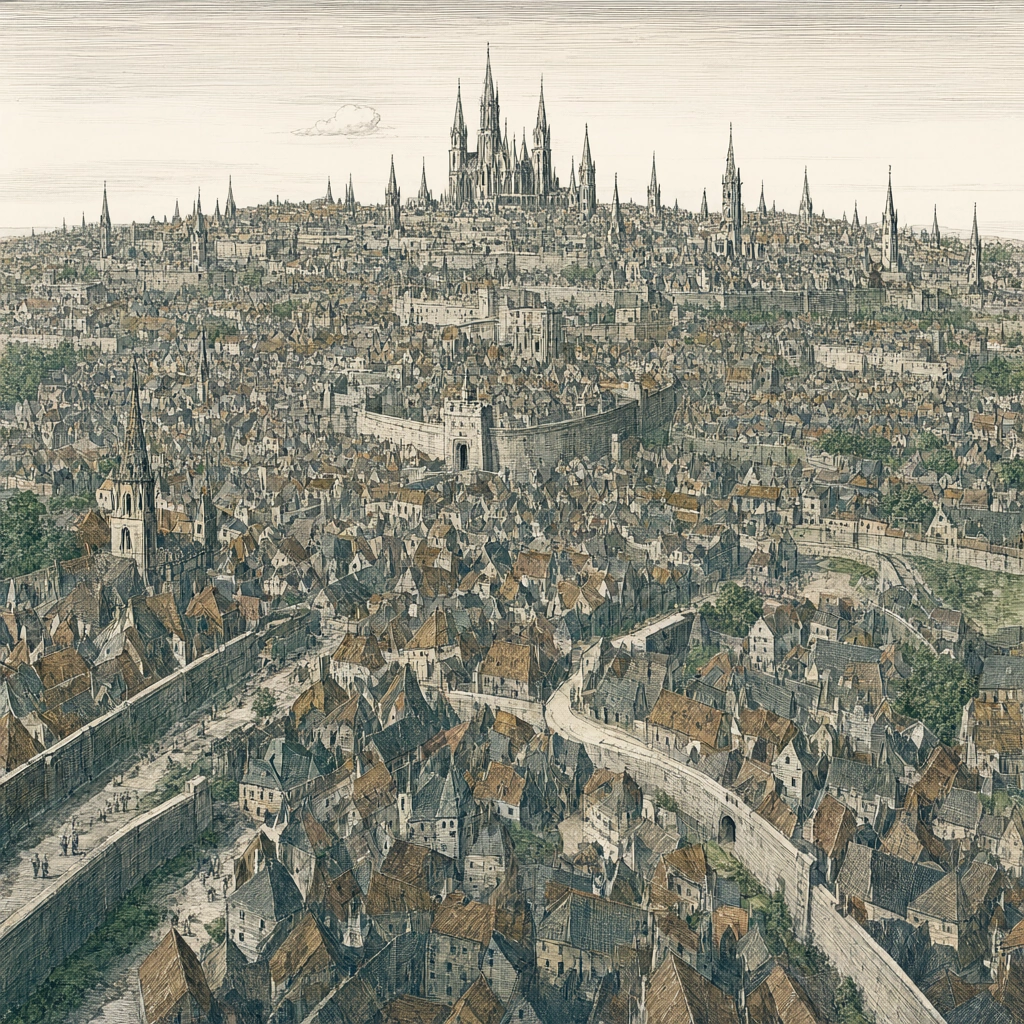 Qwen Image 2.1
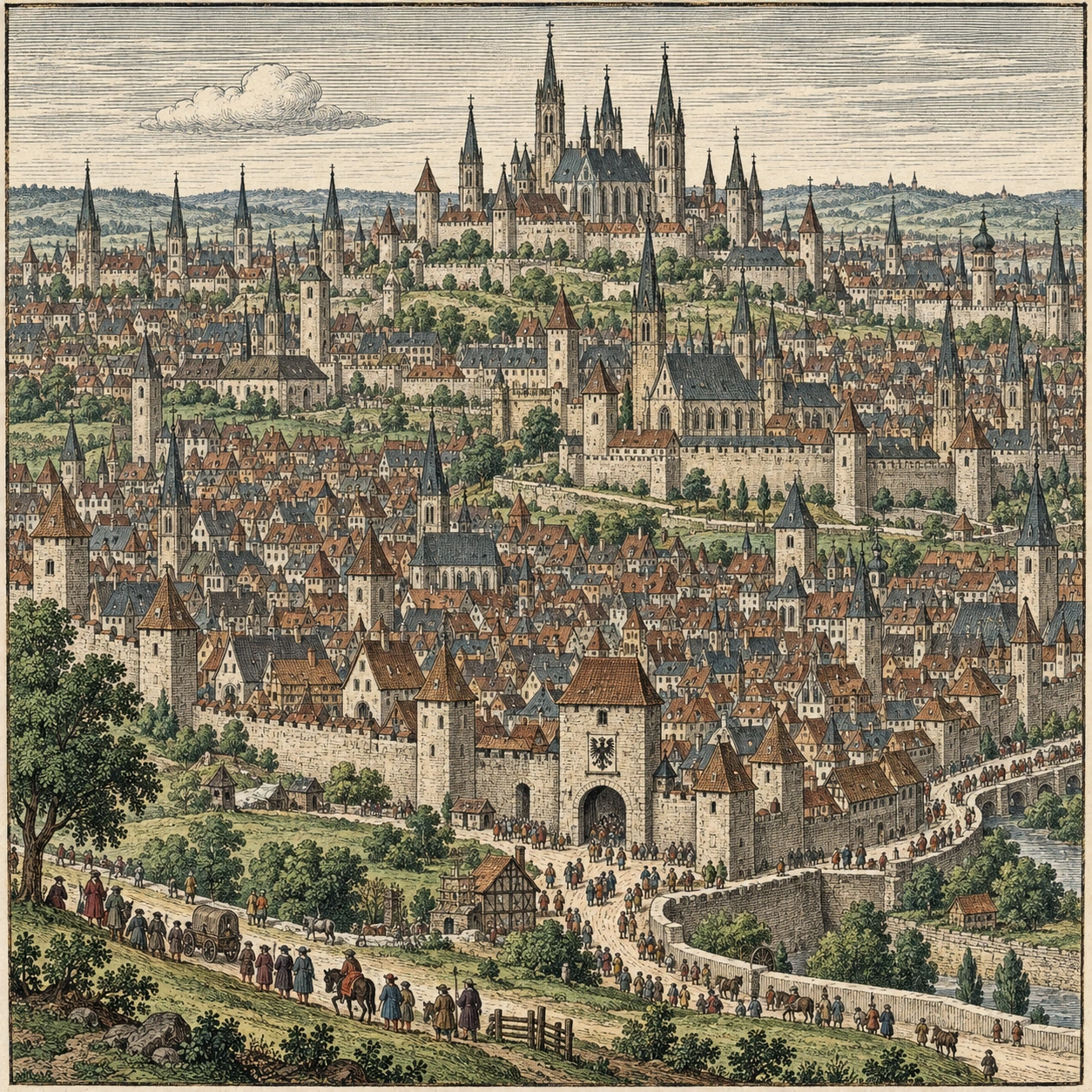 GPT Image 2.5
Reference details
- Reference ID
- 1709
- Category
- Ink & line
Reference prompts
Style prompt
The hand-colored print relies on intricate ink outlines, dense hatching, and subdued pigment laid over parchment cream. Many small units overlap in shallow panoramic layers, with a few taller vertical accents rising above a broad field of fine marks. Black line work defines edges and recesses; muted teal, moss green, dusty ochre, and brown sit as thin, slightly uneven color washes. Repeated rooftops, windows, and stepped walls create a compressed rhythm without requiring exact modern perspective. Distant forms become paler and finer but remain unusually legible, emphasizing an inventory-like view of an entire setting. Soft, nearly shadowless illumination keeps detail available across the frame, while small dark openings and line density supply local depth. Horizontal strokes in open areas counter the vertical pattern of the crowded center. The overall effect is archival and expansive, with meticulous miniature detail held together by broad tonal bands and aged-paper warmth.Full example prompt
A square hand-colored chronicle-style print surveys a sprawling walled city from elevated ground, with a dense forest of rooftops and towers under a pale lined sky. The upper band is warm parchment white, crossed by closely spaced gray horizontal strokes that describe a low cloud layer. A small rounded cloud sits to the left of the highest spires. Near the upper center, a large cluster of tall churchlike towers rises above the rest of the city. Narrow pointed roofs, pale walls, and dark window marks distinguish the peaks from the many smaller steeples on the horizon. Beneath them, terraces and walls step down through overlapping blocks of gray-green masonry. In the middle distance, another fortified complex with a square gate tower and adjoining wall sits above the crowded lower town. The central gateway appears as a dark arch framed by pale stone. Around it, small steep roofs in ochre, brown, and slate gray pack tightly together, their edges drawn in fine ink lines. At the lower left and lower center, tiny figures and clustered marks imply a busy route outside the wall, while irregular green patches and a few trees break up the built surfaces. Along the lower right, a curving pale road or wall line guides the eye through the crowd of marks toward the city's center. The perspective is elevated and panoramic rather than mathematically precise; distant towers remain visible despite the immense density below. Light is diffuse and nearly shadowless, as if the entire scene were laid out for inspection on a page. The image gains volume from fine hatching, small dark window recesses, and overlapping silhouettes, not from dramatic cast shadows. Muted teal, moss green, dusty ochre, and brown tint the predominantly black-and-cream engraving. The overall composition is crowded yet legible, using repeated vertical spires and stepped layers to turn an enormous city into a textured historical panorama.