
Styles
#1912
Stik style reference and prompts
Explore the “Stik” reference with tactile surfaces, simplified forms, and wavering reflections of the figures and mural in the canal. View the images, copy the style or example prompt, and discover related styles on Looksift.
Compare the Qwen Image 2.1 and GPT Image 2.5 examples, choose the visual qualities you want, and copy the style prompt for your own project.
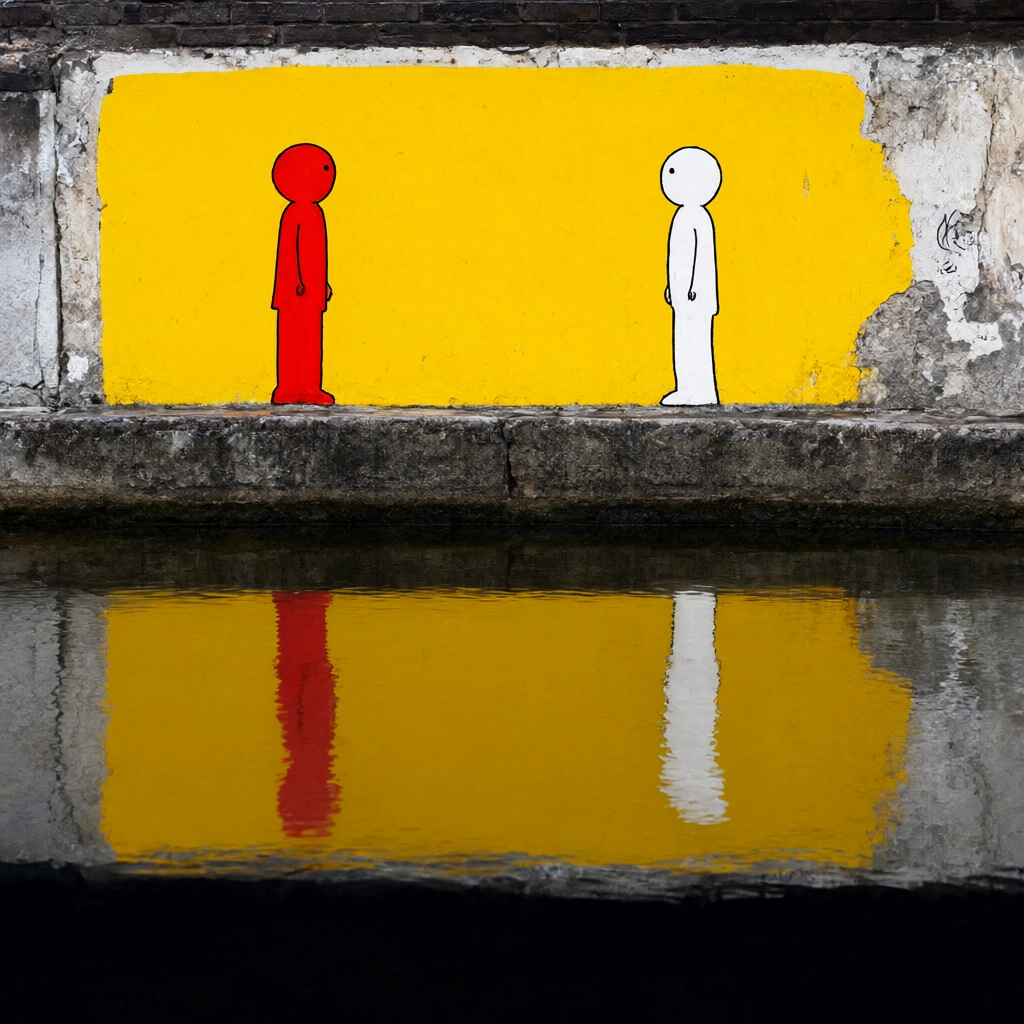 Qwen Image 2.1
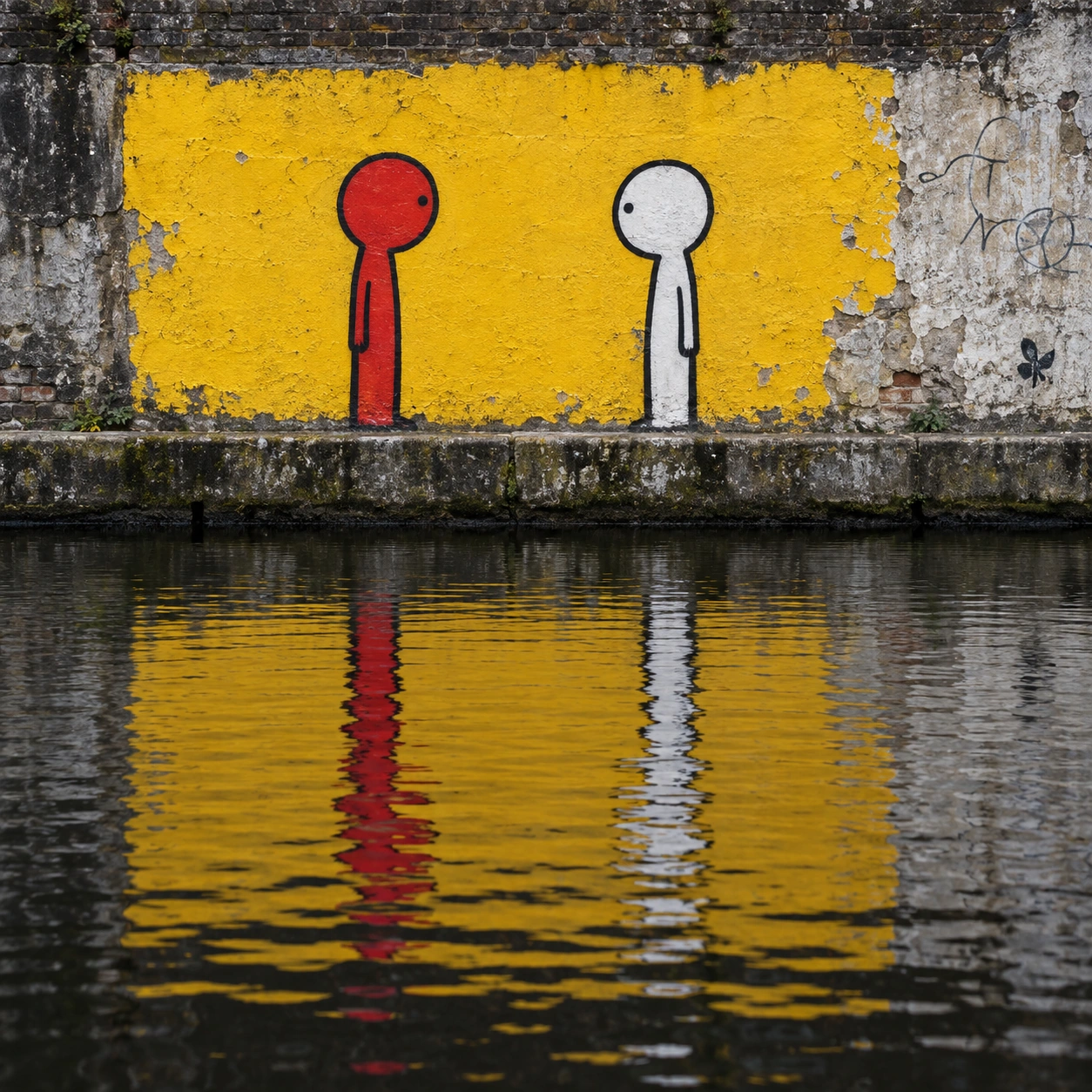 GPT Image 2.5
Reference details
- Reference ID
- 1912
- Category
- Photography
Reference prompts
Style prompt
Photography pairs extremely economical flat graphic marks with real, worn surfaces and a reflective lower field. Use bold black contours, one or two saturated primary accents, and a large irregular color block against muted gray concrete or similar matte texture. Let weathering, stains, cracks, and ragged paint edges give the graphic forms context. A horizontal boundary divides crisp upper shapes from elongated, wavering reflections below; gentle ripples soften the reflected color without losing its identity. Overcast ambient light keeps contrast in the color design rather than in cast shadows. Place simple forms with deliberate spacing so their relation is readable at a glance. The transferable effect is direct, urban, and quietly poignant, built from minimal symbols, strong color isolation, tactile ground, and mirrored distortion.Full example prompt
A square street photograph shows two simple painted human figures facing each other on a rough waterside wall. The left figure is solid bright red; the right is white. Both have large round heads, narrow straight bodies, black outline, tiny dot eyes, and short arms hanging at their sides. They stand on a narrow concrete ledge just above a still dark canal, separated by a small gap but turned toward one another. Behind them, a broad irregular rectangle of brilliant yellow paint covers the middle of a weathered gray wall. Its edges are ragged, especially on the right, where old pale plaster, cracks, faint graffiti, and a small dark scribble remain exposed. Dark brick and stained concrete frame the yellow area along the top and sides. Across the lower half, the canal reflects the figures and wall. Their red and white bodies stretch downward as wavering vertical marks, while the yellow field becomes a broad blurred golden rectangle broken by horizontal ripples. A deep black band of water fills the bottom edge. The photographic viewpoint is directly across the canal, almost level with the figures, so the wall and reflection form two stacked horizontal zones. Overcast daylight lights the painted colors evenly and reveals peeling plaster, wet stone, and small surface stains without hard shadows. The simple figures are sharply readable against the yellow, while the weathered wall and water provide layered material texture. The composition balances a minimal face-to-face encounter with a large bright color block and its subdued, moving reflection.