
Styles
#2187
Guido van Helten style reference and prompts
Explore the “Guido van Helten” reference with dry-brush texture, masonry textures, and soft tonal transitions. View the images, copy the style or example prompt, and discover related styles on Looksift.
Compare the Qwen Image 2.1 and GPT Image 2.5 examples, choose the visual qualities you want, and copy the style prompt for your own project.
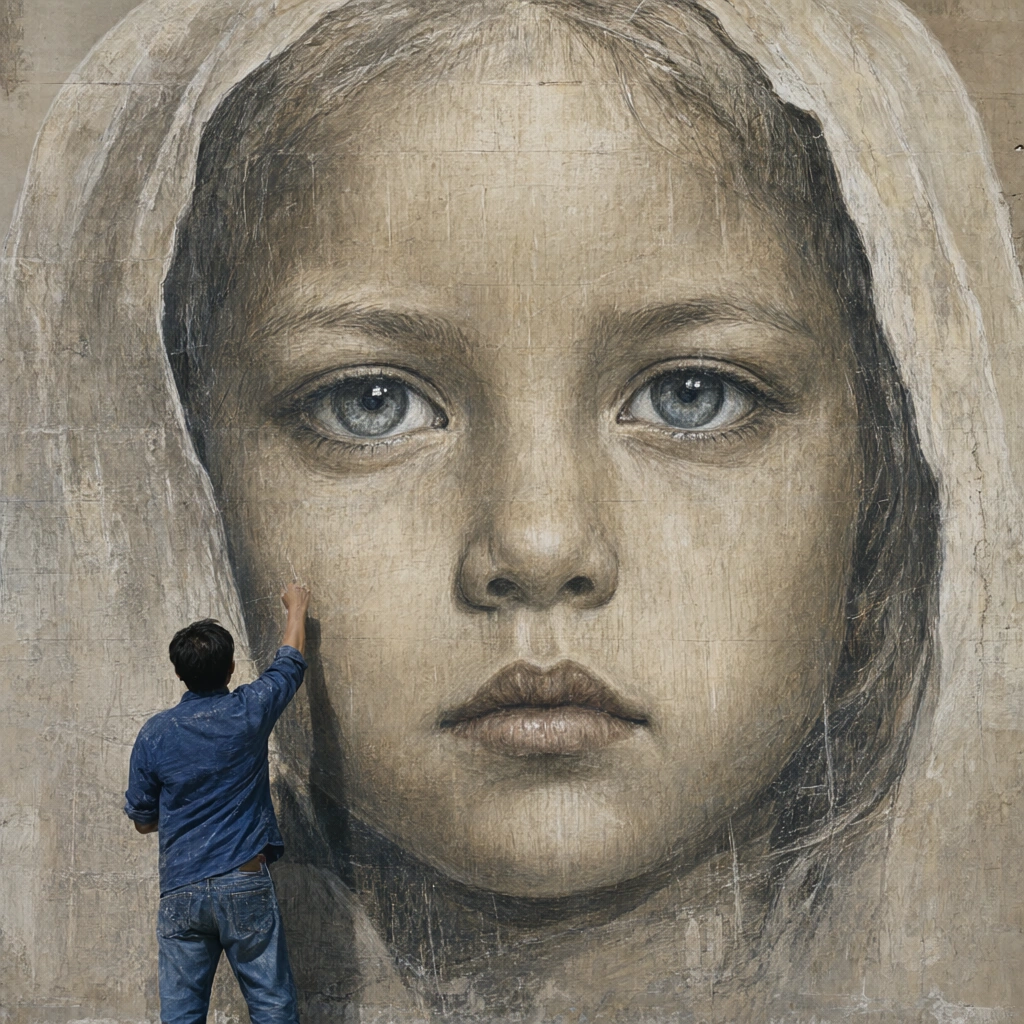 Qwen Image 2.1
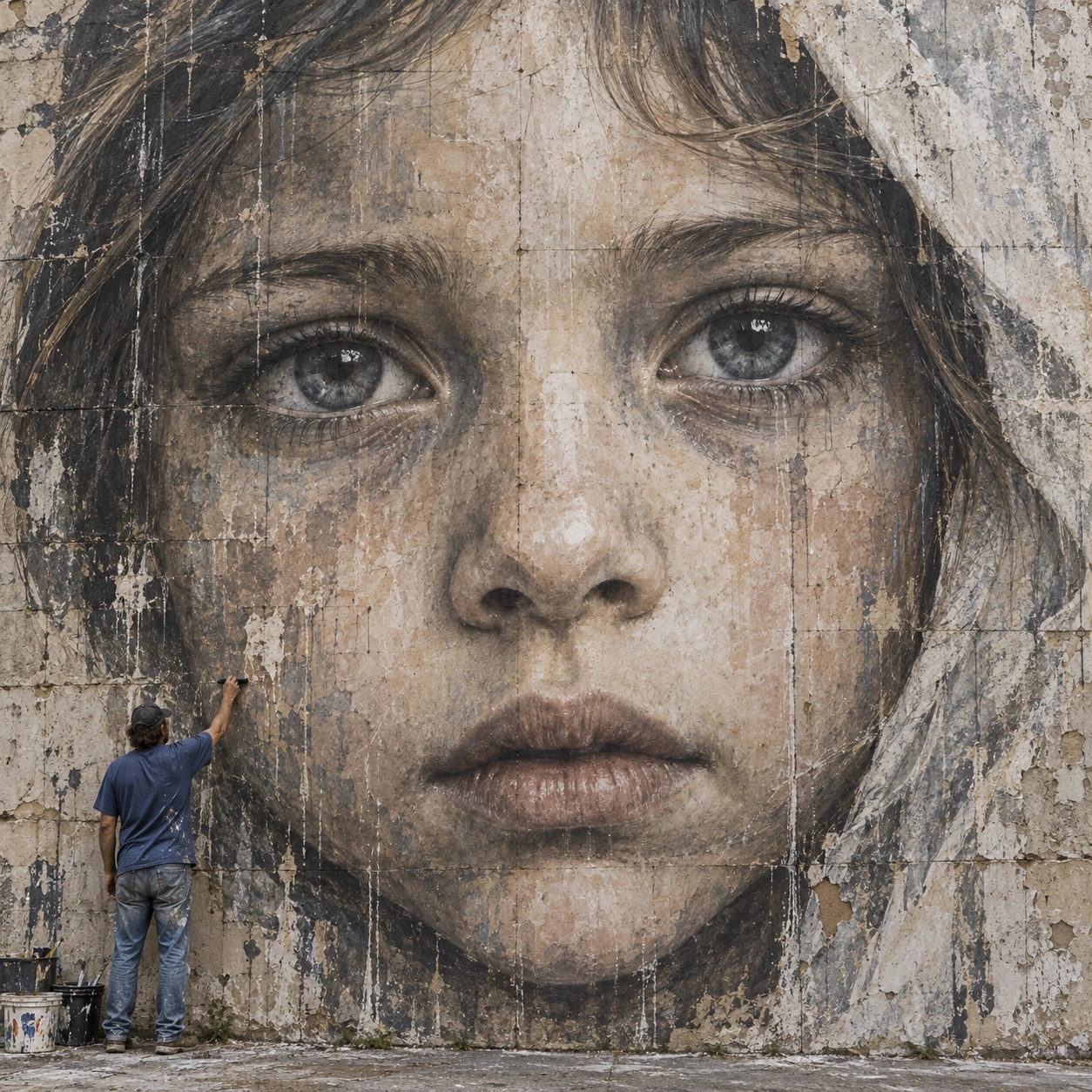 GPT Image 2.5
Reference details
- Reference ID
- 2187
- Category
- Painting
Reference prompts
Style prompt
A monumental mural-like surface uses layered charcoal, sepia, and pale gray over visibly weathered masonry. The central rounded tonal form is softly modeled with fine dry-brush marks, while square seams, vertical drips, scratches, and rubbed patches interrupt it throughout. Large eye-like high-contrast accents anchor the frontal composition, but most edges remain porous and merge with the ground. A tiny saturated cool accent near the lower edge establishes scale against the broad muted field. Diffuse outdoor light gives the pale planes a soft lift and leaves cast shadows minimal. The palette is almost monochrome, relying on subtle warm-cool shifts in gray and brown. The rhythm is slow and face-on, with immense smooth transitions crossed by many small linear abrasions and one miniature active mark.Full example prompt
A square documentary view shows an artist working at the base of a monumental portrait mural on a weathered wall. The mural fills almost the entire frame: a child's face looks directly outward, with large gray-blue eyes, a straight nose, slightly parted lips, and a solemn expression. Soft hair and a pale surrounding cloth-like shape frame the upper head and right cheek. The face is rendered in layered sepia, charcoal, and muted gray, with delicate shading around the eyelids, nose, and mouth. Across the whole surface, vertical streaks, scratches, square seams, and rubbed patches reveal the wall beneath the image. At the lower left, a real person in a blue shirt and jeans stands with back to the camera, raising one arm to work near the painted cheek. The small figure establishes the enormous scale of the mural: the portrait's single eye is many times larger than the person's head. The wall's beige-gray ground remains visible at the edges and through transparent passages of the face. Diffuse outdoor light comes from above, keeping cast shadows weak; the most luminous areas are the child's forehead, nose ridge, and eyes. Fine dry-brush and charcoal-like marks build facial texture, while broader rubbed washes integrate it with the masonry. The composition is strongly frontal and tightly cropped, with the mural's gaze anchoring the center and the artist adding a tiny active note below. The effect is both intimate and monumental, with a living working gesture against a quiet, immense painted expression.