
Styles
#2319
Charles Sheeler style reference and prompts
Explore the “Charles Sheeler” reference with visible brushwork, a matte finish, and pale neutral tones. View the images, copy the style or example prompt, and discover related styles on Looksift.
Compare the Qwen Image 2.1 and GPT Image 2.5 examples, choose the visual qualities you want, and copy the style prompt for your own project.
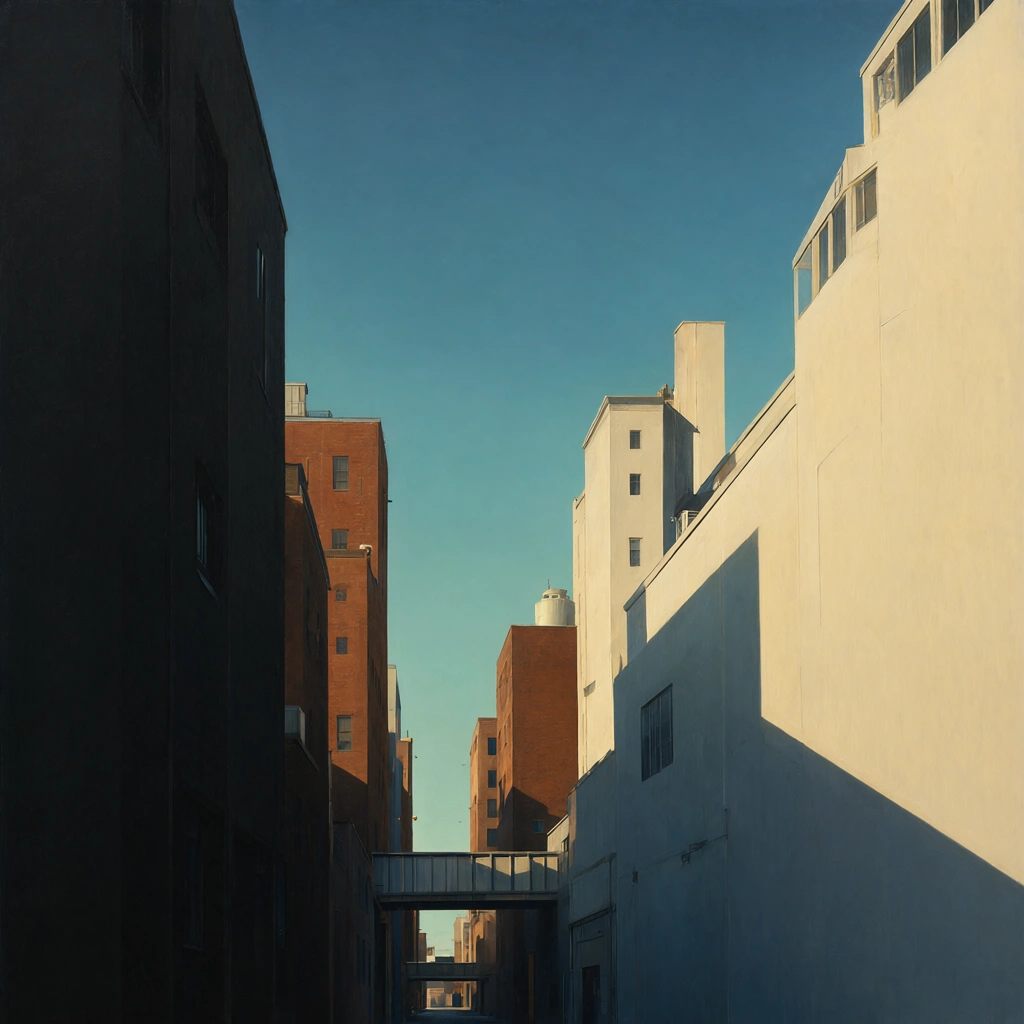 Qwen Image 2.1
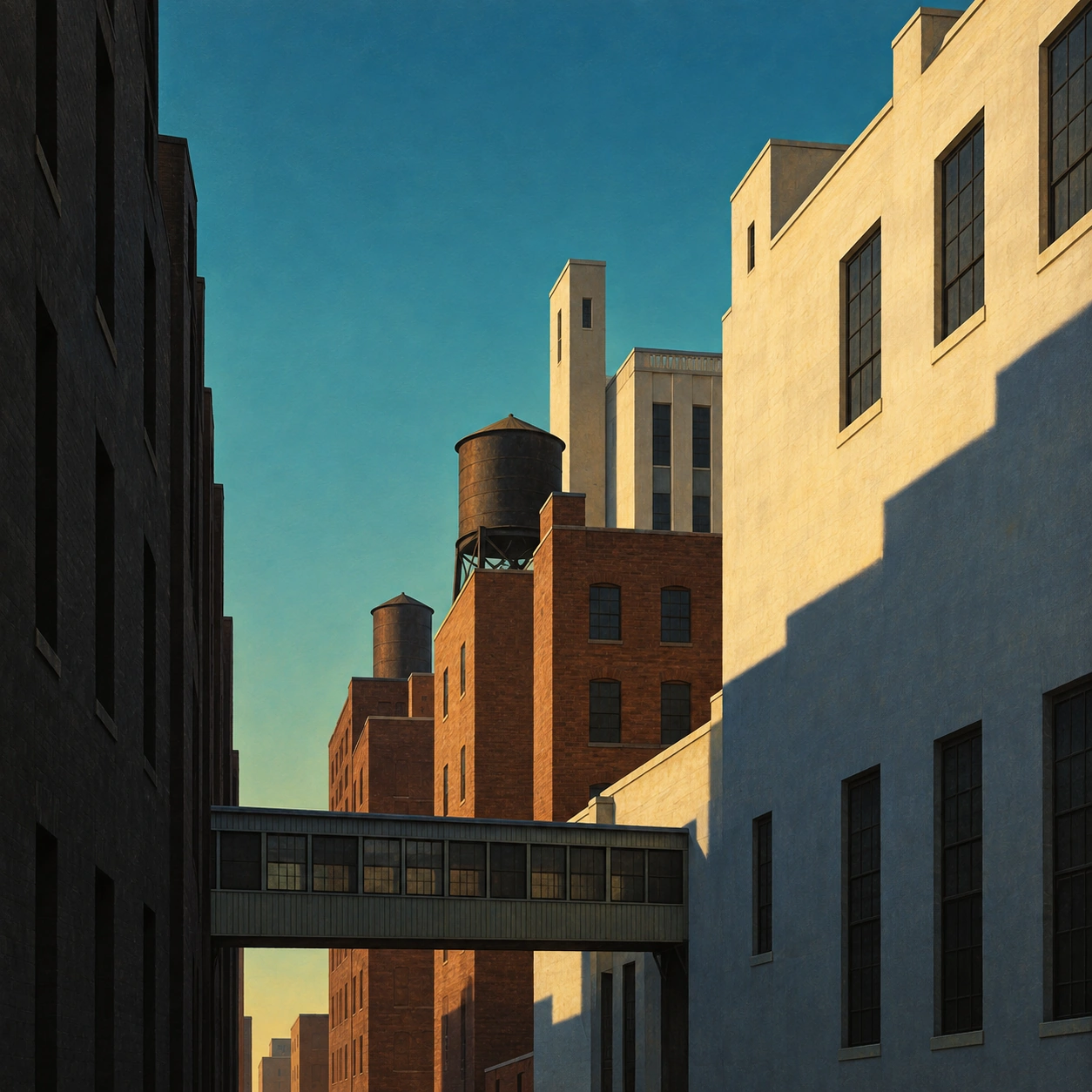 GPT Image 2.5
Reference details
- Reference ID
- 2319
- Category
- Painting
Reference prompts
Style prompt
The painting organizes space through clean, interlocking geometric planes and a disciplined contrast between warm light and cool shadow. Broad matte color fields retain faint grain but little visible brushwork; crisp edges and sharply cut shadow shapes carry the structure. Pale cream and rust-orange planes push forward against slate blue and deep teal regions, while a broad open field of cooler color grants the dense forms breathing room. Receding layers are compressed into upright blocks and thin connecting horizontals, with sparse dark apertures supplying scale rather than ornament. Low-angle light strikes selected planes and leaves neighboring surfaces in large coherent shade, making volume legible without a soft atmospheric blur. The overall effect is still, architectural in rhythm, and precise, with color and shadow functioning as equal parts of the composition.Full example prompt
A square precisionist-style painting looks down a narrow urban passage framed by tall industrial buildings under a clear blue-green sky. The left edge is occupied by a nearly black wall with only faint window recesses and vertical surface divisions. Across the upper center, a broad plane of unbroken sky opens between the building masses, its color deepening toward the top and becoming slightly warmer near the horizon. On the right, a pale cream facade rises from the bottom to the top edge, its upper windows and parapet rendered as clean rectangular cuts. Strong low sunlight from the left strikes the upper and outer faces of this wall, leaving a sharply edged blue-gray shadow across the lower central section. Near the middle distance, several warm red-brown brick structures and cylindrical rooftop tanks rise between the flanking walls. Their simple volumes are stacked at different depths, with a taller cream building and a narrow upright tower behind them. Close to the lower edge, a slim enclosed bridge crosses the passage horizontally, joining the dark left side to the more brightly lit group on the right. The street itself is largely hidden by the crop, so the view is defined by vertical facades, a small bridge, and rising rooftop machinery rather than by activity at ground level. Windows remain dark and spare; there are no visible people or readable signs. Surfaces are smoothly painted but carry light granular variation, and hard architectural outlines contrast with subtle tonal shifts inside each broad wall plane. The afternoon light creates warm cream and rust highlights against cool slate shadows, with shadow boundaries crisp enough to become part of the geometry. The overall composition is a calm upward corridor of interlocking blocks, balancing a large open sky against densely arranged industrial forms.