
Styles
#2723
Fernand Leger style reference and prompts
Explore the “Fernand Leger” reference with geometric motifs, repeated linear rhythms, and flat color areas. View the images, copy the style or example prompt, and discover related styles on Looksift.
Compare the Qwen Image 2.1 and GPT Image 2.5 examples, choose the visual qualities you want, and copy the style prompt for your own project.
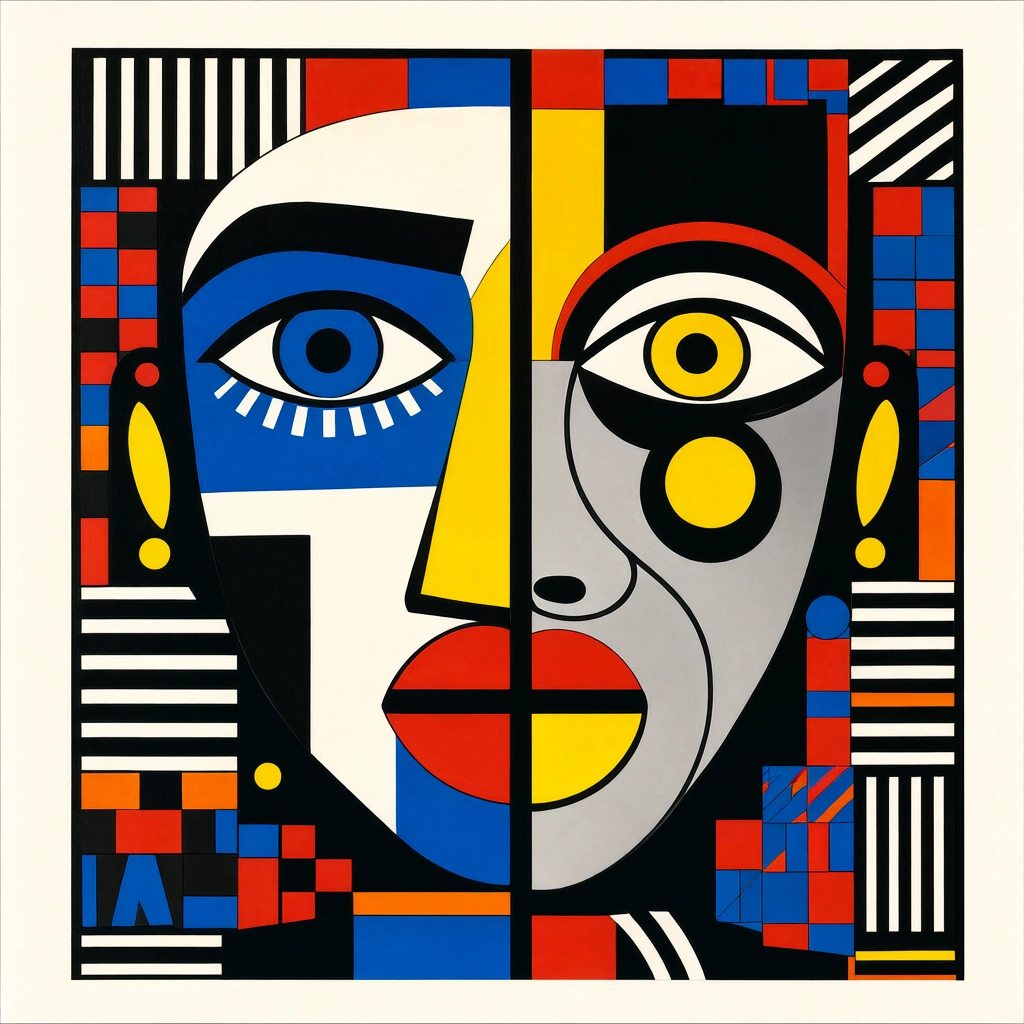 Qwen Image 2.1
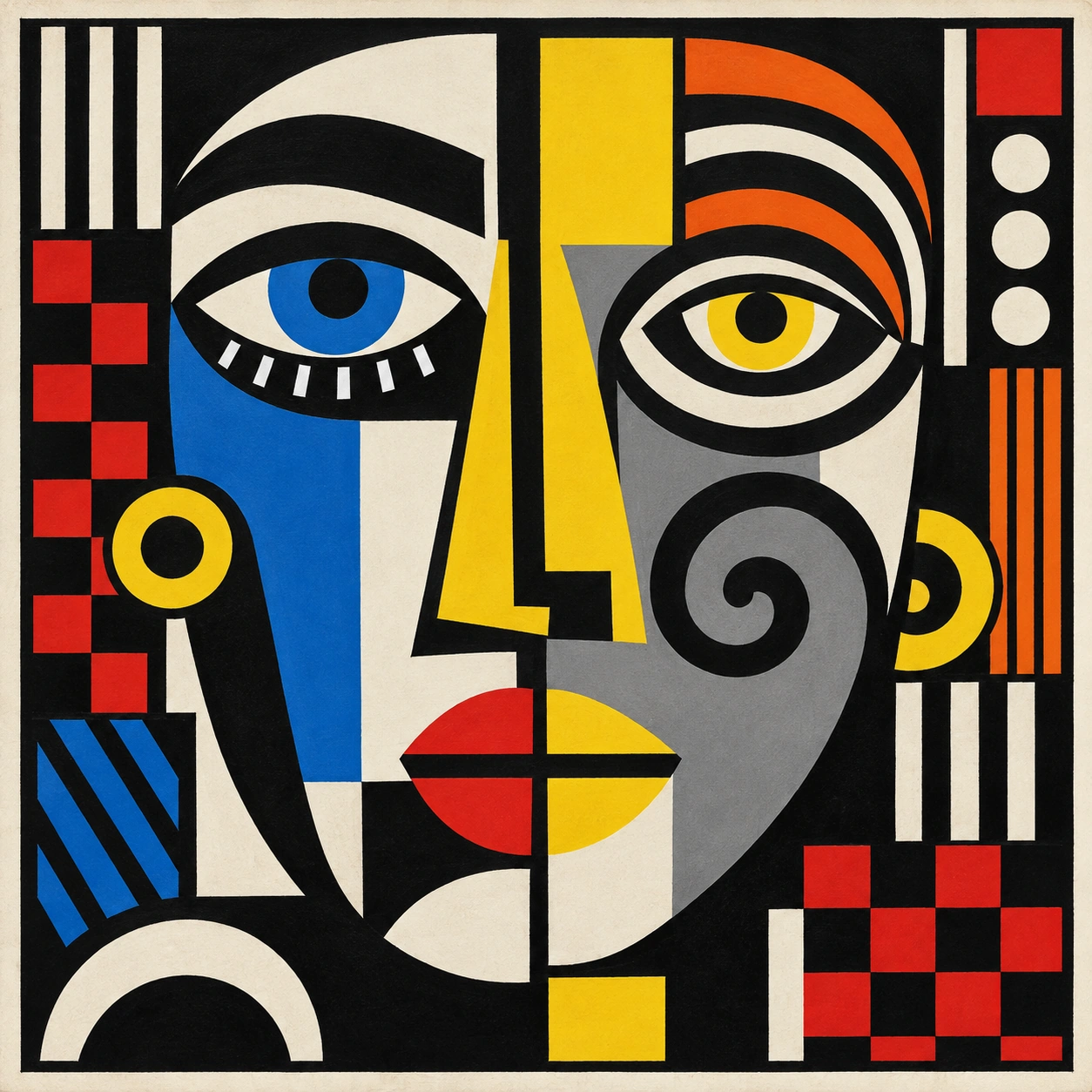 GPT Image 2.5
Reference details
- Reference ID
- 2723
- Category
- Painting
Reference prompts
Style prompt
Hard-edged geometric painting reduces recognizable forms to interlocking circles, bars, wedges, checkerboards, and thick contour lines. Black serves as a structural field, locking opaque red, yellow, blue, white, and gray pieces into a compact grid. Flat color carries brightness without external light or cast shadow. Repeated stripes and blocks create separate visual beats around a bold central shape. Symmetry supplies immediate legibility, while differing details on each side keep the design active. Edges are crisp and graphic, with only slight material variation inside the color fields. The overall effect is playful, confident, and decorative, like a carefully balanced painted print.Full example prompt
The image is a square graphic painting in which a frontal face is assembled from interlocking geometric shapes. The face fills a black rectangular panel set inside a narrow off-white margin. A thick black vertical line splits the center, though the two halves are deliberately unequal. On the left, a large blue eye sits beneath a heavy black eyebrow, with short white marks forming the lower lashes. On the right, an eye with a yellow iris is contained by concentric black, white, and orange curves. A tall yellow block descends through the forehead and becomes an angular nose. A rounded gray spiral shapes the other side of the nose and cheek. The mouth near the lower center is divided into red and yellow semicircles by a black horizontal bar. Circular yellow accents near the ears echo the eyes. Around the face, black-and-white bars, red checkerboard squares, blue slashes, and narrow orange stripes make a busy decorative frame. Despite these many pieces, the central face remains instantly recognizable. Color is flat and opaque, with crisp boundaries and no atmospheric shading. Black occupies a large share of the composition and holds the red, yellow, blue, white, and gray shapes in place. The different patterns have distinct rhythms: repeated vertical bars, squares, circles, and curling arcs. The apparent light comes from color contrast rather than an external source; no cast shadow or realistic depth is present. Slight variations in printed or painted surface may be visible, but the effect is chiefly hard-edged and deliberate. The frontal composition is compact and symmetrical enough to read as a face, yet playful asymmetry prevents it from becoming a simple mask. The result is bold, decorative, and rhythmic, with visual energy carried by interlocked shape and carefully limited color.