
Styles
#3460
M. C. Escher style reference and prompts
Explore the “M. C. Escher” reference with etched linework, negative space, and a monochrome palette. View the images, copy the style or example prompt, and discover related styles on Looksift.
Compare the Qwen Image 2.1 and GPT Image 2.5 examples, choose the visual qualities you want, and copy the style prompt for your own project.
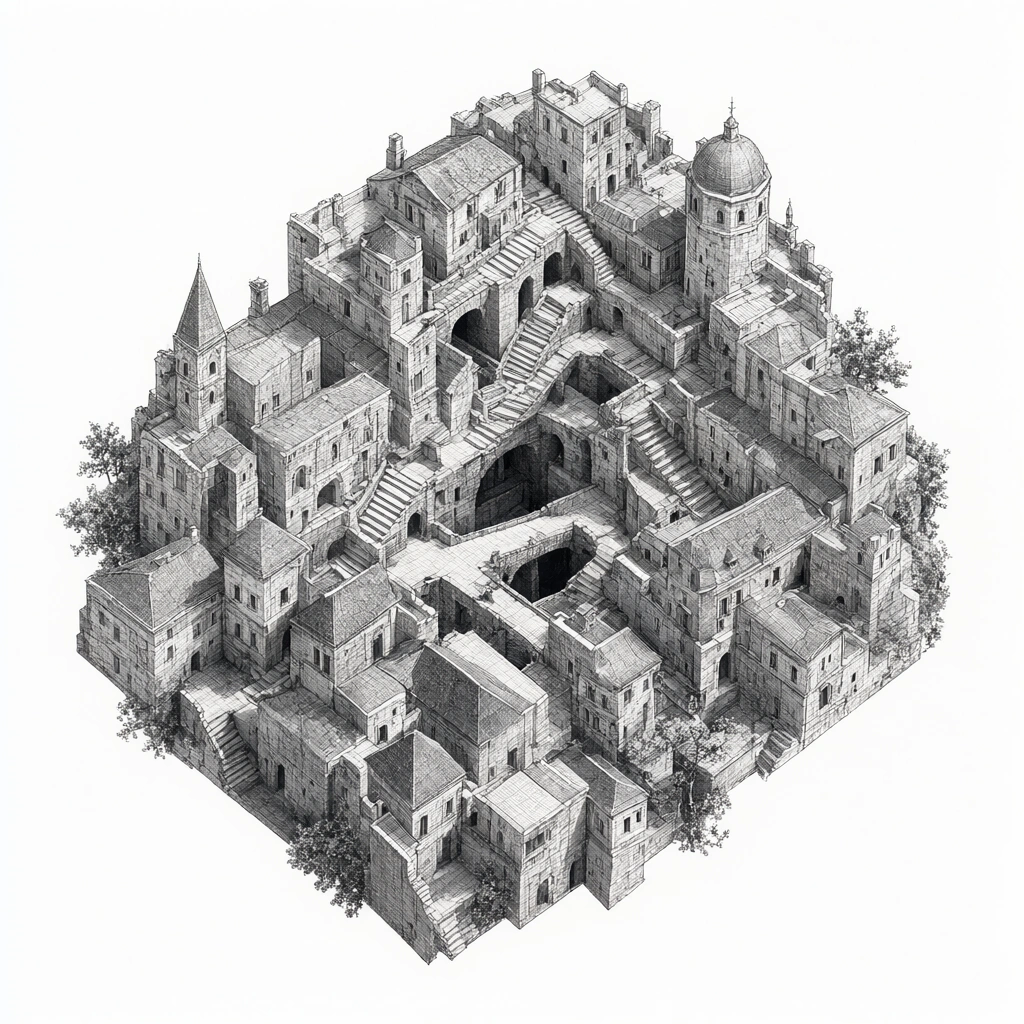 Qwen Image 2.1
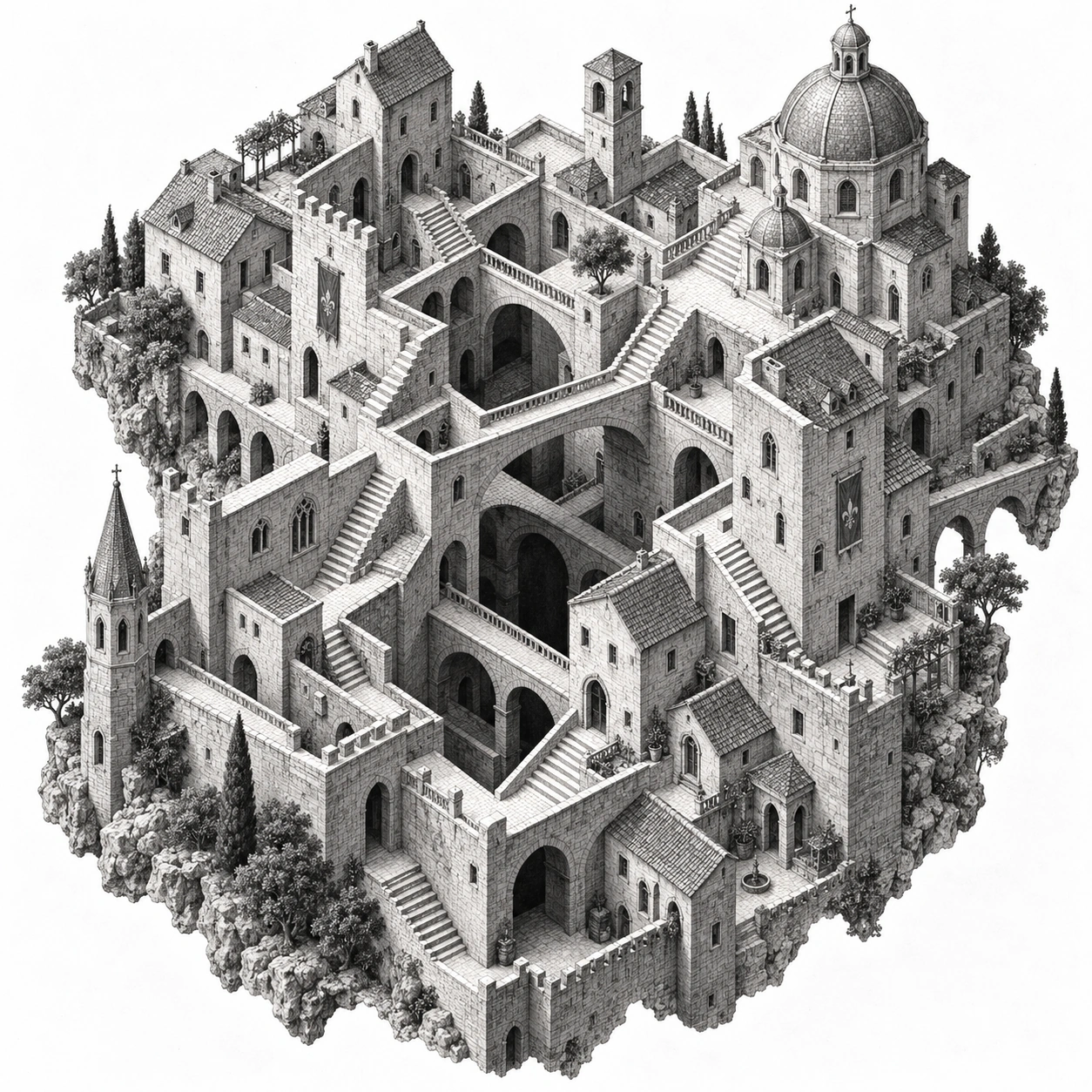 GPT Image 2.5
Reference details
- Reference ID
- 3460
- Category
- Ink & line
Reference prompts
Style prompt
Meticulous monochrome engraving and graphite drawing have precise geometric linework, small-scale hatching, granular tonal transitions, deep charcoal recesses, luminous white paper, and an intricate but coherent silhouette. Convincing local geometry coexists with subtly impossible spatial connections. Broad negative space surrounds the dense central form, and directional light articulates each plane.Full example prompt
An imaginary compact town appears as a meticulous monochrome print on a clean white field. The structure is viewed from above at an oblique angle, sitting alone like a small architectural model whose edges break into stone and sparse foliage. Towers, pitched roofs, domes, narrow windows, arched passages, terraces, parapets and bridges interlock within one dense cluster. Broad staircases climb across roofs and turn unexpectedly between levels; some passages seem to connect spaces that cannot logically meet, but each local stone step remains convincingly drawn. Near the center, a dark hollow beneath overlapping bridges anchors the eye amid the pale masonry. A larger domed building rises at the upper right, while a narrow pointed turret punctuates the lower left. Small trees at the outer edge delicately interrupt the geometric mass with organic shapes. The disciplined graphite-and-engraving character includes crisp ruled edges, granular shading, tight hatching and many values of gray, without added color. Light strikes the upper planes and stair treads, while arch interiors and the underside of bridges descend into dense charcoal. Precise details fill the tiny windows and stone courses, while the overall silhouette remains legible against generous blank paper. The square frame feels silent, intricate and spatially disorienting, with the impossible circulation discovered gradually rather than announced by a dramatic effect.