
Styles
#3609
Jacques-Louis David style reference and prompts
Explore the “Jacques-Louis David” reference with anatomical modeling, negative space, and pale neutral tones. View the images, copy the style or example prompt, and discover related styles on Looksift.
Compare the Qwen Image 2.1 and GPT Image 2.5 examples, choose the visual qualities you want, and copy the style prompt for your own project.
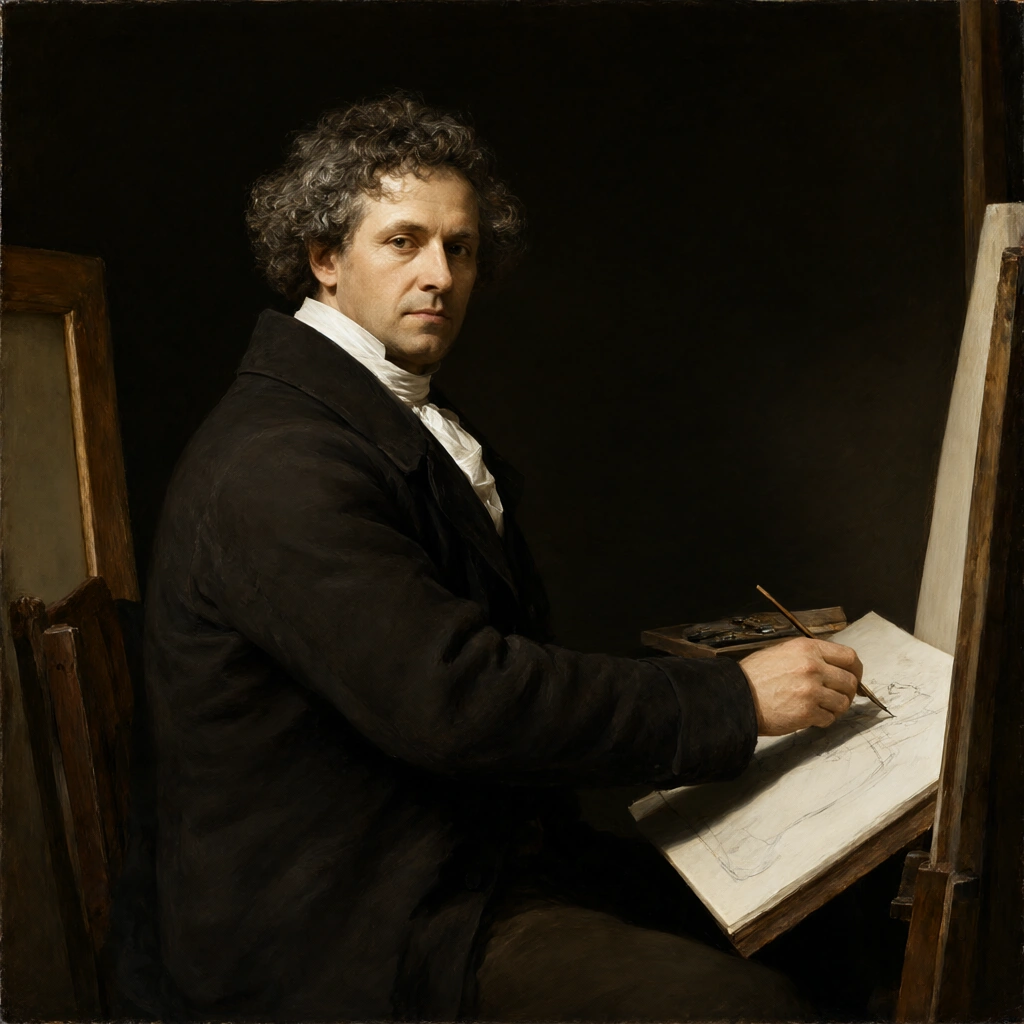 Qwen Image 2.1
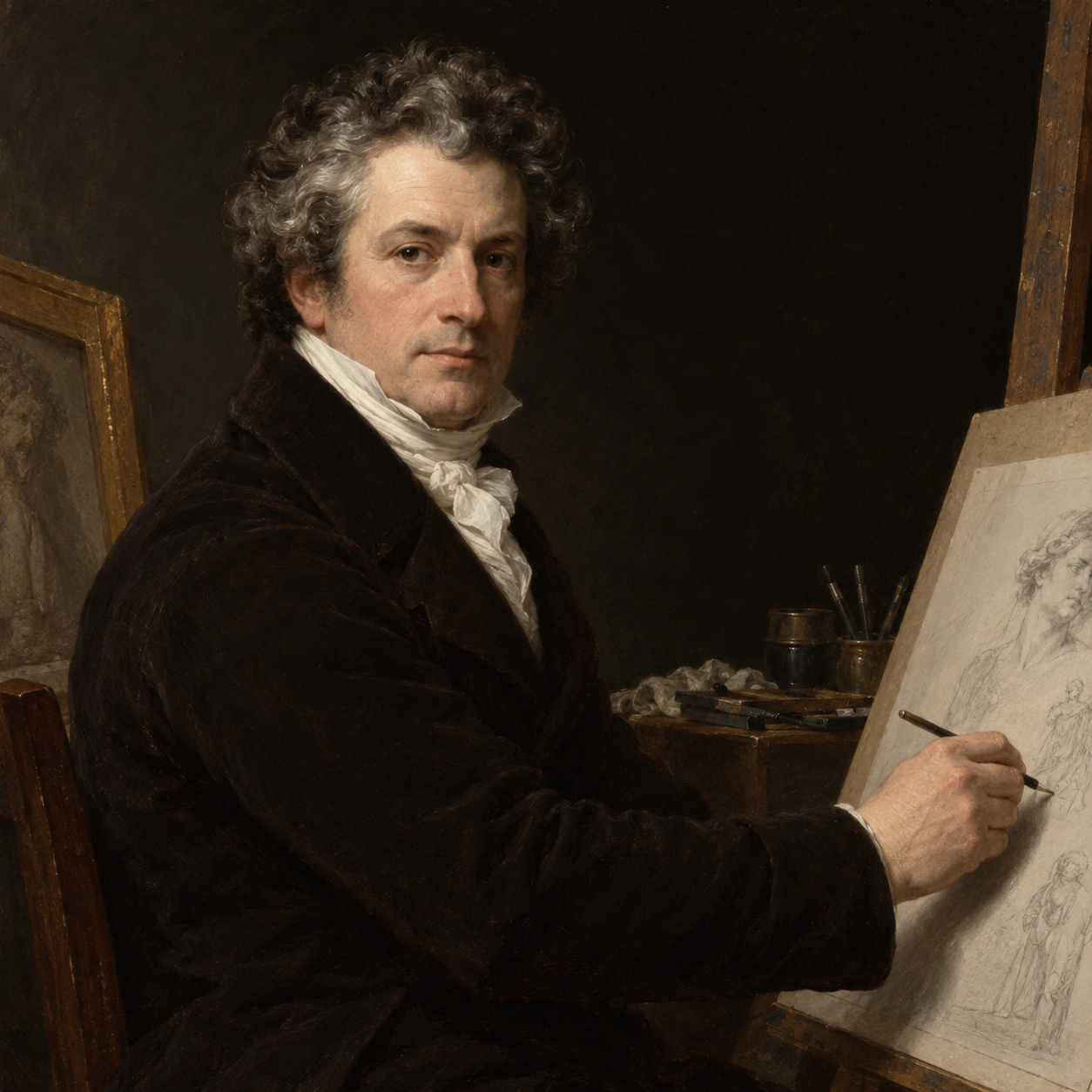 GPT Image 2.5
Reference details
- Reference ID
- 3609
- Category
- Painting
Reference prompts
Style prompt
The painting has a restrained neoclassical oil finish, joining precise anatomical modeling to quiet dark space. Warm ivory and subdued rose highlights rise from deep umber and charcoal, while narrow pale accents establish the visual route. Focal edges around the brightest planes are clean and controlled; outer forms taper into soft, nearly lost boundaries. Smooth tonal transitions give solid volume, and small linear details remain selective rather than spreading over the whole image. A single warm upper-side light reveals raised surfaces and hands while leaving broad background darkness undisturbed. The composition anchors one substantial dark mass beside a lighter diagonal plane, with generous negative space above. The overall effect is dignified, contemplative, and quietly dramatic.Full example prompt
A square neoclassical realist oil portrait shows a middle-aged painter seated at a drawing board in a dark studio, turning from his work to face the viewer. The man occupies the center-left, his upright torso wrapped in a nearly black brown coat. Thick curly gray-brown hair rises around his head and catches a few silver highlights against the deep background. His face is carefully modeled in warm ivory and muted rose, with a straight direct gaze and a reserved expression. A high white neckcloth and shirt collar frame his jaw, their folded fabric bright against the dark lapels. His right arm extends diagonally across the lower half toward a pale board on the right, and his hand holds a slender drawing tool above the surface. On the board, delicate gray marks and partial outlines are visible but do not form readable writing. A small tray or cluster of drawing materials sits behind his hand near the middle-right. At the far left, the edge of another framed or stretched surface leans into the scene, its warm wooden border partly lit. At the far right, the upright side of a larger canvas or easel forms a narrow vertical line. The studio itself recedes into black-brown shadow, with no detailed walls to compete with the seated figure. A controlled warm light from the upper left illuminates the face, white collar, hand, and paper, then falls away across the dark coat and surrounding space. Edges are crispest at the illuminated face and tools, softer where clothing merges with the ground. Smooth flesh modeling contrasts with fine folded fabric and restrained brushwork in the shadowed background. The overall composition balances the painter's watchful gaze with the diagonal path from shoulder to active hand, placing intellectual stillness and manual work within a concentrated pool of light.