
Styles
#4032
Bauhaus style reference and prompts
Explore the “Bauhaus” reference with fine linear detail, tactile surfaces, and soft tonal transitions. View the images, copy the style or example prompt, and discover related styles on Looksift.
Compare the Qwen Image 2.1 and GPT Image 2.5 examples, choose the visual qualities you want, and copy the style prompt for your own project.
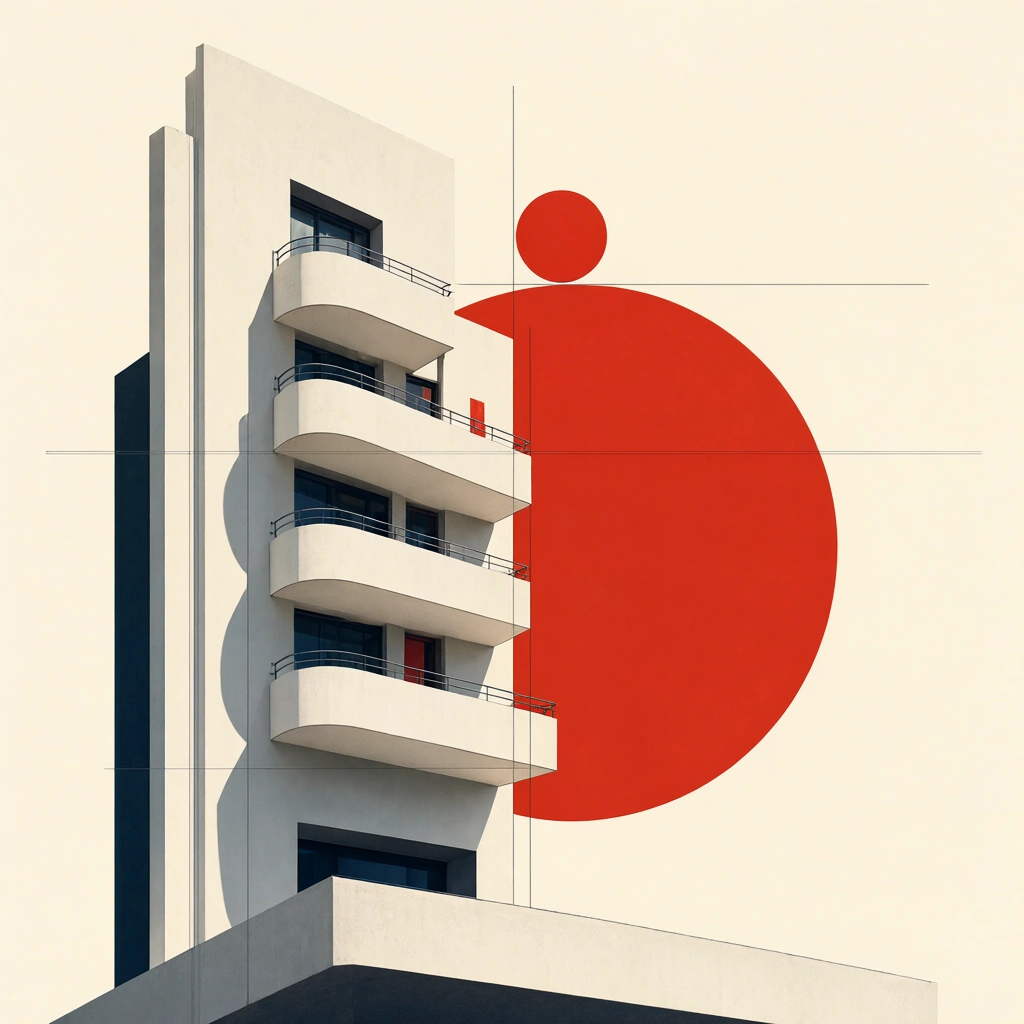 Qwen Image 2.1
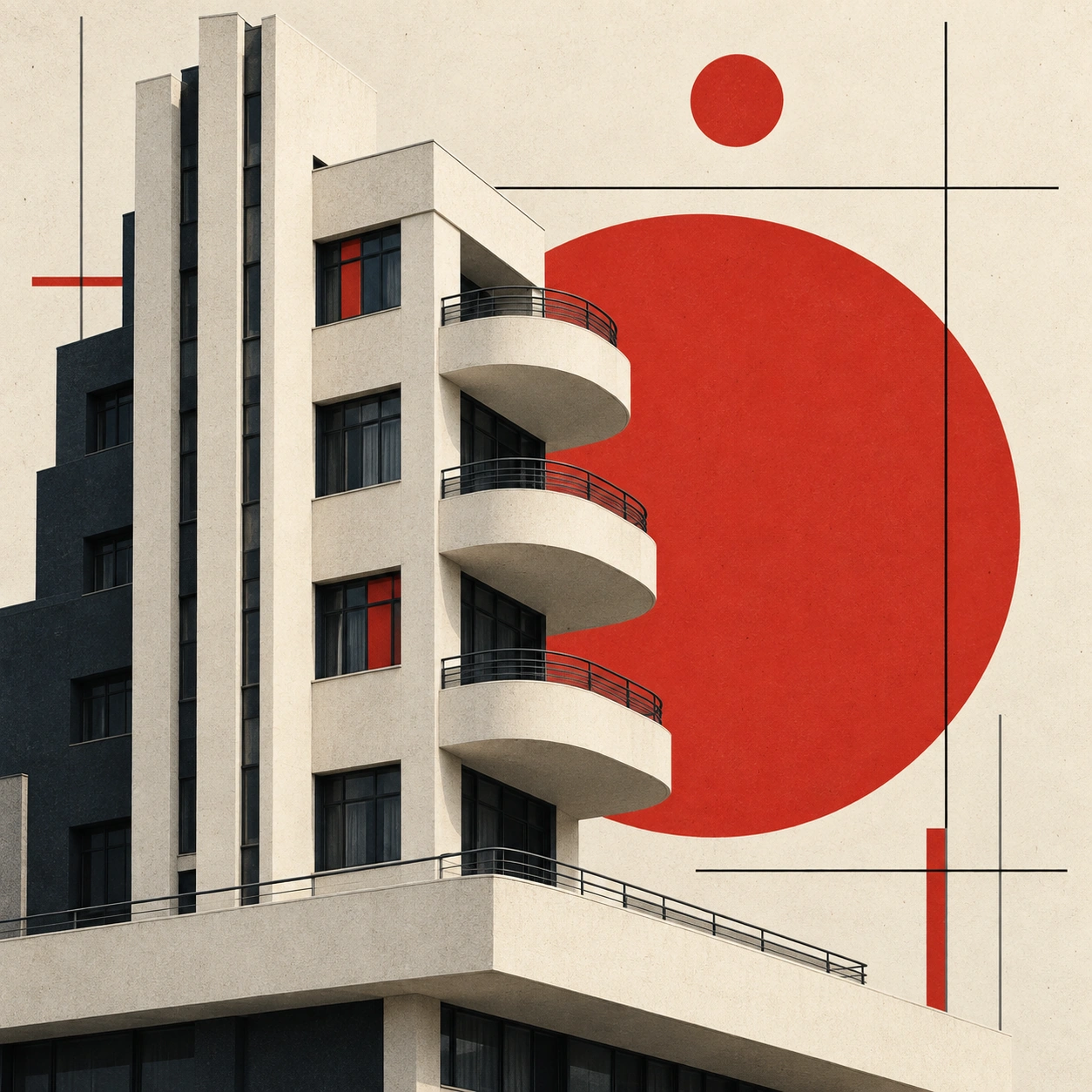 GPT Image 2.5
Reference details
- Reference ID
- 4032
- Category
- Photography
Reference prompts
Style prompt
The mixed photographic and graphic treatment sets softly modeled, lightly grainy volumes against opaque geometric color planes. Long, hairline rules and crisp circular boundaries give the forms a measured linear rhythm, while rounded edges soften the otherwise strict construction. Warm ivory occupies most of the field; vermilion carries the strongest visual weight, and small blue-black and gray accents establish depth. Illumination is broad and even, with shallow shadows confined to recesses and undersides rather than dramatic gradients. Sparse fine speckling keeps the light ground tactile without interrupting its openness. Dense vertical clusters are balanced by broad unmarked areas and a few decisive horizontal extensions. The result is restrained, precise, and quietly dynamic.Full example prompt
A square architectural collage combines a softly photographic modern building with flat Bauhaus geometry on a warm cream field. The background is nearly empty and faintly speckled, giving the pale structure and the red forms considerable breathing room. A tall off-white building rises along the left side, with several narrow vertical shafts continuing close to the upper edge. Its dark stepped side recedes behind the brighter front wall. Toward the center, rounded balconies project from the façade in a staggered stack; their smooth white undersides contrast with charcoal railings and the dark recesses of the windows. A broad lower terrace reaches horizontally across the bottom edge, anchoring the vertical mass. A large vermilion disc occupies much of the right half behind the building, its clean circular boundary partly concealed by the balcony edges. A much smaller red circle sits high above it. Fine black and gray rules cross the composition horizontally and vertically, some extending past the building as if they belong to a precise graphic construction. Small red accents appear within a few windows, while the rest of the structure remains cream, gray, and deep blue-black. The light is even and gently warm from the upper left, with soft shadows on the recessed walls and dark bands beneath the projecting terraces. The architectural surfaces look smooth but lightly grainy, while the colored circles remain opaque, flat, and sharply cut. The overall composition balances a dense left-hand structure against expansive red geometry and cream negative space, producing a measured, quietly energetic modernist image.