
Styles
#4080
Ukiyo-e style reference and prompts
Explore the “Ukiyo-e” reference with tactile surfaces, silhouette shapes, and teal and ochre tones. View the images, copy the style or example prompt, and discover related styles on Looksift.
Compare the Qwen Image 2.1 and GPT Image 2.5 examples, choose the visual qualities you want, and copy the style prompt for your own project.
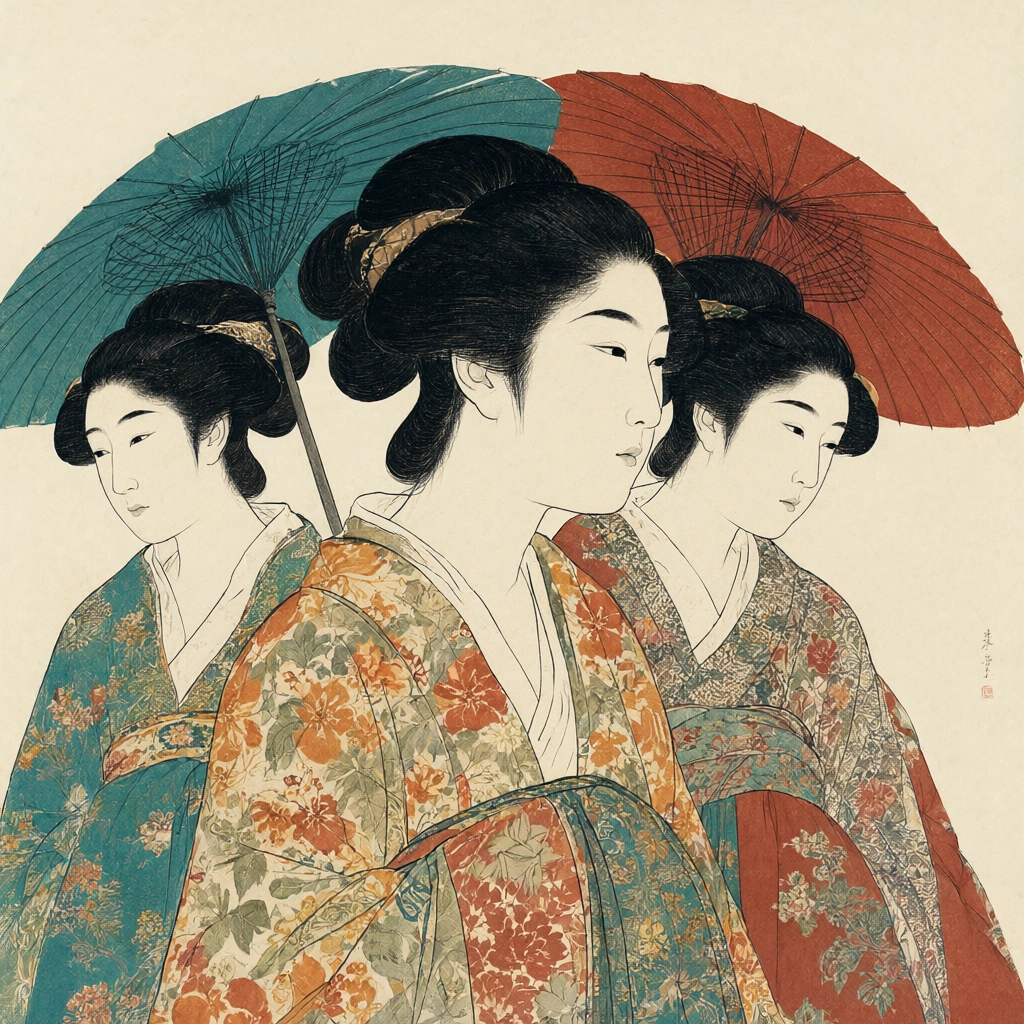 Qwen Image 2.1
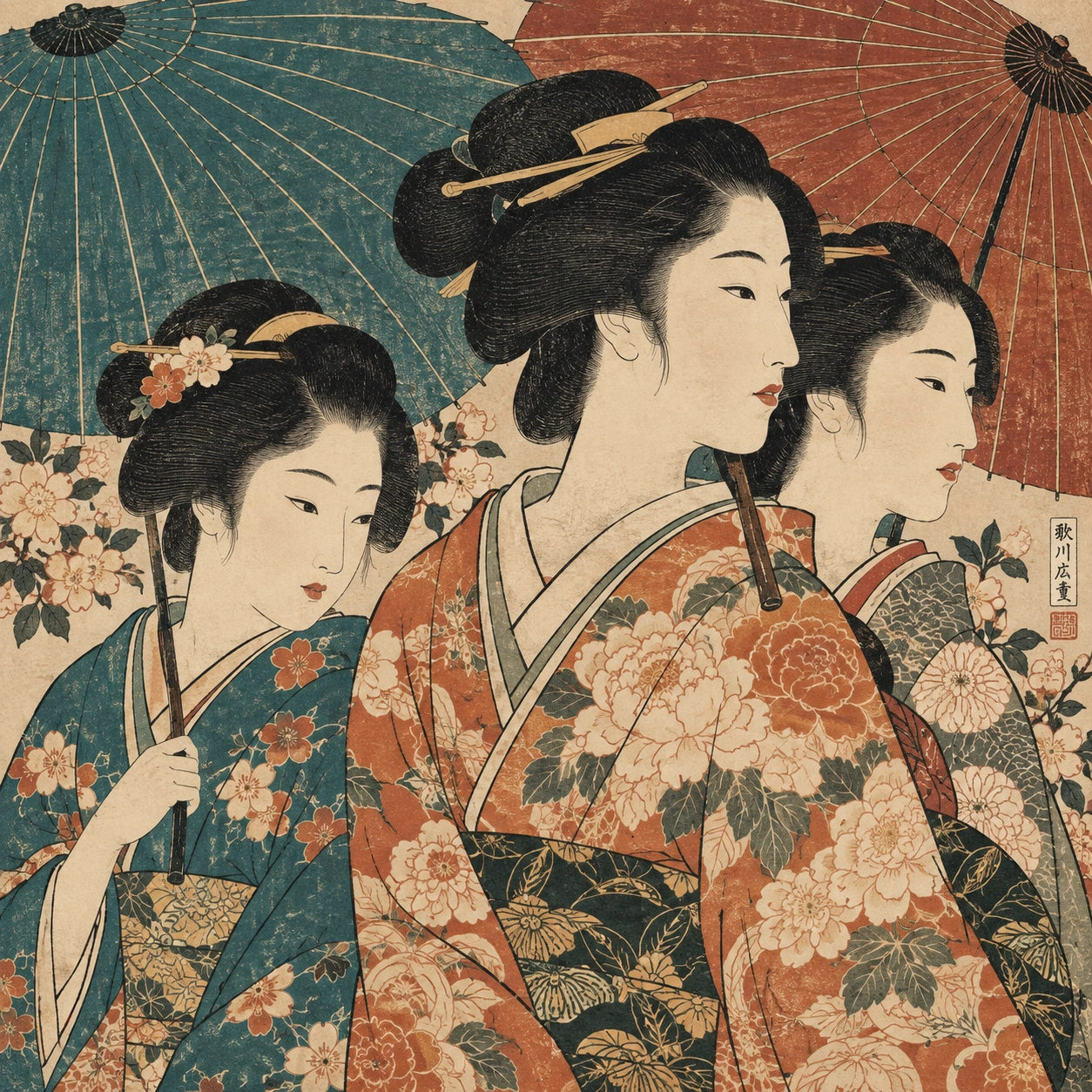 GPT Image 2.5
Reference details
- Reference ID
- 4080
- Category
- Ink & line
Reference prompts
Style prompt
Woodblock-like printmaking relies on firm dark contour lines, broad flat ink areas, and fine patterns held inside clean silhouettes. Slight grain and uneven pigment density keep the planes tactile rather than perfectly digital. Muted teal, rust red, warm cream, dull ochre, and near black repeat in balanced patches. Light is even and graphic, with almost no cast shadow; overlap and line weight organize depth. Large arcs answer smaller repeating marks, so densely patterned areas sit beside calmer paper-toned intervals. The result is decorative, poised, and rhythmically layered.Full example prompt
A square woodblock-style print groups three women in patterned robes beneath two broad parasols. The pale paper ground shows through around their dark hair and the curved umbrella ribs. At the left, a smaller woman turns slightly inward, her teal garment carrying warm floral accents. The central woman is largest, shown in right-facing profile with a carefully arranged dark coiffure and a robe patterned in orange, cream, and muted green. At the right, a third woman faces the same direction behind her, partly overlapped by the central figure and a rust-red parasol. A blue-green parasol spreads behind the left pair, its spokes radiating from an upper point; the red parasol balances it on the other side. Decorative blossoms, patterned fabric areas, and narrow contour lines fill the composition, but flat color blocks keep the figures separate. Small printed marks appear near the right edge; they are too tiny to transcribe. The paper surface carries light grain and irregular ink density, especially in the broad teal and rust fields. Illumination is even and graphic, with minimal cast shadow; depth is conveyed chiefly by overlap, scale, and the ordering of the silhouettes. The strongest darks lie in the hair and slender facial outlines, while skin remains pale and calm. The overall composition is compact and rhythmic, using the parasol arcs and repeated profiles to unite intricate fabric pattern with a restrained vintage palette.