
Styles
#4116
Wu Guanzhong style reference and prompts
Explore the “Wu Guanzhong” reference with rich color tones and a nearly monochrome palette. View the images, copy the style or example prompt, and discover related styles on Looksift.
Compare the Qwen Image 2.1 and GPT Image 2.5 examples, choose the visual qualities you want, and copy the style prompt for your own project.
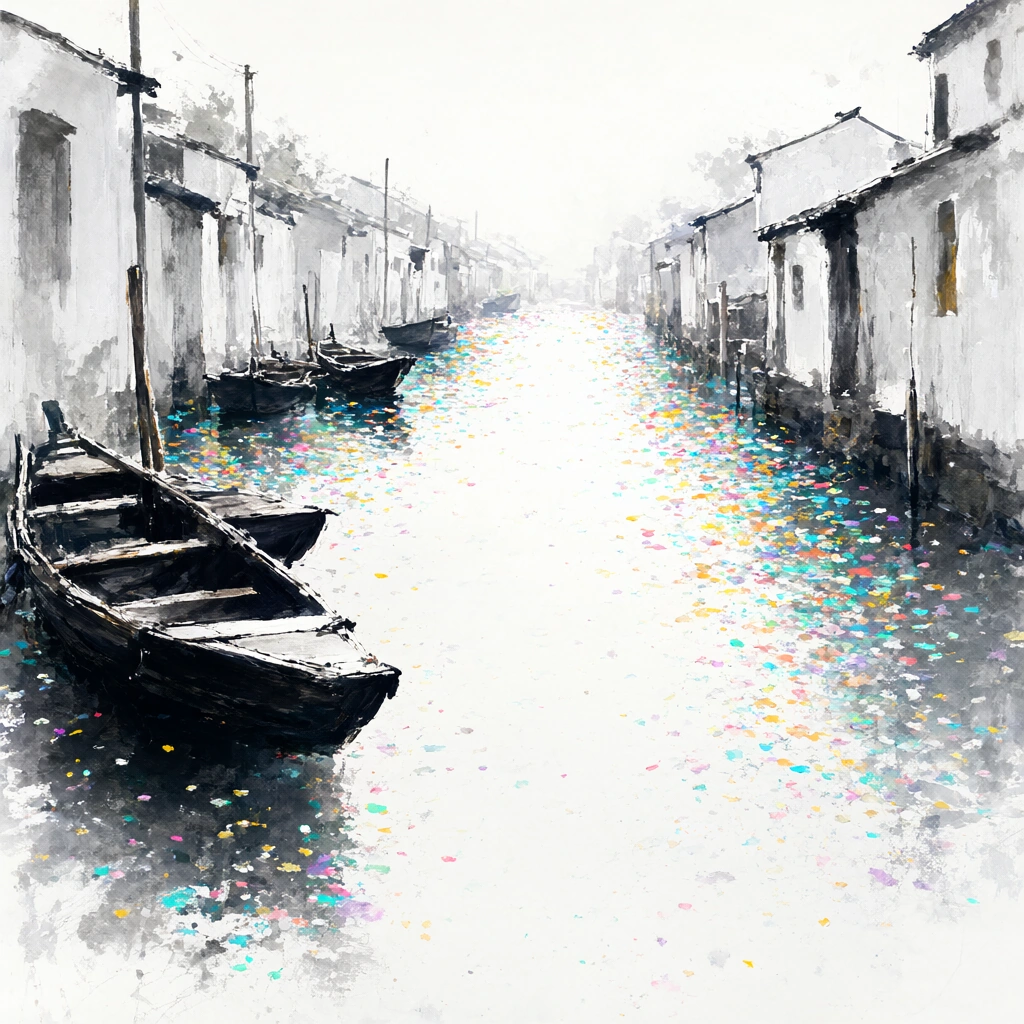 Qwen Image 2.1
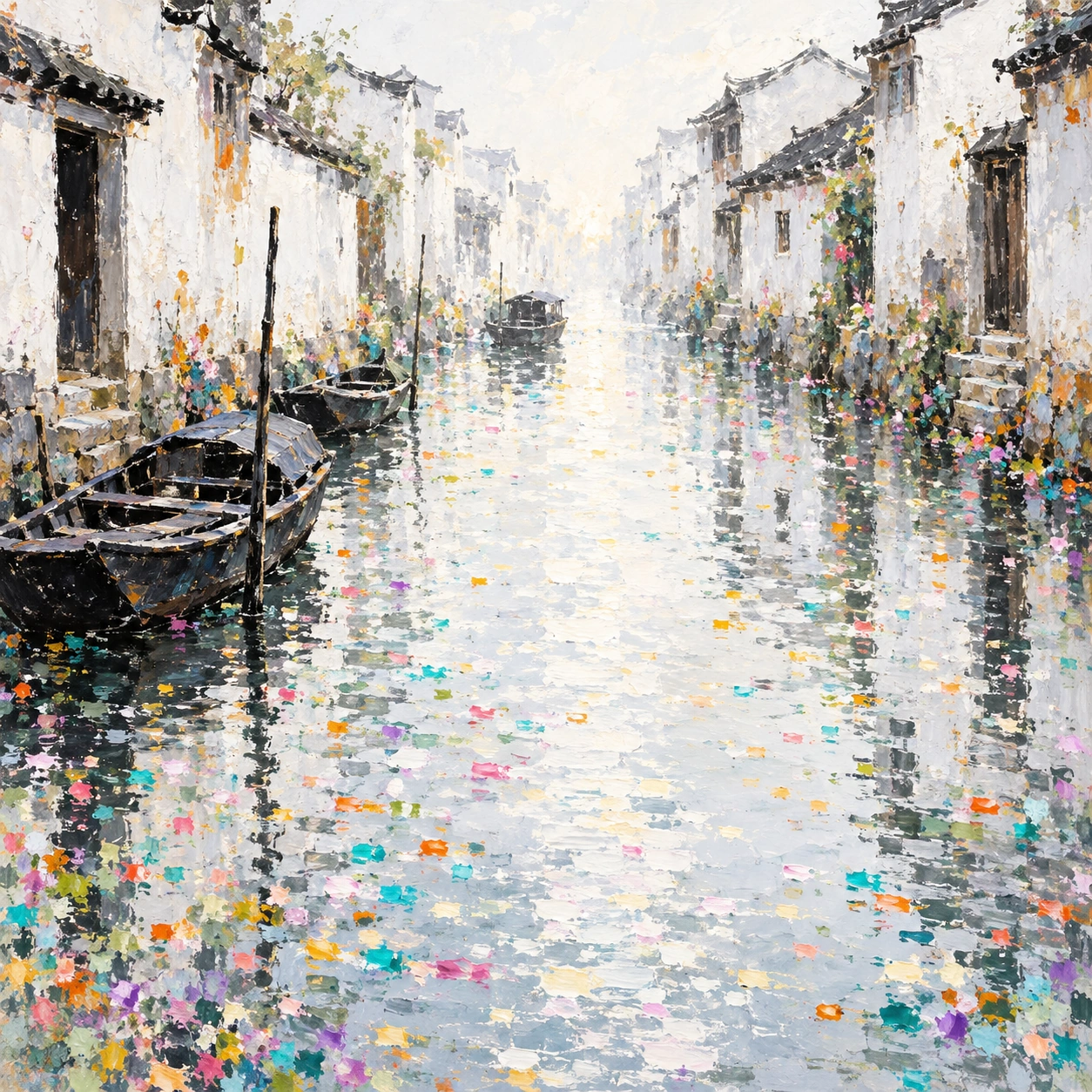 GPT Image 2.5
Reference details
- Reference ID
- 4116
- Category
- Painting
Reference prompts
Style prompt
The image has a loose ink-and-paint surface combining broad pale washes with quick dark contours and scattered bright dabs. Large white and light-gray areas keep the composition open, while black and charcoal strokes supply a spare structural skeleton. Turquoise, pink, yellow, orange, green, and violet appear in many tiny irregular marks instead of solid large fields. Edges alternate between crisp ink-like accents and broken, disappearing paint, creating a sense of light air and moving reflection. Diffuse brightness grows toward a central distance, while nearer dark silhouettes give the soft space scale. A shallow corridor perspective gathers the lines inward; color flecks spread outward and prevent the geometry from feeling rigid. The overall effect is lyrical, airy, and lively, with a nearly monochrome base enlivened by fine multicolor rhythm.Full example prompt
A square painterly image looks along a narrow canal between rows of white-walled houses. The pale water opens across the lower half and draws inward toward a hazy bright vanishing point near the upper center. At the left foreground, a long dark boat rests diagonally, its narrow bow reaching into the water and a thin upright pole rising from it. A smaller boat sits just behind, and another dark vessel appears farther down the canal near the center. The houses on both sides are simplified into white and soft gray planes, dark roof lines, recessed doorways, and a few warm ocher marks. Their edges are broken and sketchy rather than architecturally precise, and the buildings fade almost into the light at the distance. Across the water, hundreds of small flecks of turquoise, pink, yellow, orange, violet, and green float among gray brush marks. These bright dabs do not form literal objects; they animate the reflective surface and cluster more densely along the banks and near the lower edge. The boats provide strong dark silhouettes against the nearly white field. The eye-level view makes the canal a direct corridor, with the left and right walls loosely enclosing the open central light. Ink-like dark strokes define roof eaves, mooring poles, and boat contours, while thin washes and dry speckles leave the surface airy. Diffuse daylight appears to pour from the far end of the canal, whitening the distance and leaving boats and deep openings as contrasting dark marks without sharp cast shadows. No people or readable text are visible. The overall composition is light and buoyant, using a restrained gray-white structure to support a lively confetti-like rhythm of color.