
Styles
#3000
Stippling style reference and prompts
Explore the “Stippling” reference with stippled texture, fine grain, and a monochrome palette. View the images, copy the style or example prompt, and discover related styles on Looksift.
Compare the Qwen Image 2.1 and GPT Image 2.5 examples, choose the visual qualities you want, and copy the style prompt for your own project.
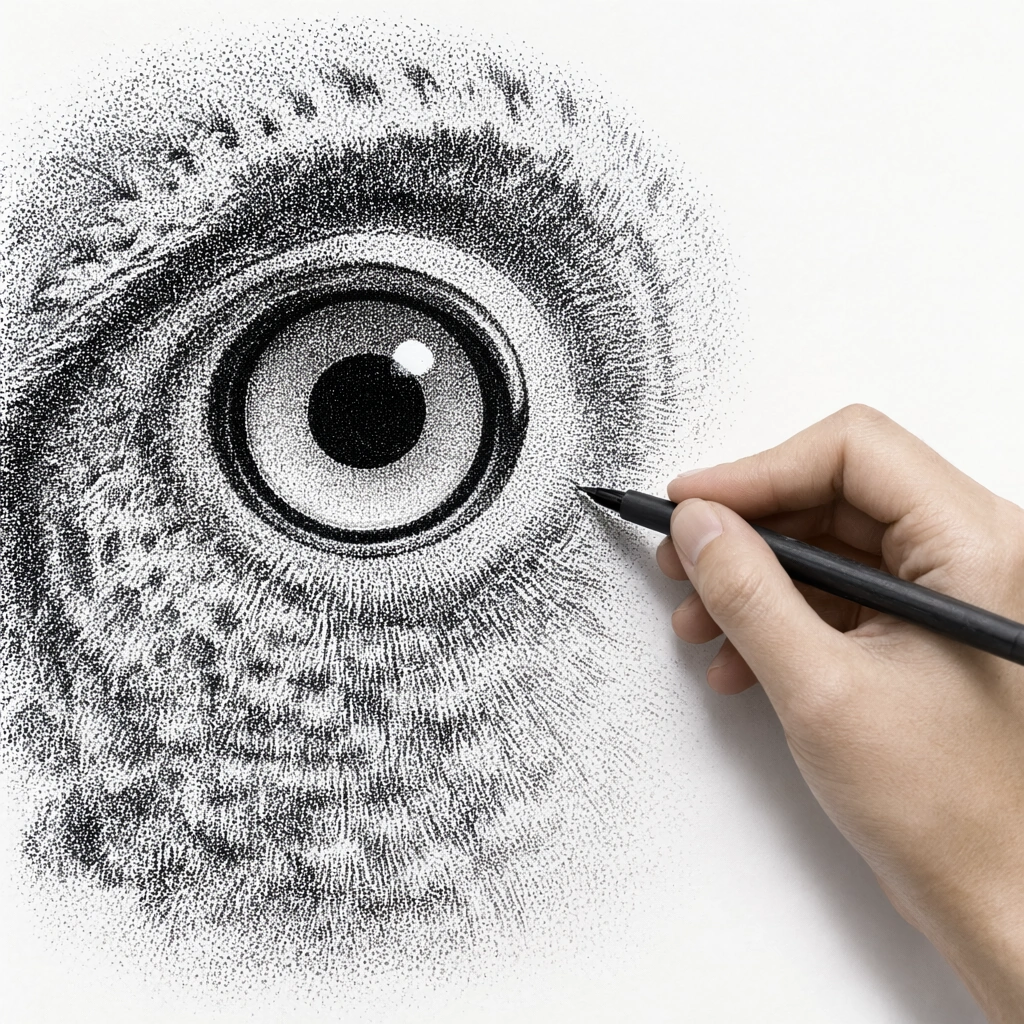 Qwen Image 2.1
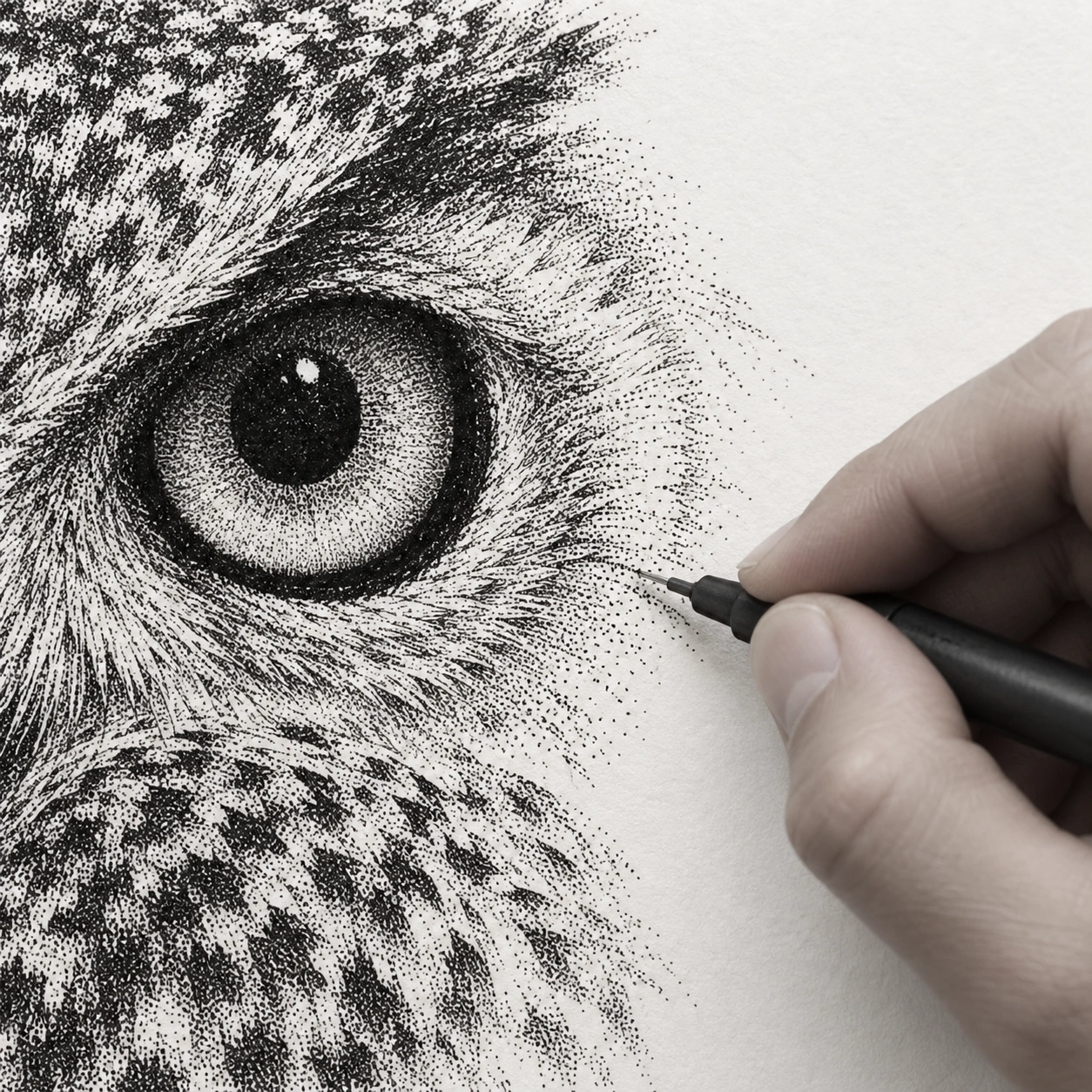 GPT Image 2.5
Reference details
- Reference ID
- 3000
- Category
- Ink & line
Reference prompts
Style prompt
The monochrome image is constructed through countless fine dots, short hatch marks, and deliberate areas of untouched white. Mark density controls value: clustered black points become deep shadow, while sparse stippling makes soft gray transitions without a continuous wash. A sharply bounded circular focal region sits beside dissolving, incomplete contours and generous paper space. Fine grain is inherent to the drawing rather than an added surface effect. Even light preserves the paper's brightness and lets the minute variations in mark size remain visible. The composition feels meticulous yet airy, with technical precision balanced by open space.Full example prompt
A square monochrome stippled drawing centers a large round owl eye on pale paper, with a hand and pen entering from the right to add marks beside it. The eye fills the left half of the frame. Its dark circular pupil is set inside a softly shaded iris, and a thick black lower rim gives the gaze a striking graphic weight. Around the eye, short feather-like strokes and hundreds of closely spaced dots build rings of gray texture. The upper brow is darker and more densely hatched, while the surrounding pale paper stays visible between individual marks. Along the lower left, overlapping speckled plumage forms a rough patterned field. To the right of the eye, the creature's contour becomes lighter and less complete, leaving a large white gap in the upper right. A human hand enters from the center-right, its fingers holding a fine dark pen whose nib touches the area just beyond the eye's lower outer corner. The hand is rendered more smoothly and softly than the drawing beneath it, making the act of mark-making clear without competing with the eye. There is no background setting; the paper surface and the contrast between dark dots and white space make up the entire scene. Even diffuse light keeps the page bright, with only a faint soft shadow under the hand. Dense stippling makes the deepest blacks, while widely spaced dots turn into mid-gray and then dissolve into untouched paper. The overall composition concentrates extraordinary detail around one circular focal point and lets the hand and open white margin reveal how the image is built.