
Styles
#4355
Charcoal drawing style reference and prompts
Explore the “Charcoal drawing” reference with paper texture, a monochrome palette, and side lighting. View the images, copy the style or example prompt, and discover related styles on Looksift.
Compare the Qwen Image 2.1 and GPT Image 2.5 examples, choose the visual qualities you want, and copy the style prompt for your own project.
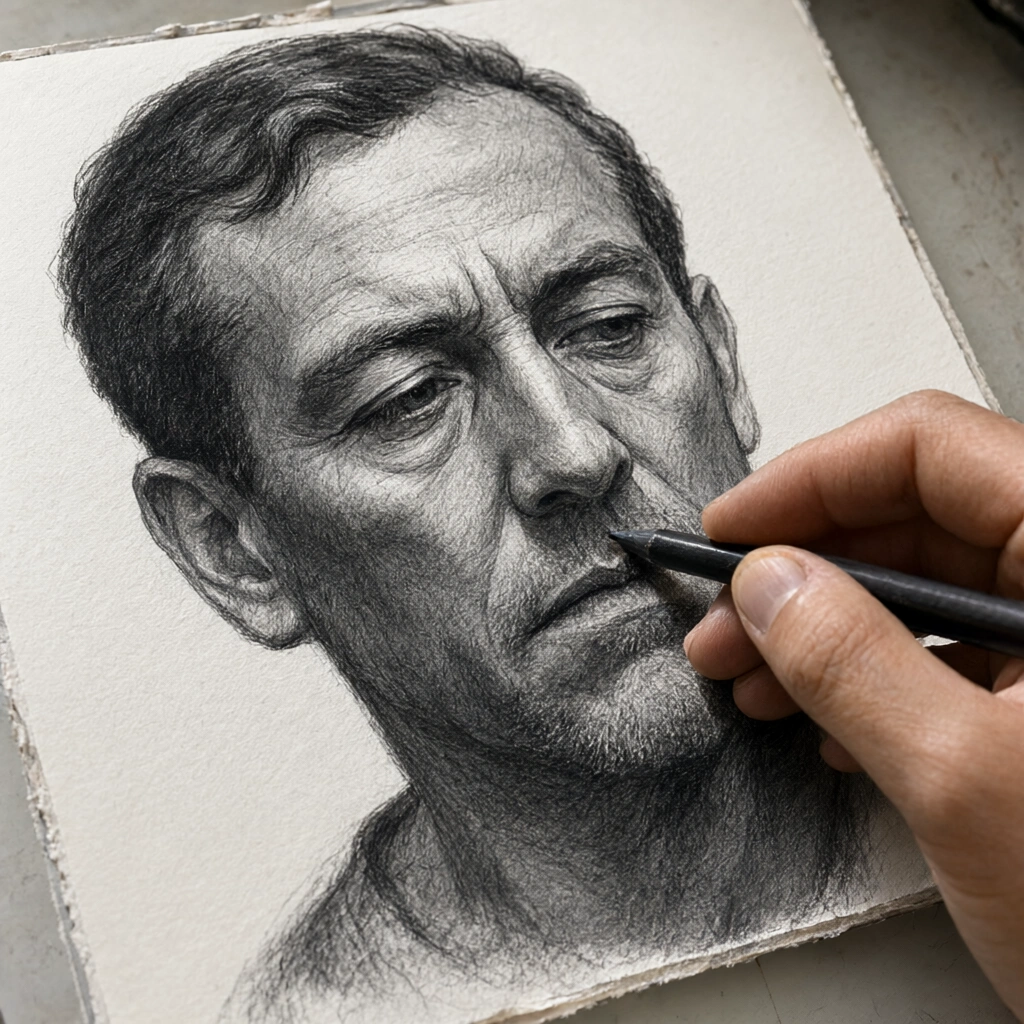 Qwen Image 2.1
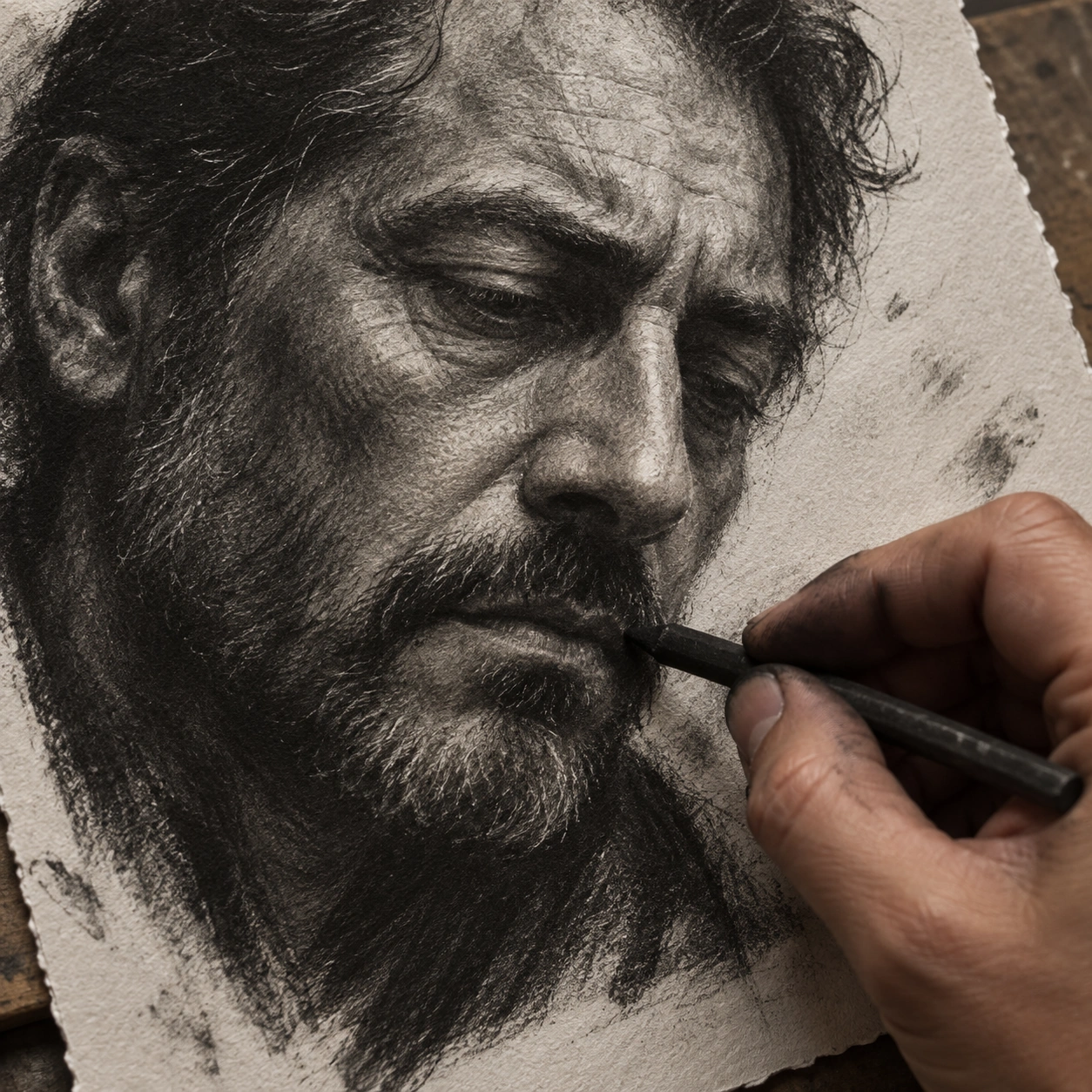 GPT Image 2.5
Reference details
- Reference ID
- 4355
- Category
- Photography
Reference prompts
Style prompt
Charcoal drawing on textured paper uses a full matte grayscale, from untouched white through rubbed gray to velvety black. Fine directional lines define high-information contours; broad smudged passages build mass and soft transitions. Grain, erasure, and powdery residue remain visible. Side light reveals paper texture without adding glossy reflections. Tight framing emphasizes the meeting of precise marks and atmospheric shadow. Edges can be sharp along focal features and dissolve into rubbed darkness nearby. The result is intimate, observant, and materially handmade.Full example prompt
A square close-up photograph of an artwork in progress centers a charcoal portrait of a middle-aged man on textured white paper. The drawn face tilts slightly down, with eyes half closed, deep furrows around the brow, and a strong nose emerging from heavy black shadow. At the right, an artist's hand holds a dark pencil or charcoal stick against the area near the mouth, visibly adding a fine edge to the drawing. The paper sits diagonally on a work surface, with rough torn margins and a few smudges. The image blurs the boundary between the actual hand and the rendered face: warm living fingers enter beside monochrome graphite skin. Charcoal values range from pale untouched paper through velvety mid-gray to near-black in the hair, cheek, and neck. Fine directional strokes describe wrinkles and hair, while broad rubbed passages build the deeper facial masses. Side light falls across the paper and fingers, picking out raised grain and giving the darkest areas a matte, powdery look. The composition is tightly cropped, drawing attention to the eyes, nose, hand, and tool rather than a complete studio. Its effect is intimate and process-oriented, showing patient observation through distinct marks and softly erased transitions.