
Styles
#2833
Low-angle Architectural Photography and Prompts
This photographic reference looks straight upward from a deep courtyard. Converging walls and repeated windows frame a bright opening of sky. View the image, copy the style or example prompt, and explore related references on Looksift.
Compare the Qwen Image 2.1 and GPT Image 2.5 examples, choose the visual qualities you want, and copy the style prompt for your own project.
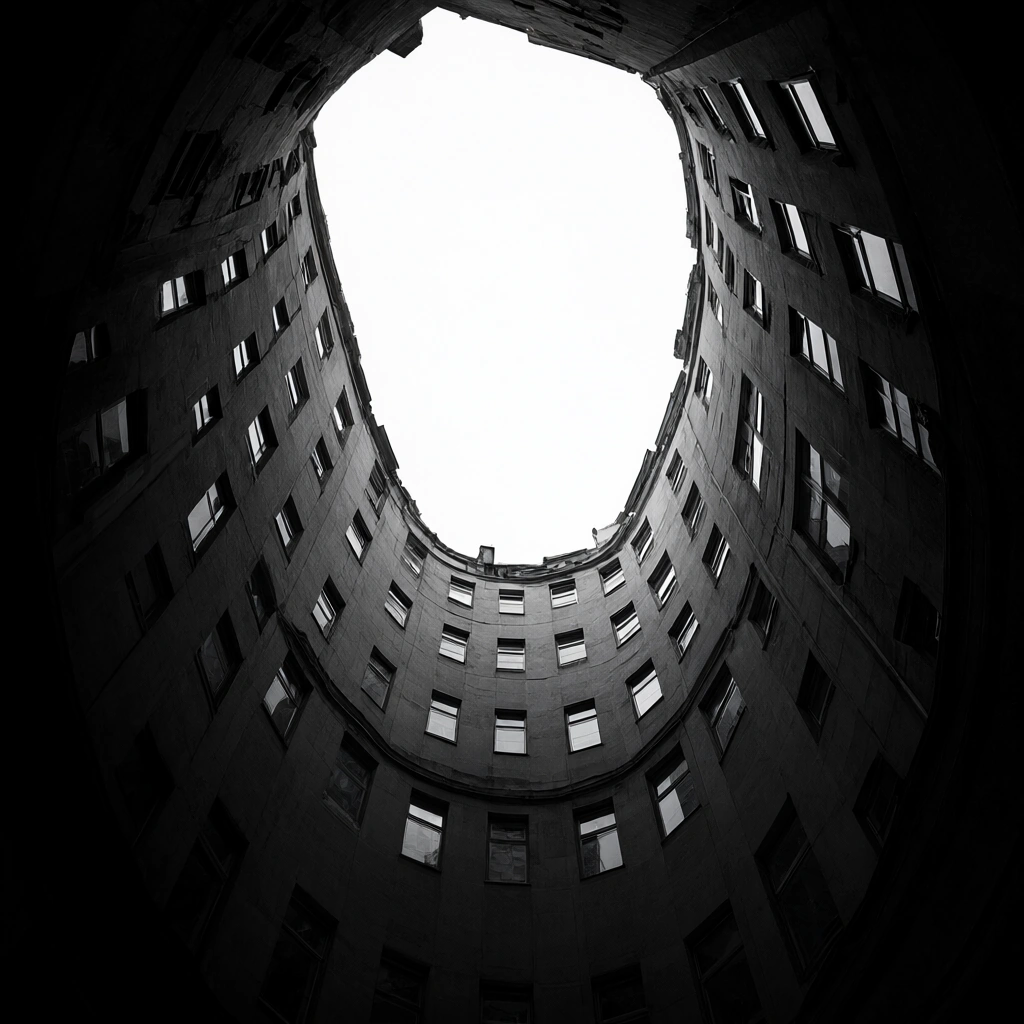 Qwen Image 2.1
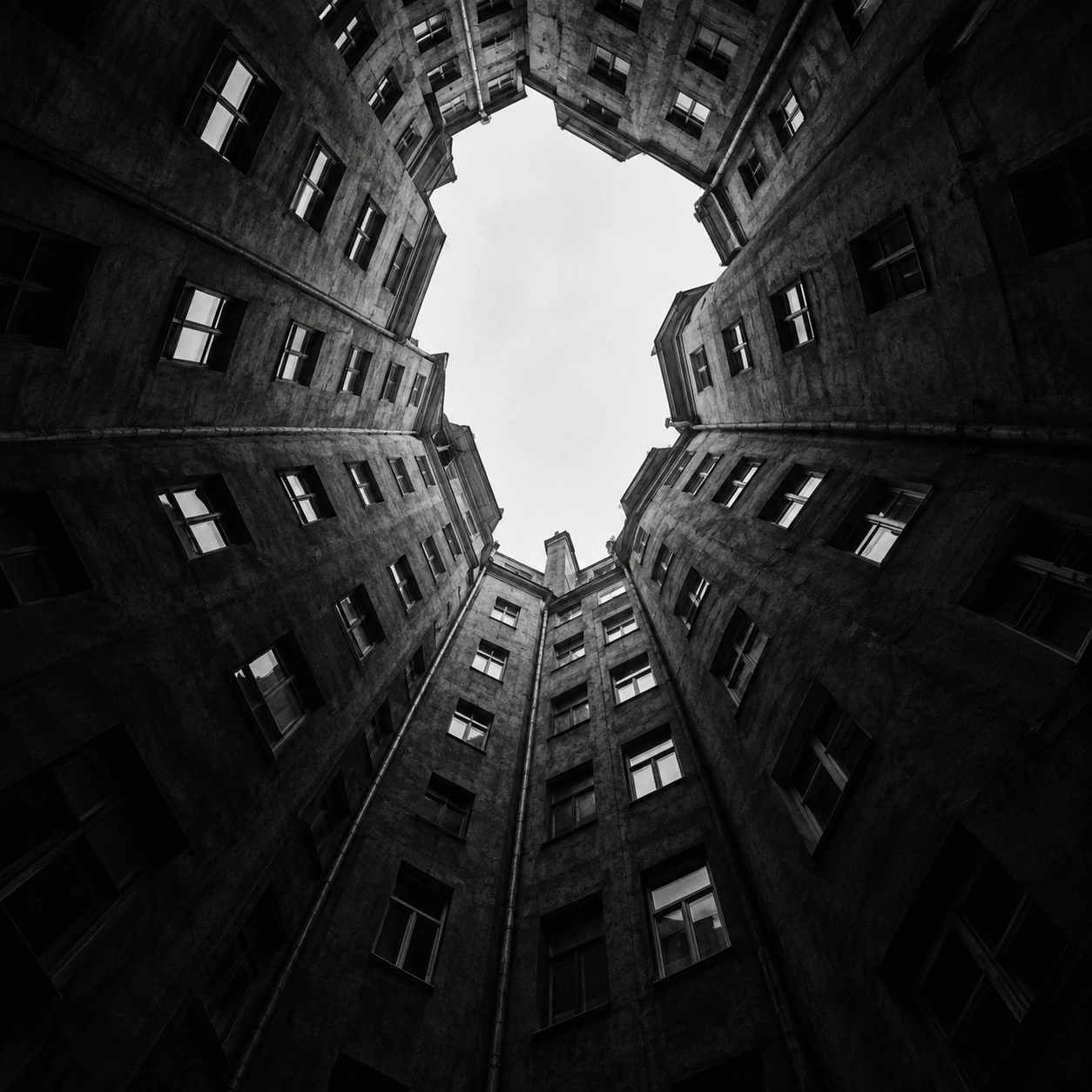 GPT Image 2.5
Reference details
- Reference ID
- 2833
- Category
- Photography
Reference prompts
Style prompt
Low-upward monochrome photography converts surrounding vertical planes into a dark converging frame around a bright irregular opening. Perspective makes repeated small rectangles diminish and tilt toward the center, generating height and enclosure. The sky or other negative space can approach white, while walls hold charcoal and black with subtle midtone texture. Light enters from above, leaving lower planes underexposed but still materially readable. Fine grain and slight optical softness preserve photographic credibility within a strongly graphic arrangement. The composition is centered enough to feel architectural, yet uneven edges and differing angles prevent mechanical symmetry. The effect is austere, vertiginous, and spatially compressed.Full example prompt
The image is a square black-and-white photograph taken from the bottom of a deep urban courtyard while the camera points straight upward. Tall building walls rise on all sides, creating a dark, almost circular enclosure. Rows of small rectangular windows follow the curved and angled facades toward the top. Some windows are pale and reflective; others disappear into shadow. The walls are darkest near the lower corners and become slightly lighter as they approach the sky. At the upper center, a jagged irregular opening of nearly white sky is the dominant bright shape. Its boundary changes direction where different rooflines and projections meet. The view is deliberately extreme: vertical structures lean inward through perspective, and the surrounding architecture appears to funnel the eye toward the opening. There is no person, street, or horizon in sight. Black and charcoal occupy most of the frame, yet intermediate gray steps preserve the texture of masonry, ledges, and window recesses. Fine grain and slight tonal softness keep the photograph from becoming a pure graphic diagram. Light comes from above; the sky is overexposed or very pale, and the interior walls remain underlit. The low camera position makes repeated windows seem small and numerous, building a strong rhythm up each side. The composition is centered but not perfectly symmetrical, because the different facade shapes converge at varying angles. It produces a sense of height and enclosure at once. The visual effect relies on radical viewpoint, dense architectural shadow, and the bright negative space of sky rather than on an object in the usual foreground.